企业回购

Search documents
抢椅子戏法终结:美股三十四年“万有引力”失效后的结构性崩塌
和讯· 2026-03-23 08:47
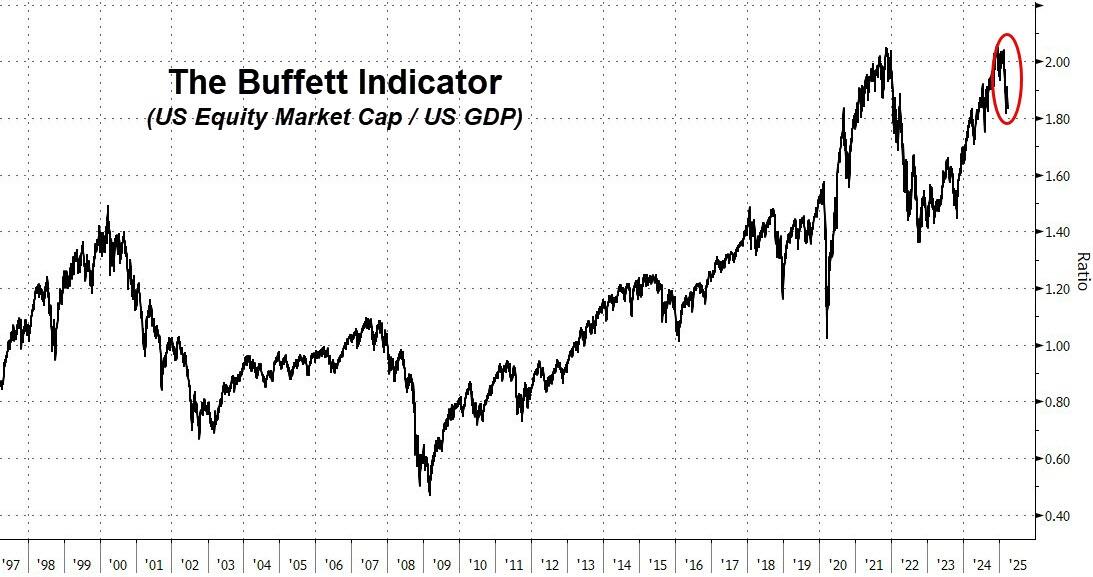
Core Viewpoint - The article discusses the impending correction in the U.S. stock market, driven by structural weaknesses and the dominance of passive investment strategies, which have led to a loss of price discovery and increased vulnerability to market shocks [3][4]. Group 1: Market Structure and Valuation - The U.S. stock market has experienced a 34-year period of abnormal valuation, with the cyclically adjusted price-to-earnings ratio (CAPE) remaining at a high of 40, deviating significantly from historical norms [4]. - Traditional macroeconomic models, such as the Federal Reserve model, have failed to predict market valuation limits, as the market has expanded due to narratives surrounding technology giants and AI, rather than fundamental value [4]. Group 2: Passive Investment and Price Discovery - Passive investment now accounts for 60% of the total market, with automated systems like 401(k) plans contributing to a "blind buying" mechanism that undermines price discovery [5]. - The reliance on algorithm-driven trading has created a liquidity vacuum, where market corrections can escalate into severe crashes due to the absence of human buyers during panic selling [6]. Group 3: Future Market Dynamics - The demographic shift, particularly the aging of the baby boomer generation, is expected to lead to a historic change in market dynamics, with mandatory withdrawals from retirement accounts projected to exceed inflows by 2028 [7]. - This shift will transform passive investors from buyers to forced sellers, fundamentally altering the landscape of the U.S. stock market and raising concerns about the definition of a company's baseline value in future market turmoil [7].


2025年末冲刺!对冲基金净杠杆飙至99%高位,连续7周疯狂加仓全球股市、美股占大头
美股IPO· 2025-12-09 07:15
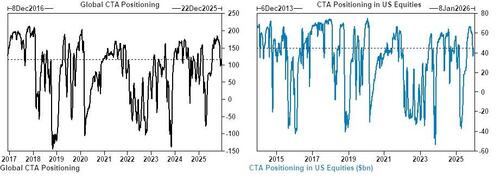
Core Insights - Hedge funds have net bought global stocks for the seventh consecutive week, with a significant shift in market sentiment and strategies observed [3][5][11] - The S&P 500 index is nearing its historical closing record, driven by various market forces and expectations surrounding the Federal Reserve's interest rate decisions [3][11] - Corporate buyback activities have surged, with trading volumes significantly higher than previous years, indicating companies' strategies to counter market weakness [11][12] Hedge Fund Activity - Hedge funds' total gross leverage increased by 1.5% to 286.6%, while net leverage rose by 0.4 percentage points to 81.2%, reaching the 99th percentile for the past year [5] - All major regions, except for Asian emerging markets, experienced net buying, with North America leading the gains [5] - The net buying ratio of long positions to short positions among hedge funds is 1.3 to 1, indicating a strong bullish sentiment [3][5] Market Trends - There is a notable rotation of funds from defensive sectors to cyclical stocks, with utilities down 4.83% and cyclical stocks up 5.01% [4] - Quantum computing stocks have seen a five-day increase of 14.61%, while non-profitable tech stocks rose by 9.61% [4] CTA Strategy - CTA strategy funds have shifted to a buying stance across various market conditions, with expected purchases of $29.8 billion in flat conditions and $31.2 billion in rising conditions [7][10] - The model predicts that these strategies will reach target exposure levels in the coming days [10] Corporate Buybacks and IPOs - Corporate buyback activities are at a peak, with trading volumes 80% higher than the average for the same period in 2024 and 100% higher than in 2023 [11] - In North America, new issuances and expansions reached $9.95 billion this week, totaling $390.2 billion year-to-date, indicating a favorable supply-demand balance for stock prices [12] Investor Sentiment - Retail investor sentiment has improved significantly, with the AAII sentiment survey showing a bullish percentage increase of 12.3 points to 44.3% [13] - The CNN Fear & Greed Index rose from 18 to 40, marking the highest level since late October, while Goldman Sachs' sentiment indicator has returned to neutral territory [15]

2025年末冲刺!对冲基金净杠杆飙至99%高位,连续7周疯狂加仓全球股市、美股占大头
Hua Er Jie Jian Wen· 2025-12-09 06:52
Core Insights - The S&P 500 index is just 30 basis points away from its historical closing record, with multiple market forces reshaping the investment landscape as the year approaches its end [1] - The consensus around the Federal Reserve's interest rate policy has shifted from "unlikely to cut rates" to a "100% probability of a cut," with expectations of a "hawkish cut" [1] Group 1: Market Trends - Hedge funds have net bought global stocks for the seventh consecutive week, with a buy-to-sell ratio of 1.3 to 1 [1] - The CTA strategy funds have shifted from net sellers to buyers, with a Goldman Sachs model indicating a purchase of $9 billion in global stocks this week, raising overall exposure to $110 billion [1] - Corporate buyback activity is notably high, with trading volume 80% above the daily average for the same period in 2024 [1][10] Group 2: Sector Performance - There is a significant rotation of funds from defensive sectors to cyclical stocks, with utilities down 4.83% and REITs down 2.58%, while cyclical stocks rose by 5.01% [3] - Quantum computing stocks have seen a five-day increase of 14.61%, and non-profitable tech stocks rose by 9.61% [3] Group 3: Hedge Fund Activity - Hedge funds' total gross leverage increased by 1.5% to 286.6%, with net leverage rising by 0.4 percentage points to 81.2%, reaching the 99th percentile for the past year [4] - All major regions, except for Asian emerging markets, experienced net buying, with North America leading the gains [4] Group 4: CTA Strategy Insights - The CTA strategy funds are expected to become buyers across various market scenarios, with projected purchases of $29.8 billion in flat conditions and $31.2 billion in rising conditions [6] - In a flat market scenario, the expected deployment of funds for one week and one month is similar, indicating that CTA strategies may soon reach an equilibrium state [9] Group 5: Corporate Buybacks and IPOs - Corporate buyback activity is at a peak, with trading volume significantly higher than both 2023 and 2024 averages, primarily in financials, consumer discretionary, and technology sectors [10] - In North America, new issuances and follow-on offerings reached $9.95 billion this week, with a year-to-date total of $390.2 billion, maintaining a favorable supply-demand balance for stock prices [10] Group 6: Investor Sentiment - Retail investor sentiment has improved significantly, with the AAII sentiment survey showing a bullish percentage increase of 12.3 points to 44.3% [11] - The CNN Fear and Greed Index rose from 18 to 40, marking the highest level since the end of October [13] - Global equity funds saw a net inflow of $8 billion, although this is down from the previous week's $18 billion [13]
美股反弹了,但年底大涨也不用指望?
Hua Er Jie Jian Wen· 2025-11-29 01:25
Core Viewpoint - The U.S. stock market appears to be stabilizing after a recent sell-off, despite disruptions caused by the Chicago Mercantile Exchange outage [1] Group 1: Market Dynamics - Bloomberg macro strategist Simon White indicates that the upward momentum in the U.S. stock market is waning, and the likelihood of a strong year-end rebound is minimal due to significantly reduced buyback activity [2] - The market has shifted from a focus on "momentum" and "trading" factors to a resurgence of the "value" factor, which has taken the lead, while the previously dominant "trading" factor has plummeted to the bottom [3] Group 2: Corporate Buybacks - The corporate buyback trend, a key driver of the current bull market, is rapidly declining. Although November and December are typically strong months for buybacks, the ability of tech giants to continue large-scale buybacks is constrained due to aggressive capital expenditures throughout the year [4] - The "momentum factor" is currently underperforming compared to the S&P 500 index, indicating a potential risk for year-end market performance [5] Group 3: Market Conditions - An analysis of market conditions over the past 25 years shows that the current market is in a "headwind period" characterized by low returns [6] - When the momentum factor outperforms the market, rebounds tend to be healthy and strong. Conversely, when it underperforms, as seen recently, it often corresponds with flat or negative index returns [7] Group 4: Investor Sentiment - Despite the challenges, the overall liquidity in the market remains ample, providing a solid support base for U.S. stocks. However, this does not imply significant upward potential, as weak momentum and limited corporate buyback intentions suggest that expectations for a dramatic year-end rally may be unrealistic [8]
宝立食品:如未来有回购计划将及时履行信息披露义务
Zheng Quan Ri Bao· 2025-11-24 13:39
Core Viewpoint - Baoli Food reported a steady growth in revenue and net profit for the first three quarters of 2025, indicating a robust operational performance and a strong industry reputation [2] Financial Performance - The company achieved an operating revenue of 2.133 billion yuan, representing a year-on-year increase of 10.50% [2] - The net profit attributable to the parent company, after deducting non-recurring gains and losses, was 181 million yuan, reflecting a year-on-year growth of 14.27% [2] Business Strategy - The company adheres to a core development model focused on "creative output as the source, R&D empowerment as the core, and production sales as the value embodiment" [2] - Continuous product innovation is a key focus area for the company, as highlighted in its periodic reports [2] Corporate Governance - The company emphasizes the maintenance and transmission of corporate value, indicating that it will fulfill information disclosure obligations if there are future share repurchase plans [2]

危险信号?美股7月大涨,公司高管却避之不及
Jin Shi Shu Ju· 2025-08-05 09:13
Core Insights - Corporate executives are showing a cautious stance towards their own companies' stocks, contrasting with the general bullish sentiment in the market as the S&P 500 index reached multiple record highs in July [2][4] - The number of insider purchases in July was the lowest since 2018, with only 151 executives buying shares, indicating a significant drop in buying activity compared to previous months [2] - The S&P 500 index's price-to-earnings ratio is nearing 23 times, significantly above the ten-year average of approximately 18 times, suggesting executives may be concerned about high valuations [2] Market Sentiment - There is a divergence in market sentiment, as corporate executives exhibit a lack of enthusiasm for their own stocks, which contrasts sharply with the overall risk appetite observed on Wall Street [4] - Recent economic data indicates a slowdown in the labor market, with employment growth decelerating and a slight increase in the unemployment rate, adding to the cautious outlook [3] Corporate Actions - Corporate buyback activities have also slowed, with the latest data showing a decline below typical seasonal levels for four consecutive weeks as of July 25 [5] - The hesitation in buybacks suggests that companies are prioritizing balance sheet protection over market confidence, reflecting concerns about high valuations and interest rates [5] - Analysts believe that corporate buyback data may serve as a more significant sentiment indicator than insider selling, as executives are signaling that most positive news has already been priced into the market [5]

花旗:什么支撑市场走高?看这3个因素就够了
Jin Rong Jie· 2025-05-22 07:34
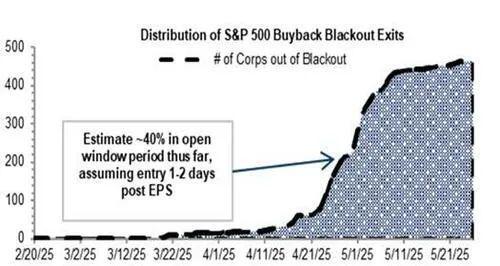
Core Viewpoint - The recent rise in the U.S. stock market is primarily driven by three forces: programmatic trading from CTAs (Commodity Trading Advisors), continuous corporate buybacks, and aggressive retail investor buying [1][3]. Group 1: Retail Investor Activity - Retail investors have shown remarkable buying strength, with net purchases reaching $4.1 billion, marking the highest level ever recorded for that time period [1]. - Retail trading volume accounted for approximately 36%, setting a new historical record, with total net purchases for the day amounting to $5.4 billion [1][3]. Group 2: Corporate Buybacks - The end of the stock buyback blackout period has contributed to the ongoing market rally, as companies are now able to repurchase their shares [2]. - Although the year-to-date buyback authorization has reached a historical high, actual execution of these buybacks has not yet matched the authorized amounts, typically executing around 80-90% of the authorized volume [10]. Group 3: CTA Activity - CTAs remain consistent buyers regardless of market conditions, with significant inflows during sideways and rising markets, and limited selling during downturns [8][10]. - In the upcoming months, CTAs are expected to sell only during significant market declines, specifically at a 2.5 standard deviation drop [10]. - Current market activity indicates that long-term institutions are slightly net selling, while hedge funds are maintaining a neutral stance with minor adjustments in macro positions [3].


策略日报:大类资产跟踪-20250520
Tai Ping Yang Zheng Quan· 2025-05-20 13:42
Group 1: Market Overview - The bond market is experiencing a slight decline, with expectations of a small adjustment following interest rate cuts. The short-term outlook indicates a higher probability of filling the gap downwards, while the long-term view suggests that fundamental weaknesses will continue to drive the bond market to new highs [20][4]. - The A-share market is showing continued volatility, with small-cap stocks performing actively while high-position stocks are retreating. This indicates ongoing rotational increases in the market, expected to persist until trading volume effectively breaks through 1.5 trillion [24][4]. - The U.S. stock market has broken through key resistance levels, increasing the likelihood of new highs. Corporate buybacks are providing support, with the S&P 500 recovering the previously mentioned resistance level of 5700 points [29][30]. Group 2: Sector Performance - In the A-share market, sectors such as technology, consumer goods, and dividends are expected to rotate upwards. The market is currently seeing a shift towards consumption and pharmaceuticals, with new consumption and innovative pharmaceuticals attracting more capital [24][4]. - The commodity market is experiencing a decline, with the Wenhua Commodity Index down by 0.22%. The market does not perceive the recent interest rate cuts as significantly stimulating demand [36][4]. - The foreign exchange market shows the onshore RMB against the USD at 7.2194, appreciating by 50 basis points. The RMB is expected to rise to around 7.1 due to favorable impacts from U.S.-China trade relations [34][6]. Group 3: Policy and Economic Indicators - The May LPR (Loan Prime Rate) has been released, with both the 5-year and 1-year rates lowered by 10 basis points. The 5-year LPR is now at 3.5%, and the 1-year LPR is at 3% [40][41]. - In April, the total retail sales of consumer goods increased by 5.1% year-on-year, indicating a recovery in consumption supported by policy measures [41][40]. - The National Development and Reform Commission has highlighted the need to address "involution" in competition, which distorts market mechanisms and disrupts fair competition [41][40].
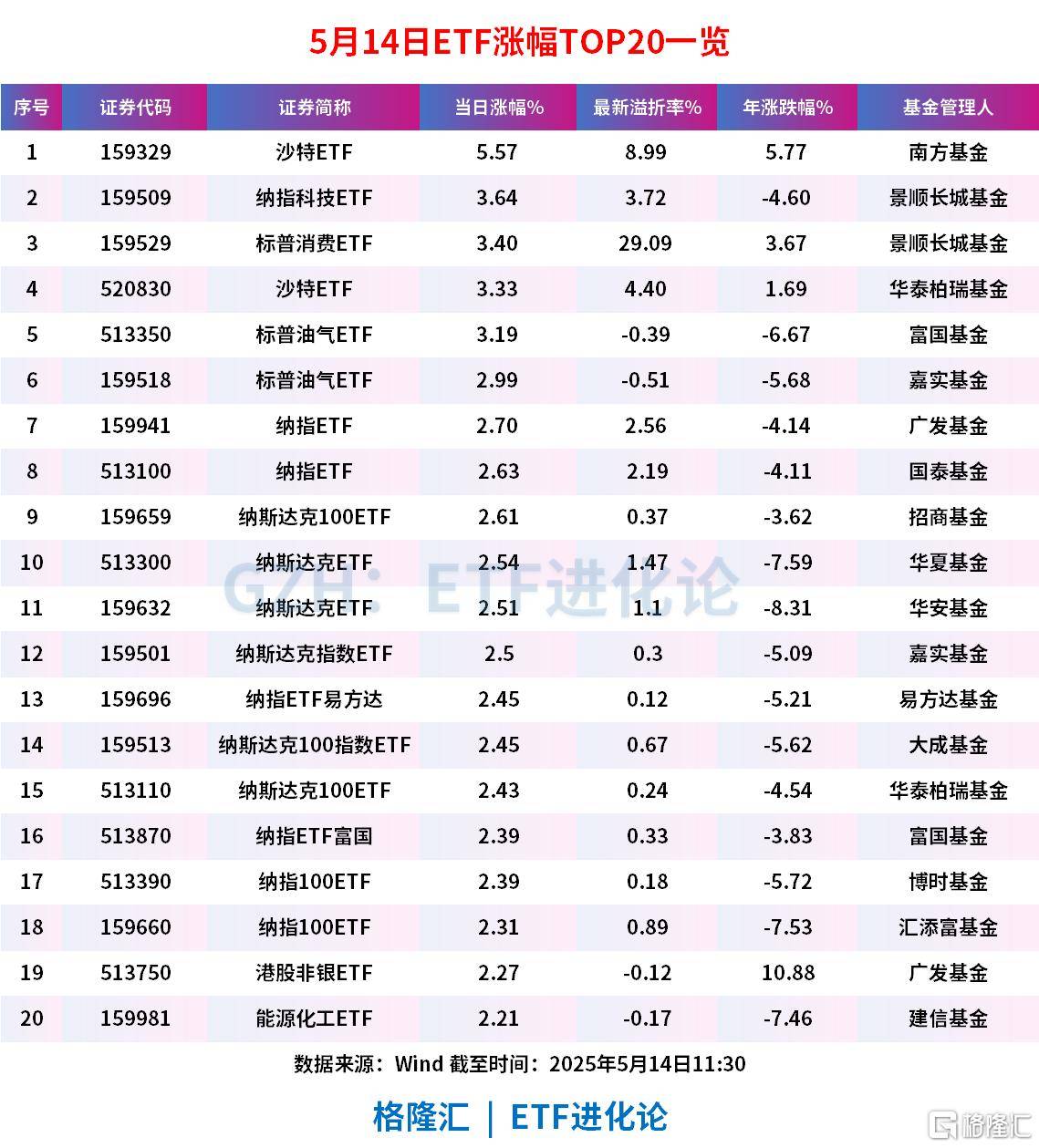
跨境ETF霸屏涨幅榜,沙特ETF涨超5%,纳指科技ETF、标普消费ETF涨超3%
Sou Hu Cai Jing· 2025-05-14 05:26
Core Viewpoint - The resurgence of cross-border ETFs has led to significant price increases across various funds, driven by positive market sentiment following favorable inflation data and a temporary trade truce between the US and China [1][5][10]. Group 1: ETF Performance - The Southern Fund's Saudi ETF, Invesco's Nasdaq Tech ETF, and Invesco's S&P Consumer ETF saw increases of 5.57%, 3.64%, and 3.4% respectively, with latest premium/discount rates at 8.99%, 3.72%, and 29.09% [1][3]. - The S&P Oil & Gas ETFs from Franklin Templeton and Harvest Fund increased by 3.19% and 2.99% respectively, reflecting a broader rise in oil prices [1][3]. - The Nasdaq index rose for the second consecutive day, with Franklin Templeton's Nasdaq ETF and Cathay Fund's Nasdaq ETF increasing by 2.7% and 2.63% respectively [1][3]. Group 2: Market Context - Global stock markets continued to rise, with the S&P 500 and Nasdaq indices gaining 0.72% and 1.61% respectively, attributed to lower-than-expected inflation data and improved investor sentiment following the US-China trade truce [5][6]. - The S&P 500 index has recovered its losses for the year, now up 0.1%, after a significant drop earlier due to escalating trade tensions [5][6]. - The recent signing of a $142 billion arms deal between the US and Saudi Arabia, along with Nvidia's commitment to supply advanced AI chips, has further bolstered market optimism [6][10]. Group 3: Economic Indicators - The US Consumer Price Index rose by 2.3% year-on-year in April, below the expected 2.4%, marking the lowest level since February 2021 [10]. - Despite the favorable inflation data, the 10-year US Treasury yield increased by 2.4 basis points to 4.481%, indicating a complex market reaction [10]. - Market analysts suggest that the upcoming month may see fluctuations in the S&P 500 index between 5500 and 5800 points, supported by corporate buybacks and trade agreements [10].
高盛对冲基金主管的总结:为何市场远比预期坚韧,有点像1998年底或者2007年末
Hua Er Jie Jian Wen· 2025-05-04 11:44
Group 1 - The current market is in a contradictory state with negative factors such as expectations of a U.S. economic recession and skepticism towards the status of risk-free assets, while positive aspects include a stable job market and strong performance from U.S. tech companies [1] - The S&P 500 index has achieved a nine-day consecutive rise, down only 3% year-to-date, with a price-to-earnings ratio at the 85th percentile of the past 25 years, indicating resilience in the market [1] - There is a notable shift in investor behavior, with leveraged investors starting to buy again, while large banks and tech giants are entering a peak period for stock buybacks, expected to exceed $1 trillion this year [3] Group 2 - The U.S. economy is experiencing a 7% year-on-year increase in fiscal deficit, suggesting continued government spending which supports employment and consumption data [4] - The uncertainty surrounding tariffs remains, with expectations of trade framework agreements being announced while economic momentum gradually weakens [4] - The upcoming FOMC meeting is anticipated to have minimal impact, with expectations that the Federal Reserve will maintain a passive stance [4] Group 3 - The market is characterized by macroeconomic uncertainty but strong technical indicators and corporate earnings, with a prevailing pessimism among investors, particularly non-U.S. investors [5] - The current market behavior resembles patterns seen in 1998 and late 2007, where increased fear among investors correlates with market resilience [5] - The long-term upward trend of the S&P 500 post-pandemic remains intact despite recent challenges [5]