
数字社会建设

Search documents
广东:推动金融机构持续加大对数字化重点领域的信贷投放与融资支持
Xin Lang Cai Jing· 2026-02-04 08:36
Core Insights - The Guangdong Provincial Government has issued the "Implementation Opinions on Accelerating the High-Quality Construction of Digital Society" to enhance the development of a digital society [1] Group 1: Financial Support and Investment - The opinions emphasize the need to strengthen the collaboration between fiscal funds and social capital, guiding various social capital investments [1] - Financial institutions are encouraged to increase credit investment and financing support for key areas of digitalization [1] Group 2: Innovation and Collaboration - There is a focus on exploring the establishment of a scene innovation incubation mechanism to enhance the cultivation and openness of diverse application scenarios [1] - The initiative aims to actively create high-level platforms for international exchange and cooperation, building a new pattern of digital open cooperation [1]
2026年江苏全省数据工作会议召开,明确今年十项重点任务
Yang Zi Wan Bao Wang· 2026-01-19 06:35
Core Insights - The 2026 provincial data work conference in Nanjing aims to leverage data elements to contribute to high-quality economic and social development during the "14th Five-Year Plan" period [1] Group 1: Achievements in 2025 - Significant breakthroughs were made in the construction of public data resource systems, with the province's registration volume ranking second nationally [2] - The implementation of the "Data Twenty Articles" and the introduction of the Jiangsu Provincial Data Regulations established a unified authorization and operation system for public data resources [2] - The province excelled in the "Data Elements ×" initiative, with 14 projects winning national awards and 7 projects selected as national pilot projects for trusted data space innovation, ranking first in the country [2] - A collaborative effort among 12 provincial departments to nurture and grow data enterprises attracted several well-known domestic and international data companies to Jiangsu [2] - The "Efficient Completion of One Matter" initiative processed a total of 40 million cases, while the "Su Service Office" registered over 153 million users, handling 110 million cases throughout the year [2] Group 2: Key Tasks for 2026 - High-quality planning for the construction of a digital Jiangsu and the development and utilization of data resources will be prioritized [3] - The completion of a three-year action plan for public data and the enhancement of operational efficiency for public data will be pursued [3] - The establishment of a unified data property registration system and the construction of a provincial data exchange will be accelerated [3] - The integration of data technology innovation with industrial innovation will be promoted, focusing on developing specialized data industry clusters [3] - The construction of a national digital economy innovation development pilot zone will be advanced, with an emphasis on monitoring and evaluation mechanisms [3] - The cultivation of 200 typical application scenarios for digital social development and the promotion of comprehensive digital transformation in cities will be initiated [3] - Data empowerment for artificial intelligence development will be strengthened through infrastructure upgrades and algorithm model innovations [3] - The construction of a digital government will be enhanced, focusing on high-level operations of the "Su Government Source" platform [3] - The efficiency of government services will be improved, with a focus on optimizing the "One Form Pass" system and enhancing the 12345 hotline service [3] - Data security measures will be reinforced, including the strengthening of safety systems and talent development [3]
票证退场,云端登场: 四十年缴费服务里的民生跃迁
2 1 Shi Ji Jing Ji Bao Dao· 2026-01-14 00:36
Core Insights - The article highlights the transformation of payment methods in China over the past 40 years, illustrating a shift from a passive to an active approach in public service, driven by technological advancements and digitalization [1] Group 1: Evolution of Payment Methods - The initial phase of payment methods relied heavily on offline points, with cash transactions being the norm, leading to long queues and inconvenience for users [2] - The rise of the internet in the early 2000s facilitated the transition to online payment methods, with banks and payment operators expanding their services to digital platforms [2][3] - The introduction of platforms like Everbright Bank's cloud payment service in 2014 marked a significant shift towards an open ecosystem, integrating various payment channels and services [3] Group 2: Technological Empowerment - Everbright's cloud payment service utilizes advanced technologies such as distributed architecture, cloud computing, and artificial intelligence to enhance service efficiency and responsiveness [4] - The system supports a high transaction volume, processing over 2.9 billion transactions daily with a response time of under 100 milliseconds, ensuring stability and reliability [4] Group 3: Inclusive Service Development - The service has developed a multi-tiered system to cater to diverse user needs, including initiatives like a bilingual payment app for minority communities in Qinghai Province [5] - Efforts to educate rural populations on digital payment methods are being implemented to foster usage and accessibility [5] Group 4: Sector-Specific Applications - In education, the service has streamlined tuition payment processes for colleges, while in tourism, it has enhanced ticketing services for parks [6] - The platform also supports government services and small businesses by providing online payment solutions, thus facilitating digital transformation [6] Group 5: Transition to Comprehensive Service Platform - Everbright's cloud payment service is evolving from a simple payment tool to a comprehensive service platform, enhancing user experience through features like payment reminders and promotional activities [7] - The platform plays a crucial role in equalizing public services between urban and rural areas, allowing all residents to access the same quality of payment services [7] Group 6: Future Outlook - The integration of 5G, IoT, and AI technologies is expected to further expand the service's capabilities, transitioning from convenient payments to a smarter lifestyle [8] - The core mission remains to empower all demographics through digital solutions, supporting inclusive growth and common prosperity [8]

票证退场,云端登场: 四十年缴费服务里的民生跃迁
21世纪经济报道· 2026-01-14 00:29
Core Viewpoint - The article highlights the transformation of payment methods in China over the past 40 years, emphasizing the shift from passive to active service in public welfare, driven by technological advancements and the digitalization of payment services [1]. Group 1: Evolution of Payment Methods - The initial phase of payment methods relied heavily on offline outlets, with cash transactions being the norm, leading to long queues and inconvenience for users [3]. - The rise of the internet post-2002 facilitated the transition to online payment methods, with banks and payment operators expanding their services to digital platforms [4]. - The second decade of the 21st century marked the emergence of open platform payment services, exemplified by the launch of Everbright Bank's cloud payment service in 2014, which integrated various payment channels and projects [5]. Group 2: Digitalization and Intelligence in Payment Services - Recent years have seen a deepening of digitalization and exploration of intelligent payment services, with Everbright Cloud Payment integrating over 19,000 payment services across various sectors [6][8]. - The service ecosystem has evolved, with suppliers building digital platforms to enhance efficiency, and channels expanding to include diverse payment scenarios [7]. - The introduction of generative AI has transformed user interactions, enabling more intelligent and proactive payment solutions [8]. Group 3: Everbright Cloud Payment's Strategic Logic - Technological innovation is central to Everbright Cloud Payment's success, utilizing distributed architecture, cloud computing, and AI to enhance service responsiveness and stability [7]. - The service has developed a multi-tiered support system to cater to diverse user needs, including localized services for minority populations and educational institutions [8][9]. - By 2025, Everbright Cloud Payment aims to expand its service offerings significantly, achieving nationwide coverage for various utility payments [9]. Group 4: Transition to a Comprehensive Service Platform - Everbright Cloud Payment is evolving from a simple payment tool to a comprehensive service platform, enhancing user experience through various features and promotional activities [11]. - The platform plays a crucial role in equalizing public services between urban and rural areas, allowing residents in remote regions to access the same quality of payment services as urban dwellers [12]. - Future developments will focus on integrating advanced technologies like 5G and IoT to further expand service boundaries and enhance user engagement [12][13].


省十四届人大常委会第十九次会议举行联组会议
Liao Ning Ri Bao· 2025-11-28 01:09
Core Viewpoint - Strengthening digital government construction is fundamental for building a strong network nation and a digital China, serving as a crucial initiative for innovating government governance concepts and methods [2] Group 1: Digital Government Construction - The provincial government emphasizes the importance of enhancing digital government construction to drive the development of the digital economy and society [2] - There is a call for a unified approach across the province, enhancing coordination, top-level design, and accountability in digital government initiatives [2] - The government aims to address shortcomings in digital government construction through targeted policies and systematic solutions [2] Group 2: Implementation and Accountability - The provincial government commits to promptly implementing suggestions from the inquiry, assigning responsibilities, and ensuring effective rectification of issues [2] - A focus on institutional innovation and collaborative governance is highlighted to systematically resolve common problems in digital government construction [2] - The government will prioritize the "people first" principle, continuously enriching application scenarios to optimize the business environment through data empowerment [2]
刷脸支付:是极致便捷还是多维风险
Jin Rong Shi Bao· 2025-11-03 05:10
Core Insights - The evolution of payment methods reflects societal technological changes, with facial recognition payment emerging as a key infrastructure in the digital economy, raising concerns beyond mere technical security and privacy issues [1][2] Group 1: Governance Principles - Establish a risk-based governance principle focusing on three core aspects: 1. Preventive principle: Regulatory measures should be proactive and adaptable to unknown risks associated with biometric data [3] 2. Proportionality principle: Regulatory intensity must correspond to the risk level of specific applications, avoiding a one-size-fits-all approach [3] 3. Collaborative governance principle: Involvement of multiple stakeholders, including government, industry, and the public, to create a cooperative governance framework [3] Group 2: Regulatory Tools and Mechanisms - Innovate key regulatory tools and mechanisms by: 1. Upgrading the "regulatory sandbox" to test data governance rules and algorithmic ethics comprehensively [4] 2. Establishing mandatory algorithm audits and certifications by independent third parties to ensure fairness and robustness [4] 3. Implementing risk-based tiered management according to transaction amounts and application scenarios, requiring multi-factor authentication for high-risk situations [4] Group 3: Legal and Standard Foundations - Strengthen the legal and standard foundations for governance by: 1. Clarifying legal responsibilities and consumer protection measures, including the principle of "reversed burden of proof" in fraud cases [5] 2. Promoting industry self-regulation and the establishment of high-standard processing norms for biometric information [5] Group 4: External Environment for Governance - Create a favorable external environment for scientific governance by: 1. Enhancing public digital literacy and awareness of risks associated with facial recognition payments [6] 2. Expanding social participation and oversight channels in the formulation of technical standards and regulations [6] - The challenges posed by facial recognition payments necessitate a comprehensive regulatory framework to guide its healthy development, ultimately supporting inclusive finance and social equity [7]
高质量完成“十四五”规划丨“十四五”以来我国数字公共服务更加可感可及
Xin Hua She· 2025-08-14 09:15
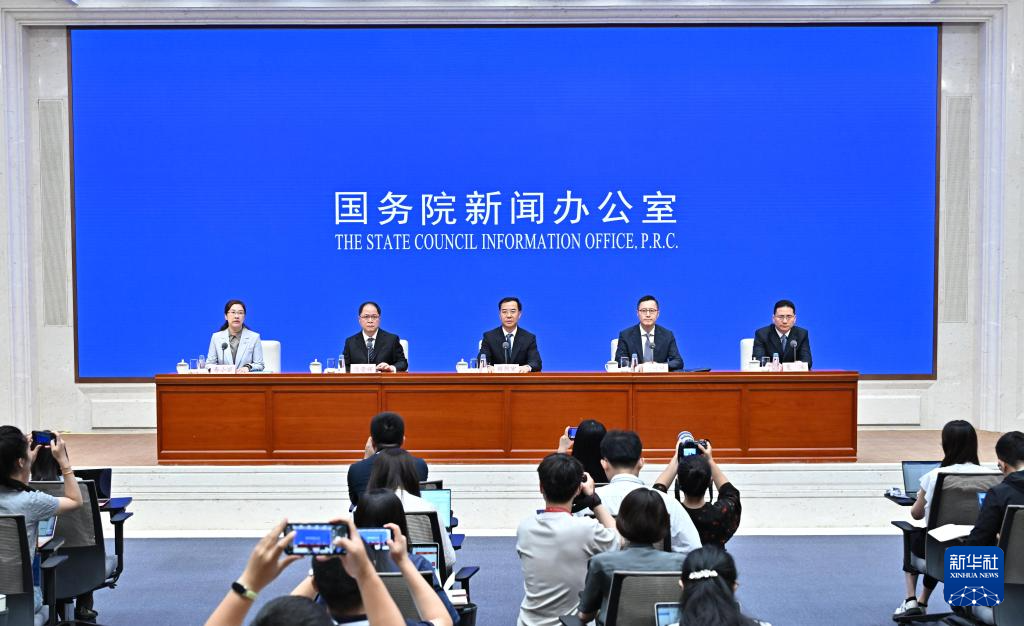
Core Viewpoint - The rapid application of digital technology in China since the "14th Five-Year Plan" has significantly transformed production, lifestyle, and social governance, providing accessible and beneficial digital services to more citizens [1][3]. Group 1: Digital Healthcare - The national internet hospitals have served over 100 million people, with over 1.2 billion users of the national medical insurance code, and direct settlement for cross-province medical services benefiting 560 million people [3][4]. - Digital social security has expanded, with 1.07 billion people using electronic social security cards, covering over 75% of the population, and cities like the Yangtze River Delta and Chengdu-Chongqing gradually achieving interconnected regional services [3][4]. Group 2: Digital Education - China has established the world's largest and most resource-rich national smart education platform, leading in both the number and application scale of massive open online courses (MOOCs), enabling access to quality courses [3][4]. Group 3: Digital Elderly Care - Positive progress has been made in digital elderly care services, with improvements in internet applications and services like "one-click access to human customer service," and the launch of a national elderly care service information platform to enhance resource matching [3][4]. Group 4: Digital Transformation in Various Sectors - The digital transformation completion rate for national 5A-level scenic spots has reached 100%, and community services have become more intelligent, with services like "one-click" assistance for the elderly [4]. - New digital consumption formats and products, such as instant retail, smart connected vehicles, and micro-short dramas, continue to emerge, unleashing new consumption potential [4]. Group 5: Future Directions - The National Data Bureau aims to leverage the amplifying, overlapping, and multiplying effects of data elements, focusing on enhancing public services, digital living, and the digital transformation of social governance to achieve more results in digital society construction [4].
“十四五”以来我国数字公共服务更加可感可及
Xin Hua She· 2025-08-14 05:52
Group 1 - The core viewpoint is that the application of digital technology in China has accelerated since the "14th Five-Year Plan," leading to significant changes in production, lifestyle, and social governance, benefiting more citizens with accessible digital services [1][2] - The national internet hospitals have served over 100 million people, with over 1.2 billion users of the national medical insurance code, and direct settlement for cross-province medical treatment benefiting 560 million people [1] - The digital social security system has expanded, with 1.07 billion people using electronic social security cards, covering over 75% of the population, and cities like the Yangtze River Delta and Chengdu-Chongqing gradually achieving interconnected regional services [1] Group 2 - The digital education sector has seen significant upgrades, establishing the world's largest and most resource-rich national smart education platform, with the largest number of massive open online courses (MOOCs) and their application scale [1] - Digital elderly care services have improved, with internet applications and "one-click" customer service enhancing service levels, and a national elderly care service information platform has been launched to efficiently connect supply and demand [1] - The completion rate of digital transformation for national 5A scenic spots has reached 100%, and community services have become more intelligent, with services like "one-click" elderly assistance being easily accessible [2]
我省召开数字社会建设推进会
Xin Hua Ri Bao· 2025-08-02 23:05
Core Insights - The meeting held on July 31 in Suzhou focused on advancing digital social construction in Jiangsu province, emphasizing the importance of data development and security as articulated by General Secretary Xi Jinping [1] - Jiangsu has achieved significant results in key areas of digital society construction, moving towards a more equitable, intelligent, efficient, and eco-friendly digital landscape [1] - The province is leading the nation in urban digital transformation and has initiated major digital social scenarios and innovative consumption scenarios, with 150 exemplary cases identified for replication and promotion [1] - The ongoing initiative to empower various industries with artificial intelligence is being actively pursued [1] - Future plans for digital social construction in Jiangsu include deepening intelligent empowerment and advancing the digital society to new heights [1]
苏州“数字重大场景”全省第一
Su Zhou Ri Bao· 2025-07-31 22:38
Group 1 - The core viewpoint of the news is that Suzhou is making significant progress in building a digital society, with various projects and initiatives being launched to enhance digital transformation and governance [1][2][3] - Suzhou has been recognized for its digital transformation efforts, with the "Suzhou International Data Port" being named a national model for city-wide digital transformation and the "Digital Painting of the Ancient City" being the only project from the province included in the first batch of typical cases for digital China construction [1] - The city has implemented a comprehensive approach to digital society construction, focusing on top-level design and mechanism guarantees, including quarterly AI application roadshows and the establishment of a unified public data foundation [1][2] Group 2 - Suzhou is advancing digital public services, with over 70 high-frequency government services being streamlined for efficiency, including initiatives for "no certificate required" and "fully online processing" [2] - The city is enhancing the convenience of digital life services, with the "Suzhou Zhoudao" platform being optimized and expanded, and digital RMB transactions leading the nation [2] - Through systematic digital construction, Suzhou is improving urban governance efficiency and providing tangible benefits to citizens, with plans for high-standard digital development and integration of AI and data elements [3]