数据三权分置

Search documents
姜奇平:加强数据基础制度建设,激活数字经济新动能
Ren Min Wang· 2025-11-29 03:12
Core Viewpoint - The article emphasizes the importance of strengthening data infrastructure and institutional construction to activate new momentum in the digital economy, highlighting the need for collaborative governance and value release in the context of ongoing reforms in data factor marketization [1]. Group 1: Data Value and Usage - The concept of "usage" is highlighted as a more accurate reflection of data's value compared to "ownership," as data must be continuously utilized to maintain its value [3]. - The distinction between value creation and value realization is made, with data collection seen as value creation and processing, re-utilization, circulation, and application as part of the value realization process [4]. - The "three rights separation" approach to data emphasizes flexibility, fairness, and incentive mechanisms, allowing various stakeholders to participate in value realization throughout the data lifecycle [5]. Group 2: Institutional Construction and Legal Framework - The article discusses the need for a robust legal framework to support data rights and usage, suggesting that existing property laws require specific interpretations to accommodate data-related issues [7]. - It advocates for exploring new business models and environments that integrate government, large enterprises, and SMEs to foster a collaborative ecosystem for data utilization [7][8]. - The importance of establishing a regulatory framework that encourages innovation while managing risks is emphasized, alongside the need for a service system to support the data industry [8]. Group 3: Government and Enterprise Collaboration - The government plays a crucial role in the foundational construction of data as a new production factor, which is essential for the development of the data industry [8]. - Collaboration between government and enterprises is necessary to promote the development of a data market, with a focus on creating a dual market structure that addresses both tangible and intangible data [8]. - The article suggests that enterprises should leverage their supply chain and value chain advantages to foster new cooperative relationships, balancing competition and collaboration [9].
超大互联网平台数据被“寄生”,法院判定不正当竞争
2 1 Shi Ji Jing Ji Bao Dao· 2025-07-02 08:45
Core Viewpoint - The case of "Xiao Wang Shen" infringement has been ruled by the Nanjing Intermediate People's Court, affirming that Taobao Tmall holds data rights over its platform's operational data and derived data products, marking a significant legal precedent in the protection of data rights for large internet platforms [1][3]. Group 1: Legal Context - The ruling is recognized as a landmark case in the realm of data resource law, often referred to as the "first case of data resource law enforcement in the country" [1]. - The court determined that Taobao Tmall possesses commercial secrets and data rights over three categories of data: raw information, processed operational data, and derived data products [3]. Group 2: Infringement Details - The "Xiao Wang Shen" software was found to have illegally accessed and sold Taobao Tmall's operational data, generating an estimated illegal income of approximately 22.96 million yuan [3]. - The court ordered the defendants to cease their infringing activities and pay punitive damages of 30 million yuan to Taobao Tmall, along with reasonable expenses of 100,000 yuan [3]. Group 3: Data Rights and Protection - The ruling reinforces the concept of "data three rights," which includes holding, using, and processing rights over data, thereby clarifying the ownership and protection of data rights in the digital economy [3]. - The "Xiao Wang Shen" software's official channels still display links to plugins with infringing functionalities, indicating ongoing challenges in enforcing the ruling [4].


同方股份文献数据库入表,估值超9000万元
2 1 Shi Ji Jing Ji Bao Dao· 2025-04-29 12:30
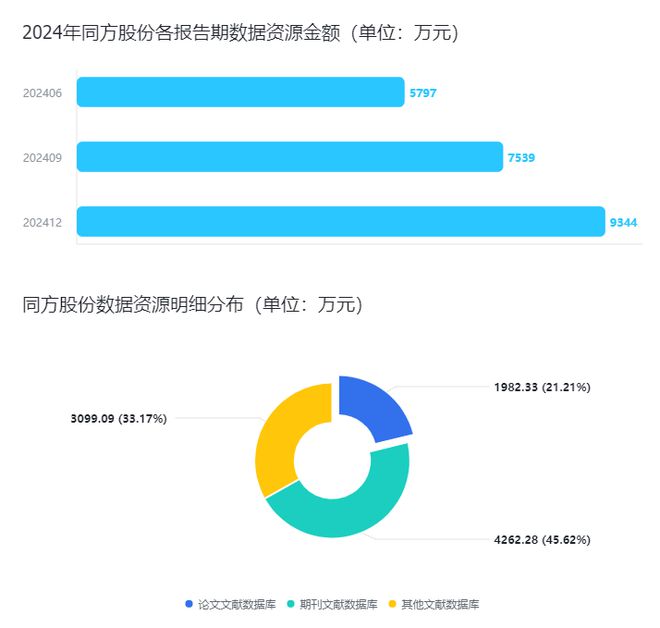
Group 1 - The core viewpoint of the article highlights the significant growth in Tongfang Co., Ltd.'s data resources, which increased by 61% to 93.44 million yuan compared to the initial disclosure in the semi-annual report [1] - Tongfang's total revenue for 2024 reached 16.802 billion yuan, with a net profit attributable to shareholders of 141 million yuan, marking the first profit after four years of losses [4] - The main revenue source for Tongfang is nuclear technology applications, generating 6.376 billion yuan, accounting for nearly 40% of total revenue, with a gross margin of 32.94% [5] Group 2 - The digital information business of Tongfang, driven by knowledge services, big data, industrial internet, and generative AI technology, reported revenue of 3.936 billion yuan, with a gross margin of 32.73%, the second highest among its five main business segments [5][11] - Tongfang's subsidiary, CNKI, holds nearly 380 million literature resources and has faced frequent copyright disputes, including issues related to authors needing to pay fees to download their own papers [11][12] - The current copyright model of CNKI involves indirect authorization through agreements with journal publishers, which has led to legal challenges regarding the rights of authors [12][14] Group 3 - The market regulatory authority investigated CNKI for abusing its dominant market position in the Chinese academic literature database service market, resulting in a fine of 87.6 million yuan based on 5% of its 2021 sales in China [14] - The "three rights separation" framework established by the "Data Twenty Articles" indicates that data ownership, processing rights, and product operation rights are now distinct, with CNKI primarily holding processing and operational rights rather than ownership [16]