
日元走弱

Search documents
荷兰国际银行:日本央行行长植田和男不太可能暗示进一步加息
Jin Rong Jie· 2026-01-23 01:21
Core Viewpoint - The Bank of Japan is expected to maintain its policy interest rate at 0.75%, focusing on economic growth, inflation trends, and the impact of a weakening yen rather than political dynamics [1] Group 1: Monetary Policy - The Bank of Japan is likely to keep its current policy stance, balancing between supporting economic recovery and achieving inflation targets [1] - Bank of Japan Governor Kazuo Ueda is not expected to signal further interest rate hikes but will explore the impact of the weakening yen on domestic inflation [1] Group 2: Market Dynamics - Recent surges in Japanese government bond yields are under close scrutiny, with the expectation that the market will determine interest rates [1] - The authorities have tools available to manage risks if necessary [1]
植田和男“鹰声”难改颓势 日元空头大军仍死守阵地
智通财经网· 2025-12-08 01:21
Core Viewpoint - The market is increasingly speculating that the Bank of Japan will raise interest rates this month, yet participants continue to bet on a weaker yen against the dollar [1][2]. Group 1: Market Sentiment and Positioning - Traders from Bank of America, Nomura Holdings, and Royal Bank of Canada indicate that investor positioning reflects a bearish sentiment towards the yen, as evidenced by Citigroup's yen "pain index" remaining well below zero [1]. - Despite the Bank of Japan Governor Ueda's hints at a potential rate hike, investors maintain bearish bets, reasoning that even if action is taken, Japanese yields are expected to remain significantly lower than those in the U.S., supporting the dollar [1]. - The positioning still leans towards a gradual increase in the dollar-yen exchange rate by year-end, unless there is a significant surprise from the Bank of Japan [1]. Group 2: Currency Trends and Predictions - Japanese Finance Minister Satsuki Katayama's efforts to curb the yen's weakness have had limited success, with the yen's decline partly fueled by speculation regarding the delay in rate hikes [2]. - Following Ueda's comments, hedge funds have gradually reduced their bets on the dollar-yen rise, but most still hold this position [2]. - The options market shows a similar trend, with a 40% higher trading volume in call options compared to put options after Ueda's speech [2]. - UBS has revised its year-end yen exchange rate forecast from 152 yen to 158 yen per dollar, while Bank of America predicts the yen will fall below 160 yen by early 2026 [3].
前日本央行官员称日元走弱提升12月加息可能性
Di Yi Cai Jing· 2025-11-26 01:50
Core Insights - The recent depreciation of the Japanese yen has increased the likelihood of a rate hike by the Bank of Japan next month [1] Group 1 - The former Bank of Japan board member, Kazuo Momma, indicated that the weakening yen is a significant factor influencing the central bank's monetary policy decisions [1]
日本明确将外汇干预列为选项,警惕长周末前突袭的风险!
Jin Shi Shu Ju· 2025-11-21 03:08
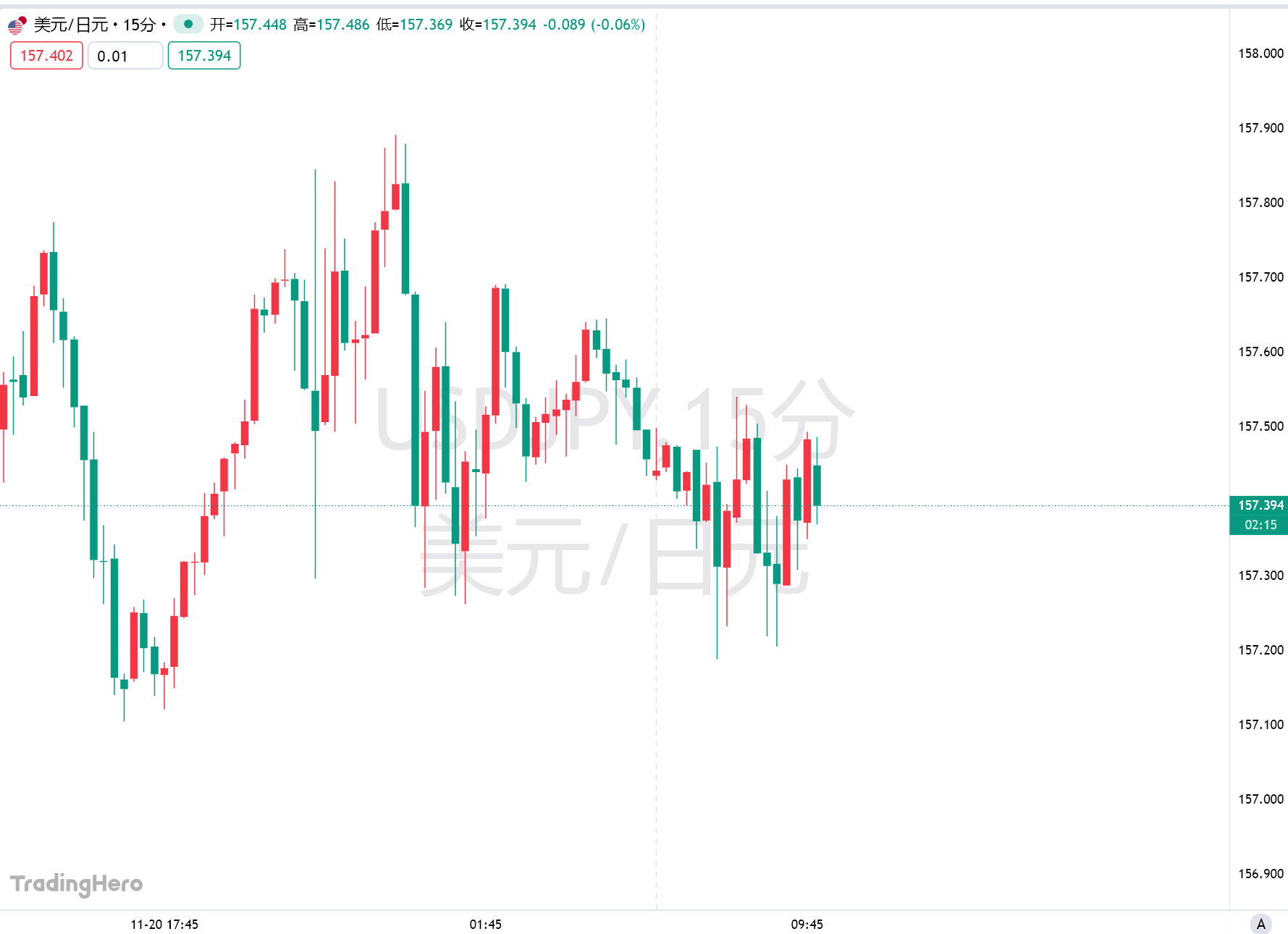
Core Viewpoint - Japan has issued its strongest warning yet regarding the recent volatility of the yen, with the finance minister indicating that intervention is a potential response to curb the yen's continued decline [1][4]. Group 1: Government Actions and Statements - Finance Minister Satsuki Katayama expressed deep concern over the extreme and rapid fluctuations in the foreign exchange market, stating that appropriate actions will be taken against disorderly movements, including potential intervention [1][4]. - The government is expected to announce a significant economic stimulus package, funded by an additional budget of 17.7 trillion yen (approximately 112 billion USD), which is the largest since the reduction of pandemic-era measures [4][5]. - Market participants are closely monitoring the 160 yen per dollar level, as the Japanese authorities have previously intervened in this range [3][7]. Group 2: Market Reactions and Speculations - The dollar briefly fell to 157.20 yen following the finance minister's comments but rebounded, remaining near its highest level since January [1]. - Analysts suggest that the yen is becoming a speculative tool, with market sensitivity to Japanese officials' comments diminishing, and macroeconomic factors supporting a weaker yen [4][6]. - There is speculation that Japan may intervene before the yen reaches the 160 mark, as the government believes it has sufficient foreign reserves to act if necessary [5][9]. Group 3: Historical Context and Future Outlook - Japan has previously intervened in the market four times last year to support the yen, costing approximately 100 billion USD, and has spent around 173 billion USD since 2022 on interventions [9]. - The Japanese government emphasizes that intervention will only occur in response to sudden, disorderly, or speculative fluctuations in the market [9][11]. - The yield on Japan's 10-year government bonds has risen to 1.8%, the highest since 2008, reflecting market optimism about the Japanese economy despite concerns over fiscal stability [5][6].

日本旅游和消费股大跌!券商警告日元或因赴日游客量骤降走弱
Nan Fang Du Shi Bao· 2025-11-17 10:37
Core Viewpoint - The Chinese Ministry of Culture and Tourism has advised Chinese tourists to avoid traveling to Japan, which has led to significant declines in Japanese tourism and consumer stocks [1][2]. Group 1: Impact on Tourism and Consumer Stocks - From January to September 2025, tourists from mainland China and Hong Kong are expected to account for approximately 30% of all foreign visitors to Japan, with about 7.49 million from mainland China, representing a 42.7% increase year-on-year [2]. - On November 17, multiple tourism and consumer stocks in Japan experienced substantial declines, with Shiseido's stock dropping over 9% and Fast Retailing (Uniqlo's parent company) falling over 4% [1]. - Department store stocks, including Mitsukoshi Isetan Holdings and Takashimaya, fell between 6% to 11%, while the operator of Tokyo Disneyland, Oriental Land Company, saw a decline of about 5% [1]. Group 2: Economic Implications - If the number of Chinese tourists to Japan drops to zero and remains at that level, Japan's tourism revenue could decrease by nearly 200 billion yen (approximately 9.19 billion RMB) per month [1]. - The chief currency strategist at Nomura Securities indicated that a sustained drop in Chinese tourists could lead to a weakening of the yen [1].