
日本央行政策

Search documents
日元狂飙冲击关键关口 日本央行干预警报双重绞杀
Jin Tou Wang· 2026-01-30 12:22
Group 1 - The core point of the articles highlights the pressure on the Japanese yen due to a combination of low inflation, fiscal concerns, and political uncertainty, leading to a strong rebound of the USD/JPY exchange rate [1] - The Japanese Prime Minister's large-scale spending and tax cut plans have raised fiscal concerns, while the political turmoil surrounding early elections has further weakened the yen, indirectly supporting the USD/JPY rebound [1] - The Bank of Japan's policy is a key variable affecting the yen's performance, as the central bank maintained interest rates but raised economic and inflation forecasts, signaling potential future rate hikes [1] Group 2 - The USD's rebound lacks sufficient momentum and is hindered by economic and policy uncertainties, including decisions from the Trump administration and the Federal Reserve's policy shifts [2] - There is a growing divergence in Federal Reserve policy expectations, with some officials supporting further rate cuts, which undermines market confidence in the dollar [2] - The technical outlook for USD/JPY indicates bearish signals, with the price struggling at key moving averages and momentum indicators showing weakness, suggesting a high probability of short-term declines [2]
日元,突发!
Zhong Guo Ji Jin Bao· 2026-01-23 11:51
Core Viewpoint - The Japanese yen experienced a rapid appreciation, briefly reaching the 157 yen range against the US dollar, following a period of depreciation that saw it drop to 159 yen, indicating market tension and potential intervention by the Bank of Japan [1][2] Group 1: Currency Movement - The yen had previously depreciated to 159.45 yen per dollar, marking its lowest point since July 2024, before the recent appreciation [1] - Analysts suggest that the market may be entering a phase where official intervention by the authorities is likely, given the proximity of the exchange rate to intervention levels [1] Group 2: Bank of Japan's Stance - Bank of Japan Governor Ueda indicated that the rising long-term interest rates are occurring at a "considerably fast" pace, and the bank may implement flexible market operations under exceptional circumstances [2] - Ueda emphasized the importance of monitoring the impact of exchange rates on domestic prices, particularly as corporate wage increases become more pronounced [2] Group 3: Market Reactions - There are speculations about significant dollar selling pressure in the market, with analysts noting the absence of official verbal interventions or direct market actions [1] - The potential for large European investors to engage in profit-taking during the European trading session was also mentioned, alongside the possibility of a rate check by authorities near the 160 yen level [1]
荷兰国际银行:日本央行行长植田和男不太可能暗示进一步加息
Jin Rong Jie· 2026-01-23 01:21
Core Viewpoint - The Bank of Japan is expected to maintain its policy interest rate at 0.75%, focusing on economic growth, inflation trends, and the impact of a weakening yen rather than political dynamics [1] Group 1: Monetary Policy - The Bank of Japan is likely to keep its current policy stance, balancing between supporting economic recovery and achieving inflation targets [1] - Bank of Japan Governor Kazuo Ueda is not expected to signal further interest rate hikes but will explore the impact of the weakening yen on domestic inflation [1] Group 2: Market Dynamics - Recent surges in Japanese government bond yields are under close scrutiny, with the expectation that the market will determine interest rates [1] - The authorities have tools available to manage risks if necessary [1]
日元没有“速效药”!日本央行渐进紧缩难逆转结构性颓势,华尔街唱空声浪高涨
Sou Hu Cai Jing· 2025-12-26 01:36
Core Viewpoint - The Japanese yen is facing structural weakness with no quick fix, as major financial institutions predict further depreciation against the US dollar by 2026, potentially reaching levels of 160 yen or lower per dollar [1][2]. Group 1: Economic Factors - The significant interest rate differential between the US and Japan, negative real interest rates, and ongoing capital outflows are key drivers of the yen's depreciation [1]. - The yen has seen a slight increase of less than 1% against the dollar this year after four consecutive years of decline, but expectations for a reversal due to Bank of Japan's rate hikes and Federal Reserve's rate cuts have not materialized [1]. - The return of arbitrage trading, where investors borrow low-yielding yen to invest in higher-yielding currencies, is making it more difficult for the yen to rebound [2]. Group 2: Market Predictions - Morgan Stanley's chief forex strategist predicts a pessimistic outlook for the yen, forecasting a dollar-to-yen exchange rate of 164 by the end of 2026, citing cyclical pressures and the impact of higher interest rate expectations in other regions [2]. - BNP Paribas anticipates that the global macro environment will favor risk sentiment, which typically benefits arbitrage strategies, leading to a dollar-to-yen rate of 160 by 2026 [3]. - Bank of America highlights that Japan's direct foreign investment has remained stable, indicating a persistent outflow of capital that could continue to pressure the yen [3]. Group 3: Government and Policy Responses - The Bank of Japan's lack of aggressive rate hikes and the persistence of negative real interest rates are seen as critical factors maintaining the yen's weakness [4]. - There is growing concern about potential government intervention as the yen approaches levels that previously triggered official action, although analysts believe that intervention alone may not be sufficient to reverse the yen's downward trend [4][5]. - The focus remains on the upcoming fiscal strategy from the Japanese government, which could influence market sentiment and the yen's trajectory [5].
【UNforex财经事件】美联储鹰派预期升温 美元站稳高位 黄金震荡整理
Sou Hu Cai Jing· 2025-10-31 10:33
Group 1 - Recent US economic data remains robust, leading to a decrease in market expectations for interest rate cuts by the Federal Reserve, with the probability of a December rate cut dropping from 90% to below 70% [1] - The strong performance of the US dollar is supported by high interest rates and signs of economic expansion, with the dollar index maintaining above 99.50 [1] - The European Central Bank decided to keep its main interest rates unchanged, aligning with market expectations, while the Eurozone inflation has decreased to 2.1%, indicating weak growth momentum [1] Group 2 - The strong US dollar is hindering the rebound of gold prices, which saw a temporary increase of over 2% but remains under pressure due to the Fed's tight policy and declining rate cut expectations [2] - Gold is experiencing limited upward movement due to reduced safe-haven demand and the strengthening dollar, resulting in a short-term inability to break through resistance levels [2] - Market focus is expected to shift back to central bank policy signals as key inflation and employment data are released in the coming weeks, highlighting the need for vigilance regarding monetary policy and global economic changes [2]
DLSM:美元反弹是技术性修正,还是新一轮强势周期的开始?
Sou Hu Cai Jing· 2025-07-30 10:19
Group 1 - The US dollar index continues to rise, reaching 98.91, the highest level since June 23, driven by new trade agreements between the US and the EU, Japan, and a recovering market risk appetite [1] - The dollar has strengthened against major currencies, with the euro experiencing a significant decline, dropping 1.29% in a single day, marking the largest daily drop since mid-May [3] - Recent trade agreements involve substantial commitments, including a 15% tariff on most EU goods in exchange for a $600 billion investment commitment from the EU to the US, and a $550 billion bilateral trade agreement with Japan [3] Group 2 - Market analysts suggest that the recent dollar strength may reflect a technical correction rather than a trend reversal, as the dollar had previously underperformed in the first half of the year [3] - The upcoming Federal Reserve meeting is expected to maintain current policy, but market participants are closely watching for any dovish language regarding inflation and potential rate cuts, which could lead to a reversal of recent dollar gains [4] - The divergence in monetary policy expectations among central banks is influencing the dollar's performance against various currencies, with the Japanese yen showing slight weakness against the dollar [4]

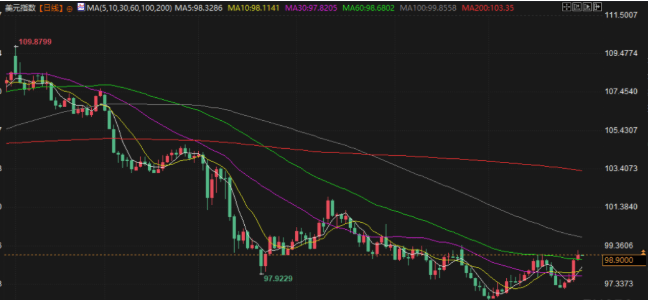
贸易政策持续反复 国际黄金急速拉高
Jin Tou Wang· 2025-06-13 06:15
Group 1 - The international gold price is experiencing a strong upward trend, currently quoted at $3421.69 per ounce with a 1.07% increase [1] - Morgan Stanley's global macro strategy head highlights that fluctuating trade policies are driving funds towards safe-haven currencies like the Japanese yen [2] - The market anticipates that the Bank of Japan may have room for policy tightening due to inflation consistently exceeding the 2% target for three years [2] Group 2 - Recent U.S. economic data shows a 0.1% month-on-month increase in the Producer Price Index (PPI) and an increase in initial jobless claims to 1.951 million, the highest since November 2021, reinforcing expectations for a Federal Reserve rate cut in September [2] - The dollar index has reached its lowest level since March 2022, indicating potential continued depreciation pressure on the dollar [2] - Technical analysis indicates that gold prices are likely to rise, with key resistance levels at $3435 and $3500, while support levels are identified at $3399-3393 and $3376-3380 [3]