日特估

Search documents
日本股市没想到过去10年回报还行
集思录· 2025-12-14 14:17
Core Viewpoint - The article discusses the performance of the Japanese stock market and its relationship with the country's economic growth, highlighting the disparity between stock market returns and GDP growth rates [2][3]. Group 1: Japanese Stock Market Performance - The annualized return of the Japanese stock market over the past 10 years is approximately 7.8% [2]. - Major companies mentioned include Toyota with a market cap of over 2 trillion RMB and a PE ratio of 8.67, Fast Retailing with a market cap of 800 billion RMB and a PE of 39, and others like SoftBank, Mitsubishi, Sony, Hitachi, and Nintendo [2]. - The article notes that the performance of the stock market may not directly correlate with domestic economic growth, as many large companies operate internationally [6][11]. Group 2: Economic Growth Data - Japan's GDP growth rates from 2020 to 2023 show fluctuations: -4.3% in 2020, +2.1% in 2021, +1.0% in 2022, and +1.9% in 2023 [2]. - IMF forecasts for 2024 and 2025 predict GDP growth rates of 0.7% and 0.5%, respectively, citing factors like insufficient domestic demand and an aging population [2][4]. Group 3: Global Economic Context - Japan's share of the global GDP has significantly decreased from 17.7% in 1995 to an estimated 3.6% in 2024, indicating a substantial decline in its economic influence [3][4]. - The article suggests that the stock market's performance may not be a reliable indicator of the overall economy, as evidenced by the contrasting trends in GDP and stock market returns [3][10]. Group 4: Investment Strategies - The article mentions that the Bank of Japan has been actively buying Japanese stocks for over 15 years, contributing to market liquidity [12]. - Notable investors like Warren Buffett have shown interest in Japanese companies, focusing on valuation, fundamentals, and shareholder return mechanisms [7].






今日!日本股市暴涨4.6%突破47000点!国庆节后A股怎么走
Sou Hu Cai Jing· 2025-10-06 20:18
Market Overview - The Nikkei 225 index surged over 1,000 points, closing at 47,873, marking a historical high and a 4.6% increase, breaking the 47,000-point barrier for the first time [1][3] - Major stocks like Mitsubishi Heavy Industries and Nippon Steel saw gains exceeding 12%, with the automotive and electronics sectors also experiencing significant upward movement [1][3] Currency and Bond Market - The Japanese yen weakened significantly against the US dollar, dropping 1.5% and approaching the critical level of 150 [3] - The yield on Japan's 40-year government bonds rose by 14 basis points, indicating volatility in the bond market [3] Political Catalyst - The recent election of Sanae Takaichi as the new president of the ruling Liberal Democratic Party (LDP) is seen as a key driver behind the market movements, with expectations that she will become Japan's first female Prime Minister [3][5] - Takaichi's policies are aligned with "Abenomics," which includes measures to combat inflation and maintain loose monetary policy, influencing market expectations [3][5] Economic Policy Impact - Since the implementation of "Abenomics" in 2013, the Nikkei 225 index has increased by over 270%, outperforming other major stock indices [5] - The Bank of Japan's monetary policy, characterized by negative short-term rates and zero long-term rates, has supported market confidence, with the central bank being the largest buyer of ETFs, holding about 6% of the total market capitalization [5][6] Foreign Investment - In 2023, foreign net inflows into the Japanese stock market reached approximately 6.3 trillion yen (about 434 billion USD), the highest since 2014 [6] - The favorable interest rate differential of 5.5% between Japan and the US has attracted foreign investments, enhancing returns through currency hedging [5][6] Sector Performance - The manufacturing sector, particularly electronics, automotive, and heavy industries, led the market rally, benefiting from the yen's depreciation which enhances export competitiveness [8] - Notable stock performances included Advantest rising nearly 10%, and companies like Fujitsu and Honda seeing gains over 5% [8] Governance and Market Structure - The Tokyo Stock Exchange's governance reforms, aimed at improving corporate valuations, have also contributed to the market's upward trajectory [8][10] - The government is reforming personal savings account plans to attract retail investors, enhancing the market's microstructure [10] Future Outlook - Analysts suggest that Takaichi's focus on economic security may benefit defense, critical resources, and technology stocks, while the nuclear sector could gain from her support for nuclear power initiatives [12] - The market is expected to remain volatile as Takaichi's government outlines specific stimulus policies, with potential for the Nikkei to reach 48,000 points in the short term [12]
韩国新总统李在明欲大举扩张财政 韩国国债恐掀新一轮抛售潮
智通财经网· 2025-06-04 09:31
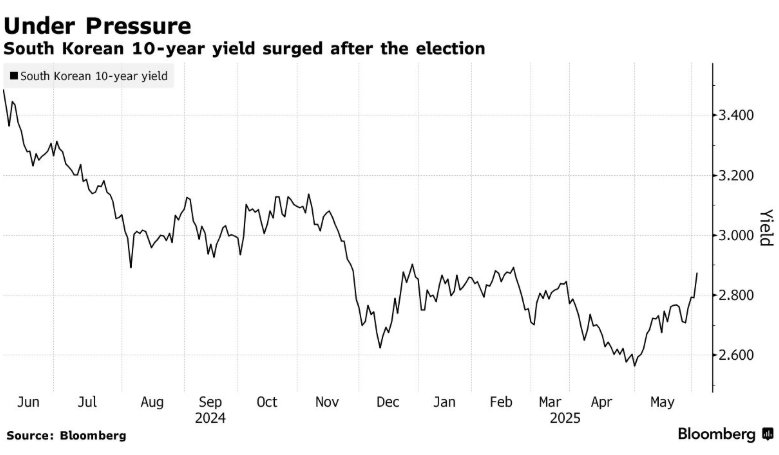
Group 1 - The new left-leaning president of South Korea, Lee Jae-myung, is expected to initiate a fiscal expansion era accompanied by rising government debt, leading to increased challenges for South Korean bonds [1][3] - The yield on 10-year South Korean government bonds surged over 10 basis points to 2.90%, reflecting investor concerns about increased debt supply following Lee's election [1][3] - The Ministry of Finance plans to issue 207.1 trillion KRW (approximately 150.7 billion USD) in government bonds this year, with expectations of additional stimulus measures that could further increase debt issuance [3] Group 2 - Major banks, including Morgan Stanley, predict that the Lee administration will introduce a second round of stimulus worth at least 35 trillion KRW, while ING forecasts it could be between 40 trillion and 45 trillion KRW [3] - Analysts suggest that if the second supplementary budget is around 30 trillion KRW, it could lead to an additional 25 trillion KRW in government bond issuance for the year [3] - The South Korean stock market has entered a "technical bull market," driven by expectations of accelerated economic expansion under Lee's government [3][4] Group 3 - Lee Jae-myung has set a target for the KOSPI index at 5000 points, indicating a strong focus on enhancing the valuation of South Korean stocks and addressing the "Korea discount" phenomenon [4] - The KOSPI index closed around 2770 points, reflecting market optimism regarding potential policy-driven growth in the stock market [4]