
韩国国债

Search documents
黑天鹅,突袭!日本遭遇“特拉斯时刻”!
券商中国· 2026-01-21 14:54
Core Viewpoint - Japan's bond market is experiencing significant volatility, reminiscent of the "Truss moment" in the UK, with potential implications for global debt markets as major financial institutions adjust their strategies in response to rising yields and economic policies [1][4]. Group 1: Japan's Recent Actions - Sumitomo Mitsui Financial Group plans to significantly increase its holdings of Japanese government bonds, potentially doubling its asset portfolio of 10.6 trillion yen (approximately 67 billion USD) as overseas returns become less attractive [2]. - The volatility in Japanese government bonds is expected to impact global debt markets, particularly U.S. Treasuries, with risk parity funds possibly needing to sell up to one-third of their current risk positions, which could lead to a bond sell-off of up to 130 billion USD in the U.S. alone [2][3]. Group 2: Market Implications - The recent sell-off in Japanese government bonds has already affected the U.S. bond market, as indicated by U.S. Treasury Secretary Scott Bessenet's discussions with Japanese officials regarding the situation [4]. - Concerns about Japan's fiscal health are rising, with projections indicating that by the end of 2025, Japan's total government debt will reach 229.6% of GDP, leading to increased long-term bond yields and further fiscal pressure [4]. Group 3: Broader Market Reactions - Analysts suggest that while there are concerns about the impact of Japanese bond volatility on global markets, the U.S. Treasury market remains the largest and most liquid, and significant changes to its role in the financial system will take time [5].


花旗预警:日本国债“风暴”来袭,或触发全球1300亿美元债券抛售潮
Zhi Tong Cai Jing· 2026-01-21 06:00
Group 1 - The volatility in the Japanese bond market is rising sharply, which may spread to other markets, particularly the U.S. Treasury market, prompting some investors to significantly reduce portfolio risk [1] - Risk parity funds may need to cut up to one-third of their current risk exposure, potentially leading to bond sell-offs of up to $130 billion in the U.S. alone [1] - The Japanese Prime Minister's campaign promise to reduce food taxes has led to a surge in long-term bond yields, with 30-year and 40-year bond yields rising over 25 basis points, reaching new highs [1] Group 2 - Since early last year, the volatility in Japan's bond market has been increasing due to growing fiscal concerns, significantly impacting global markets [2] - Analysts now view Japan as a major source of global bond volatility, with long-term yields soaring, exacerbating market turmoil already heightened by global fiscal deficit worries [2] - Japanese investors are the largest foreign holders of U.S. Treasuries, indicating that the U.S. bond market faces long-term risks from Japan [2]
花旗称日债剧烈震荡或导致基金调仓 可能引发多达1300亿美元美债卖出
Xin Lang Cai Jing· 2026-01-21 02:20
Core Viewpoint - The volatility of Japanese government bonds has sharply increased, which may lead to heightened volatility in other asset classes, particularly U.S. Treasuries, necessitating a reduction in overall portfolio sizes [1] Group 1: Impact on Investment Strategies - Risk parity funds may need to sell up to one-third of their current exposures, potentially triggering a bond sell-off of up to $130 billion in the U.S. alone [1] - The increase in volatility of Japanese bonds is expected to have a significant impact on the Korean bond market, which is highly susceptible to these fluctuations [1] Group 2: Foreign Investment Concerns - Since July 2024, foreign investors have incurred cumulative losses exceeding 10% on Korean government bonds, raising the risk of triggering stop-loss sell-offs [1] - The UK government bonds may also face similar risks due to the increased volatility in Japanese bonds [1]

花旗:日债动荡或导致高达1300亿美元的美债抛售
Sou Hu Cai Jing· 2026-01-21 02:16
Group 1 - The volatility of Japanese government bonds is rising sharply, which may lead to increased volatility in other asset classes, particularly U.S. Treasuries, necessitating a reduction in overall portfolio sizes [1] - Risk parity funds, which diversify investments across various asset classes such as stocks, bonds, and commodities, may need to sell off one-third of their current portfolios, potentially resulting in bond sell-offs of up to $130 billion in the U.S. alone [1] - The South Korean bond market is also highly susceptible to the rising volatility of Japanese bonds, with foreign investors experiencing cumulative losses exceeding 10% since early July 2024, increasing the risk of triggering stop-loss sell-offs [1] Group 2 - The UK government bonds may face similar risks due to the volatility in Japanese bonds, indicating a broader impact on global bond markets [1]
突发大风暴!全线杀跌!印度、越南、韩国、马来西亚、新加坡、日本......
券商中国· 2025-12-01 08:42
Core Viewpoint - The article highlights significant volatility in the Asia-Pacific market, particularly in government bonds and foreign exchange, with the Indian rupee hitting a record low against the US dollar and widespread declines in bond markets across several countries [1][3][6]. Group 1: Currency Market Movements - The Indian rupee fell to a record low of 88.49 against the US dollar, with concerns that it could breach the 90 mark [1][4]. - Other currencies, including the euro, pound, Australian dollar, Swiss franc, Korean won, and Indonesian rupiah, also experienced declines [1]. - The Thai central bank announced measures to address the volatility of the Thai baht and monitor its exchange rate closely [5]. Group 2: Bond Market Reactions - Japanese government bonds saw significant declines, contributing to a broader sell-off in the Asia-Pacific stock markets, with the Nikkei index dropping by 1.89% [6]. - In Malaysia, short-term government bond yields surged, indicating a sharp drop in bond prices [3][4]. - South Korean government bonds also experienced declines, with many showing a drop of over 1% [3]. Group 3: Economic Implications - The Bank of Japan indicated a hawkish stance, suggesting potential future interest rate hikes, which could impact inflation and economic growth [6]. - Analysts warn that Japan's position as a major creditor could lead to market disruptions if it sells off US Treasury bonds to support the yen [7]. - The potential for a significant appreciation of the yen in 2024 could trigger global market volatility, particularly if capital flows reverse [7].

专家访谈 | 韩国国债国际化能为投资者和做市商带来什么?(视频)
彭博Bloomberg· 2025-06-16 03:03
Core Insights - The South Korean bond market is emerging as a significant investment opportunity, attracting global investors due to ongoing policy reforms and market accessibility improvements [1][3]. Group 1: Internationalization of Korean Bonds - The South Korean government prioritizes the internationalization of its bonds, enhancing market accessibility for overseas investors and maintaining open communication to gather feedback [3]. - Inclusion in the World Government Bond Index (WGBI) last year recognized South Korea's fiscal stability and robust capital market, further attracting global capital inflows [3]. Group 2: Policy Reforms - The South Korean government is focused on creating a transparent, efficient, and convenient market environment to enhance the global appeal of its bonds [4]. - Key initiatives include the establishment of a comprehensive bond account system through collaboration between the Korea Securities Depository (KSD) and the International Central Securities Depository (ICSD), which is significant for offshore trading [4]. - The introduction of a night trading market this year aims to help foreign investors manage risks from global events, improving liquidity and reducing daytime trading volatility [4]. Group 3: Opportunities for Market Makers - The inclusion of Korean bonds in the WGBI presents new business opportunities for domestic and international market makers [5]. - The introduction of global operating models and rapid policy reforms facilitate local trading services for overseas investors by international banks [5]. - Amid rising global market volatility due to tariffs and other factors, initiatives surrounding Korean bonds aim to provide market makers with new opportunities and revenue sources to mitigate volatility [5].

韩国新总统李在明欲大举扩张财政 韩国国债恐掀新一轮抛售潮
智通财经网· 2025-06-04 09:31
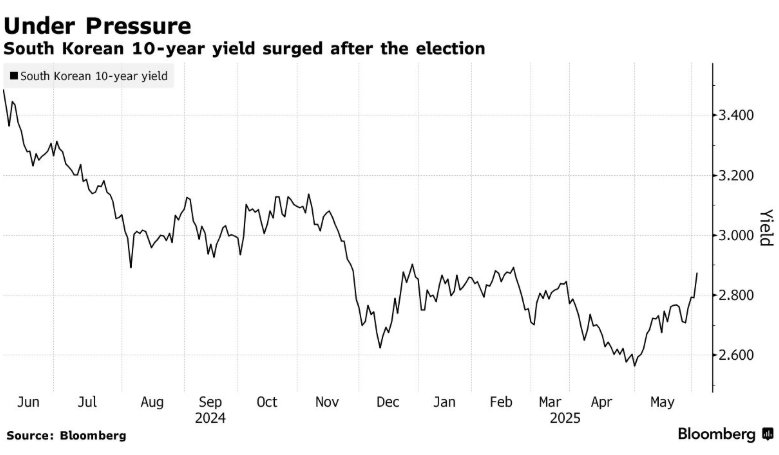
Group 1 - The new left-leaning president of South Korea, Lee Jae-myung, is expected to initiate a fiscal expansion era accompanied by rising government debt, leading to increased challenges for South Korean bonds [1][3] - The yield on 10-year South Korean government bonds surged over 10 basis points to 2.90%, reflecting investor concerns about increased debt supply following Lee's election [1][3] - The Ministry of Finance plans to issue 207.1 trillion KRW (approximately 150.7 billion USD) in government bonds this year, with expectations of additional stimulus measures that could further increase debt issuance [3] Group 2 - Major banks, including Morgan Stanley, predict that the Lee administration will introduce a second round of stimulus worth at least 35 trillion KRW, while ING forecasts it could be between 40 trillion and 45 trillion KRW [3] - Analysts suggest that if the second supplementary budget is around 30 trillion KRW, it could lead to an additional 25 trillion KRW in government bond issuance for the year [3] - The South Korean stock market has entered a "technical bull market," driven by expectations of accelerated economic expansion under Lee's government [3][4] Group 3 - Lee Jae-myung has set a target for the KOSPI index at 5000 points, indicating a strong focus on enhancing the valuation of South Korean stocks and addressing the "Korea discount" phenomenon [4] - The KOSPI index closed around 2770 points, reflecting market optimism regarding potential policy-driven growth in the stock market [4]
富时罗素推迟将韩债纳入富时世界国债指数
news flash· 2025-04-08 23:55
Group 1 - FTSE Russell has postponed the inclusion of South Korean bonds in the FTSE World Government Bond Index (WGBI) from November 2025 to April 2026 [1] - The inclusion of South Korean government bonds will occur gradually over a period of eight months, completing in November 2026 [1] - This decision was made based on feedback from stakeholders related to the index [1]