智能化融合

Search documents
康斯特:公司一直在积极进行研产销体系的数字化、自动化、智能化融合
Zheng Quan Ri Bao· 2026-02-09 13:37
Core Viewpoint - The company, 康斯特, primarily focuses on calibration testing instruments, which account for 95% of its revenue, and operates under a multi-variety, small-batch production model [2] Group 1: Revenue and Production - The company indicates that the production capacity and order conversion efficiency may fluctuate due to factors such as demand rhythm, supply chain capabilities, integration of new products and processes, and external business environment [2] - The pressure product line, which contributes over 70% to the company's revenue, has sufficient production capacity elasticity [2] Group 2: Digital Transformation - The company has been actively pursuing the integration of digitalization, automation, and intelligence in its research, production, and sales systems [2] - Continuous optimization of supply efficiency and order conversion efficiency for mid-to-high-end products is a key focus for the company [2]


趋势研判!2025年中国数字印刷机行业产业链图谱、发展现状、细分市场、企业布局及未来发展趋势分析:智联喷墨迭代升级,千亿市场加速扩容[图]
Chan Ye Xin Xi Wang· 2025-12-25 01:20
Core Insights - The digital printing machine industry is experiencing significant growth driven by the demand for short runs, variable data, and rapid delivery, aligning with modern printing needs [1][8] - China's printing industry is projected to exceed 1.52 trillion yuan in total output value by 2024, with digital transformation becoming an essential trend under the "Three-Year Action Plan for Digitalization in the Printing Industry (2025-2027)" [1][8] - Integrated digital printing machines are gaining popularity, with production and demand expected to reach 9,434 units and 11,349 units respectively in 2024, indicating synchronized growth on both supply and demand sides [1][8] Digital Printing Machine Overview - Digital printing machines operate without traditional printing plates, directly transferring digital images to substrates, characterized by "digital input - digital output" [2][3] - They offer advantages such as eliminating the plate-making process, flexibility in handling personalized orders, and suitability for small batch and multi-batch printing [2][3] Industry Chain Analysis - The upstream of the digital printing machine industry includes raw material supply, core component manufacturing, and technological support, with a focus on domestic production of key materials like eco-friendly inks and high-precision print heads [5][6] - The midstream consists of equipment manufacturers driving product innovation, while the downstream benefits from stable demand in traditional sectors and rapid growth in personalized and smart label markets [6][8] Current Industry Status - The printing industry is a vital part of the modern economy, with a steady increase in total output value, projected to surpass 1.52 trillion yuan in 2024 [8] - Digital printing addresses traditional printing challenges by enabling cost-effective, efficient solutions for small batch orders, facilitating a shift towards flexible and customized production [8][9] Market Growth and Projections - The digital inkjet printing market is expected to grow from 110.43 billion yuan in 2020 to 177.38 billion yuan by 2024, with a compound annual growth rate of 12.6% [9] - The market is projected to reach 205.77 billion yuan by 2025, indicating sustained growth potential [9] Competitive Landscape - The industry is characterized by a structure where international giants dominate the high-end market, while domestic companies are accelerating breakthroughs in core technologies [10][11] - Key players like HanHong Group and Peking University Founder Electronics are focusing on integrated solutions to enhance market share in specific sectors [10][11] Future Development Trends - The industry is expected to evolve towards core technology independence, with domestic companies increasing investment in key components to enhance supply chain control [11][12] - There will be a deepening integration of smart technologies, leading to a shift from single equipment sales to comprehensive service models [13] - Environmental sustainability will become a crucial focus, with the adoption of eco-friendly technologies and an expansion of application scenarios into various industrial fields [14]


解锁人居新体验:2026TATA木门美好人居创新大会即将开启
Sou Hu Wang· 2025-12-16 03:10
Core Insights - TATA Wood Door continues its 14-year tradition of the "Winter Solstice Appointment," showcasing its commitment to innovation and user-centric design in the home furnishing industry [1][3][10] Group 1: User-Centric Innovation - The "Winter Solstice Appointment" has become a unique industry IP by focusing on user needs and maintaining its core essence since 2012, when TATA Wood Door first emphasized "design changes life" [3][6] - TATA Wood Door has consistently introduced innovative products, such as the "Super Silent Three Components" in 2017 and the proactive noise-reducing door in 2021, addressing real-life pain points for users [3][5] Group 2: Technological Advancements - TATA Wood Door has accumulated over 190 patents in 26 years, focusing on core technologies like the 45° slanted soft magnetic suction technology and professional noise reduction solutions [6][8] - The company is evolving from merely creating good doors to building a beautiful home, adapting to changing user expectations for functional and aesthetic enhancements [6][8] Group 3: Industry Trends and Responses - The upcoming innovation conference will explore three core trends: smart integration, breakthroughs in new materials, and a comprehensive soundproofing approach that addresses various living scenarios [8][9] - TATA Wood Door's initiatives align with national policies aimed at creating safe, comfortable, green, and smart housing, responding to the demand for quality upgrades in the home furnishing sector [9][10] Group 4: Social Responsibility - The brand emphasizes its responsibility to enhance living conditions for families, offering renovation solutions for existing homes and affordable products for first-time buyers, while also considering special needs for the elderly and children [9][10] - TATA Wood Door's practices exemplify a deep integration of policy guidance, industry responsibility, and public needs, setting a benchmark for high-quality development in the industry [9][10]

结构性复苏下出海突围 新能源商用车鏖战“下半场”
Zhong Guo Jing Ying Bao· 2025-11-17 02:38
Core Insights - The commercial vehicle industry is facing three major challenges: intensified competition, technological iteration, and trade barriers, while also presenting four significant opportunities: transition to new energy, overseas expansion, integration of intelligence, and extension of the value chain [1] Industry Overview - In the first ten months of 2025, commercial vehicle production and sales reached 3.456 million and 3.479 million units, respectively, representing year-on-year growth of 10.9% and 9% [1] - The sales of natural gas commercial vehicles reached 207,000 units, with a year-on-year increase of 8.6% [1] - Exports have become a strong driving force for the commercial vehicle industry, with 843,000 units exported in the first ten months, marking a year-on-year growth of 11.6% [1][7] - The industry has emerged from a prolonged adjustment period, indicating a stabilization and recovery phase [2] Company Performance - Weichai Power reported a revenue of 170.57 billion yuan in the first three quarters of 2025, a year-on-year increase of 5.3%, with a net profit of 8.88 billion yuan, up 5.7% [2][3] - The company achieved a quarterly revenue of 57.42 billion yuan in Q3 2025, reflecting a year-on-year growth of 16.1% [2] - Other companies like China National Heavy Duty Truck Group and Foton Motor also reported significant revenue growth, with increases of 20.6% and 27.09%, respectively [3] New Energy Transition - The new energy wave is reshaping the commercial vehicle industry, with new energy vehicles becoming a core engine for recovery and market growth [4] - In the first ten months of 2025, the domestic sales of new energy commercial vehicles accounted for 24.6% of total commercial vehicle sales [5] - Weichai Power's new energy power system business achieved a revenue of 1.97 billion yuan, growing by 84% year-on-year [3][5] Global Expansion - The export of commercial vehicles is increasingly viewed as a new growth engine, with a focus on international markets [7][8] - Companies are enhancing their global strategies, with Weichai Power and Chery Commercial Vehicle emphasizing localized service systems and partnerships in overseas markets [8][9] - The commercial vehicle industry is leveraging its technological advantages in the three-electric system and intelligent networking to meet global green transition demands [7]

海门建成首个光储充一体化充电站
Yang Zi Wan Bao Wang· 2025-11-13 09:22
Group 1 - The project marks the successful delivery of the first integrated solar-storage charging station in Haimen, which is now in trial operation [1][3] - The charging station covers an area of approximately 6,600 square meters and integrates photovoltaic power generation, energy storage batteries, and charging equipment, functioning as a comprehensive energy station [3] - The project team effectively managed a tight construction schedule by adjusting procurement processes and utilizing a fixed-price model, ensuring timely project completion while controlling costs [3][5] Group 2 - The project is considered a significant breakthrough in the construction of smart new energy parking systems, with plans to enhance technological accumulation in the integration of new energy and intelligence [5] - The successful experience from this project will serve as a foundation for expanding business boundaries and contributing to the development of efficient, intelligent, and green urban infrastructure [5]


2025年中国电子雷管行业发展历程、政策、产销量、重点企业及发展趋势研判:政策利好行业发展,上半年电子雷管产量为2.91亿发[图]
Chan Ye Xin Xi Wang· 2025-10-17 01:16
Core Insights - The electronic detonator industry in China has experienced explosive growth driven by policy mandates and technological advancements, with production increasing from 117 million units in 2020 to 670 million units in 2023, reflecting a compound annual growth rate (CAGR) of 78.91% [1][14] - Despite a projected decline in production and sales in 2024 due to reduced infrastructure demand, the penetration rate of electronic detonators in the industrial detonator market has risen significantly, from 12.24% in 2020 to 94.79% in 2024, indicating a near-complete replacement of traditional detonators [1][14] - The industry is expected to continue evolving, with electronic detonators gradually replacing other types of industrial detonators, leading to a rapid development phase [1][14] Industry Overview - Electronic detonators, also known as digital electronic detonators, utilize an internal electronic control module for precise detonation control and are primarily used in mining, tunneling, and demolition [4][6] - The structure of electronic detonators includes components such as lead wires, rubber plugs, connectors, control modules, explosive heads, and shells [4][6] Industry Development History - The research and development of electronic detonator technology began in the early 1980s, with significant advancements occurring throughout the 1990s, leading to the introduction of various electronic detonator systems globally [7][8] - China began engineering applications of electronic detonators in 2006, with significant growth occurring post-2018 due to accelerated promotion by the government [8] Industry Policies - The Chinese government has implemented multiple policies to promote the replacement of traditional detonators with electronic detonators, aiming to enhance safety management in the blasting industry [8][9] Industry Value Chain - The electronic detonator industry value chain consists of upstream raw materials (e.g., polyethylene, copper/aluminum, explosives), midstream production, and downstream applications in mining, geological exploration, tunneling, and construction demolition [10][11] Current Market Status - The industrial detonator market in China has seen a decline in production and sales due to structural adjustments and technological upgrades, with electronic detonators increasingly replacing traditional types [12][14] - In the first half of 2025, electronic detonators accounted for approximately 93.99% of total industrial detonator production [13] Key Companies - Major players in the electronic detonator industry include Yahua Group, Poly United, and Yunnan Minexplosion, with the top five companies holding about 50% of the market share [17] - Yahua Group reported a revenue of 1.465 billion yuan in the civil explosives sector in the first half of 2025, reflecting a year-on-year growth of 3.68% [18] Future Trends - The electronic detonator industry is moving towards smart integration, environmental upgrades, and wireless technology, enhancing operational efficiency and safety [19][20][21]







研判2025!中国轮滑鞋行业产业链、发展现状、竞争格局及发展趋势分析:在体育热潮的背景下,轮滑鞋行业发展速度加快[图]
Chan Ye Xin Xi Wang· 2025-05-30 01:43
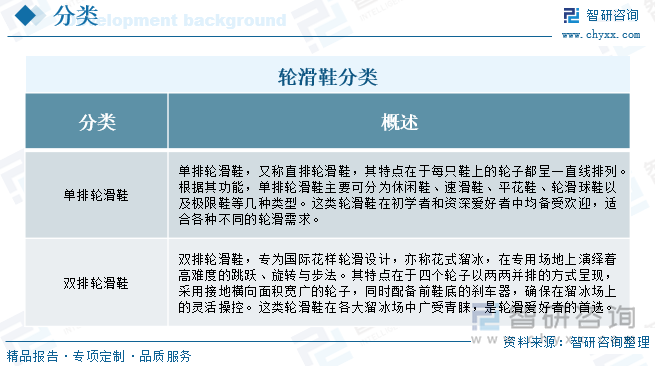
Core Insights - The roller skate industry is experiencing rapid growth due to changing lifestyles and increased interest in recreational sports, particularly among youth and adults [1][12] - The market size of the roller skate industry in China is projected to reach 7.73 billion yuan in 2024, reflecting a year-on-year increase of 5.31% [1][12] - Government support for the sports industry and the rise of e-commerce are contributing to the expansion of the roller skate market [1][12] Industry Overview - Roller skates, also known as inline skates, are categorized into two main types: inline skates and quad skates, each serving different purposes and user preferences [3][4] - Inline skates are popular among both beginners and experienced enthusiasts, while quad skates are primarily designed for artistic skating [3][4] Market Dynamics - The roller skate industry benefits from a favorable environment created by government policies aimed at promoting sports [1][12] - The increasing disposable income of consumers is driving demand for recreational and fitness-related products, including roller skates [8] Competitive Landscape - The market is characterized by a mix of established international brands and numerous domestic brands competing in the mid to low-end segments [16][17] - Key players in the industry include companies like Guangdong Maika Sports Co., Ltd., Guangzhou Montlay Sports Equipment Co., Ltd., and Decathlon (Shanghai) Sports Goods Co., Ltd. [16][17] Supply Chain - The upstream supply chain includes raw material suppliers and component manufacturers, which directly impact the quality and performance of roller skates [10] - The downstream applications of roller skates span recreational use, competitive sports, and professional training [10] Future Trends - The integration of smart technology into roller skates is anticipated, offering features like heart rate monitoring and activity tracking [20] - There is a growing emphasis on sustainability, with companies adopting eco-friendly materials and practices [21][22] - The industry is expected to see further integration of online and offline sales channels, enhancing consumer experience and market reach [23]