
期货合约修订

Search documents
EC合约规则调整解读
Zhong Xin Qi Huo· 2026-03-03 08:00
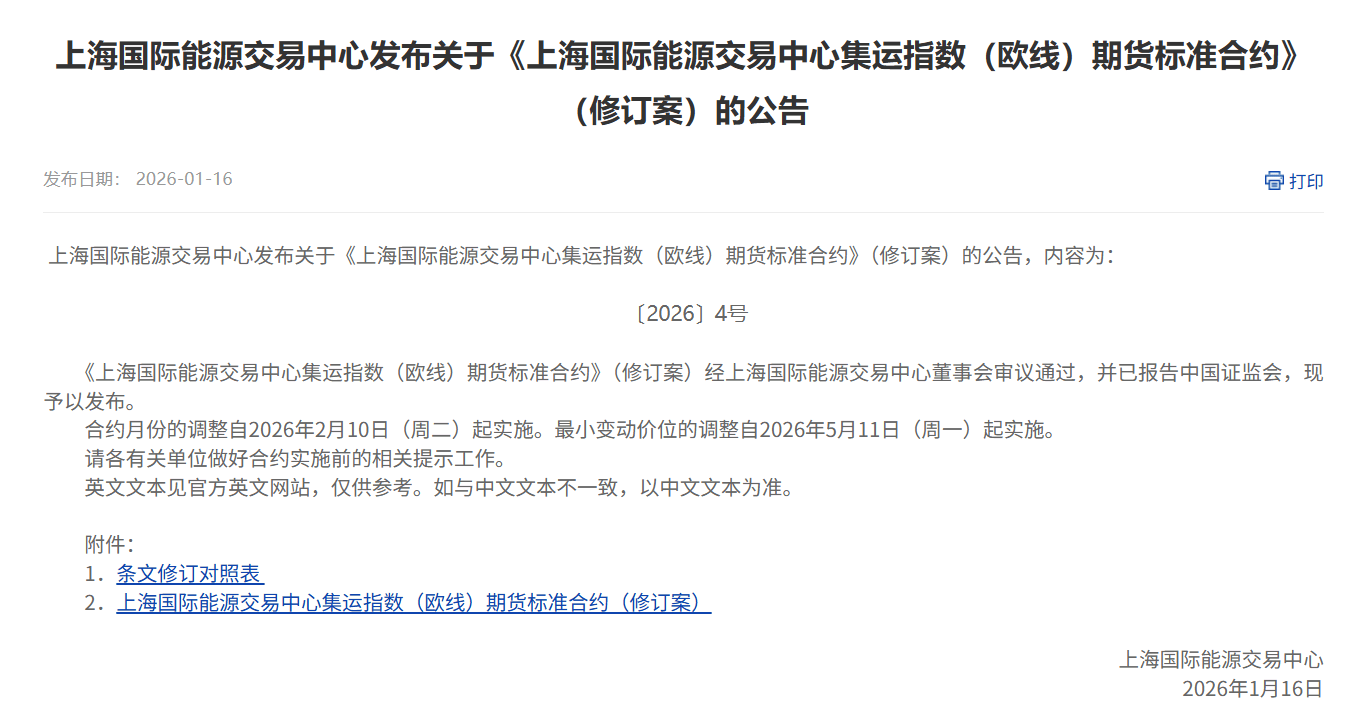
1. Report Industry Investment Rating There is no information about the report industry investment rating in the provided content. 2. Core Viewpoint of the Report The Shanghai International Energy Exchange released a notice on the implementation of the revised Containerized Freight Index (Europe Service) Futures Contract. The main revisions include changes to the contract months and the minimum price fluctuation [2][4]. 3. Summary According to the Table of Contents 3.1 Circular on the Implementation of the Revised Containerized Freight Index (Europe Service) Futures Contract - **Implementation of the Revision to the Listed Contracts**: As of February 10, 2026, EC2605, EC2607, and EC2609 were newly listed. Considering the switch of the most active contract, EC2603 was not listed. EC2703 will be listed on March 31, 2026. New contracts will be listed according to the contract specification in subsequent months [10][18][20]. - **Implementation of the Revision to the Minimum Price Fluctuation**: As of May 11, 2026, the minimum price fluctuation will be revised. The settlement on May 8, 2026, will be executed according to the previous rules, and the settlement prices on May 8 will serve as the previous settlement prices for May 11. On May 11, the real - time market data will be released after adjusting the market data, previous settlement, and closing prices according to the revised provision. The adjusted previous settlement prices will be applied to the daily price limit and margin calculation [11][12][19]. 3.2 Comparison and Interpretation of the Revisions to the Containerized Freight Index (Europe Service) Futures Contract - **Contract Comparison**: The main changes in the contract are the contract months and the minimum price fluctuation. The contract months change from February, April, June, August, October, and December to monthly contracts of the most recent six consecutive months among January, March, April, May, June, July, August, September, October, November, and December, followed by two quarterly contracts. The minimum price fluctuation changes from 0.1 index points to 0.5 index points [13][15][22]. - **Typical Structure of Contract Months**: Each column in the table represents the month. From March to August, the number of listed contracts is 8 because the 07 and 08 contracts are added in March. From September to February, the number of listed contracts is 7 as the 08 contract is delisted with no new contracts added. Quarter - month contracts have a lifecycle of 12 months, while non - quarter - month contracts have a lifecycle of 6 months [17][19][23].
EC标准合约修订,合约增加背景下的运价规律探究
Hua Tai Qi Huo· 2026-02-04 12:08
1. Report Industry Investment Rating No relevant content provided. 2. Core Views of the Report - The Shanghai International Energy Exchange plans to revise the "Shanghai International Energy Exchange Container Shipping Index (European Line) Futures Standard Contract". The contract months will be adjusted from "February, April, June, August, October, December" to "the nearest 1 - 6 consecutive months (excluding February) and the following two quarterly months", and the minimum price change will be adjusted from "0.1 point" to "0.5 point" [1][8]. - Under the new contract rules, it is necessary to explore the seasonal characteristics of monthly prices in more detail to provide guidance for future unilateral and arbitrage operations [1][21]. - The freight rate has strong seasonal patterns, which are highly correlated with the monthly container trade volume between the Far East and Europe, indicating demand - side marginal pricing under certain supply conditions [2][19][32]. 3. Summary by Relevant Catalogs 3.1 Shanghai International Energy Exchange Container Shipping Index (European Line) Futures Standard Contract Revision - **Contract Month Adjustment**: The original contract months were "2, 4, 6, 8, 10, 12 months", and after adjustment, they are "the nearest 1 - 6 consecutive months (excluding February) and the following two quarterly months". The number of listed contracts will increase from 6 to 7 - 8. The adjustment aims to help industrial customers precisely match futures and spot expiration times, improve hedging efficiency, and avoid the inactive February (Spring Festival) market [1][8]. - **Minimum Price Change Adjustment**: The minimum price change will be adjusted from "0.1 point" to "0.5 point" according to the current shipping market quotation [1][8]. - **Implementation Arrangements**: The contract month adjustment will be implemented from February 10, 2026, and the minimum price change adjustment will be implemented from May 11, 2026, with corresponding adjustment arrangements [10][11]. 3.2 Potential Impacts of Contract Month Adjustment - **Enhance the Participability of Industrial Customers in Hedging**: Adding consecutive - month contracts allows industrial customers to better match futures contracts with spot shipping times, reducing basis risk and improving hedging efficiency [14]. - **Improve the Liquidity of Container Shipping Index (European Line) Futures**: The new rules cover consecutive near - months, which helps form a continuous and reasonable price curve for near - month contracts and better reflects short - term spot supply and demand changes [15][16]. - **Avoid Seasonal Liquidity Risks**: Excluding the February contract avoids price distortion or insufficient liquidity during the Spring Festival [17]. - **Increase the Number of Contracts**: The new rules increase the number of contracts to 7 - 8, which can cover medium - and long - term hedging needs and enhance the term - matching function of container shipping index futures [18]. 3.3 Backtracking of Freight Rate Seasonal Patterns - **General Seasonal Patterns**: In normal years, from week 1 to week 15, freight rates are in a seasonal downward phase; from week 15 to week 34, they are in a seasonal upward phase; from week 34 to week 42, they are in a seasonal downward phase; from week 42 to week 53, they are in a seasonal upward phase [19]. - **Reasons for Seasonal Patterns**: Due to the Spring Festival in February, domestic exports and container exports decline. In April, freight rates are usually at a low point. From May to June, demand recovers, and freight rates strengthen. July - September is the peak shipping season, and freight rates rise seasonally. From October to December, due to Western holidays, freight volume remains high, and shipping companies adjust supply to keep freight rates high [20]. - **Analysis of Different Time Periods**: Different time periods (2010 - 2014, 2017 - 2019, 2020 - 2022, 2023 - present) have different monthly average price characteristics, but generally, the annual high point of freight rates often appears in July or August [22][23]. - **Correlation with Trade Volume**: The seasonal pattern of freight rates is highly correlated with the monthly container trade volume between the Far East and Europe, indicating demand - side marginal pricing [2][32].
上期能源修订集运指数(欧线)期货合约 进一步顺应航运产业发展趋势
Sou Hu Cai Jing· 2026-01-16 08:32
Core Viewpoint - The Shanghai International Energy Exchange announced revisions to the minimum tick size and contract month terms for the Container Shipping Index (European Line) futures, aimed at enhancing service to the shipping and foreign trade industries and improving risk management capabilities for market participants [1][2][6]. Summary by Sections Contract Adjustments - The minimum tick size is adjusted to 0.5 points, and the contract months will now include continuous months within the last six months of the year and the following two seasonal months [6][7]. - The implementation dates are set for February 10, 2026, for the contract month adjustments and May 11, 2026, for the minimum tick size changes [6]. Market Response and Functionality - The Container Shipping Index (European Line) futures have maintained active trading and stable operation since their launch, with domestic and foreign freight forwarding companies and foreign trade enterprises actively using futures for hedging [6][7]. - The revisions are based on feedback from various stakeholders, including index compilers, shipping industry chain enterprises, futures company members, and individual traders, to better meet the needs of industry clients [6][7]. Benefits of the Revisions - The change from bi-monthly to continuous month contracts is expected to narrow basis fluctuations, thereby reducing risks in industry spot and futures trading [7]. - The removal of the February contract reflects seasonal characteristics of the industry while adding nearly six months of continuous contracts to enhance overall market matching [7][8]. - The adjustments are anticipated to improve contract quoting efficiency and market participation depth, attracting a broader range of international participants and enhancing the price discovery function [8]. Future Directions - The Shanghai International Energy Exchange plans to continue optimizing contract rules to better meet market participant needs and promote effective functioning of the futures market, supporting high-quality development in the shipping industry [8].

上期能源发布关于集运指数(欧线)期货合约修订实施有关事项的通知
Di Yi Cai Jing· 2026-01-16 08:04
Group 1 - The Shanghai International Energy Exchange has announced revisions to the Shanghai International Energy Exchange Container Index (European Line) futures contract, effective from February 10, 2026 [1] - The contract months will include EC2605, EC2607, and EC2609, while EC2603 will not be added due to the transition of the main contract [1] - The minimum price fluctuation will be adjusted starting May 11, 2026, with specific rules for price adjustments based on the last digit of the contract price [2] Group 2 - The previous settlement price on May 8, 2026, will be used as the front settlement price for May 11, 2026 [2] - Adjusted prices will be applied to limit price movements and margin calculations, with updates reflected in trading systems and market information [2]
航运月报:MSC以及马士基1月下半月线上涨价,02合约估值不断抬升-20260104
Hua Tai Qi Huo· 2026-01-04 11:52
Report Industry Investment Rating No relevant information provided. Core Viewpoints - The online quotes of shipping lines such as MSC and Maersk increased in the second half of January, causing the valuation of the 02 contract to rise continuously [1][4][5]. - The Shanghai International Energy Exchange plans to revise the "Shanghai International Energy Exchange Container Shipping Index (European Line) Futures Standard Contract," including adjusting the contract months and the minimum price change [4]. - The far - month contracts are under pressure from the resumption of the Suez Canal, and their valuations may be revised downward, but there is still uncertainty in the adjustment space. Contracts in June and August, which are relatively peak seasons, still face uncertainty [6]. - The 02 contract is expected to fluctuate strongly in the unilateral strategy, and there is no recommendation for the arbitrage strategy [8]. Summary by Directory 1. Futures Price - As of January 4, 2026, the total open interest of all contracts of the container shipping index European line futures was 54,478 lots, and the single - day trading volume was 26,823 lots. The closing prices of EC2602, EC2604, EC2606, EC2608, EC2610, and EC2512 contracts were 1801.30, 1166.00, 1367.90, 1500.00, 1060.00, and 1297.00 respectively [7]. 2. Spot Price - Shipping lines' online quotes for the Shanghai - Rotterdam route changed in January. For example, Maersk's quote in the second week of January was 1600/2580, and in the third week it was 1625/2610; HPL's quote in the first half of January was 1835/3035, and in the second half it was 2135/3535. MSC's price in the first half of January was 1700/2840, and in the second half it was 1880/3140 [1]. - The SCFI (Shanghai - Europe route) price announced on December 26 was 1690 dollars/TEU, the SCFI (Shanghai - US West route) price was 2188 dollars/FEU, and the SCFI (Shanghai - US East) price was 3033 dollars/FEU. The SCFIS (Shanghai - Europe) on December 29 was 1742.64 points, and the SCFIS (Shanghai - US West) was 1301.41 points [7]. 3. Container Ship Capacity Supply Static Supply - As of December 31, 2025, 268 container ships with a total capacity of 2.155 million TEU were delivered in 2025. Among them, 80 ships with a capacity of 12,000 - 16,999 TEU were delivered, with a total capacity of 1.213 million TEU; 13 ships with a capacity of over 17,000 TEU were delivered, with a total capacity of 277,672 TEU [2]. - For ships with a capacity of 12,000 - 16,999 TEU, the expected delivery in 2026 is 781,200 TEU (53 ships), 944,500 TEU (64 ships) in 2027, 1.212 million TEU (82 ships) in 2028, and 415,400 TEU (29 ships) in 2029. For ships with a capacity of over 17,000 TEU, the expected delivery in 2026 is 210,400 TEU (9 ships), 862,800 TEU (40 ships) in 2027, 1.5734 million TEU (78 ships) in 2028, and 1.3755 million TEU (67 ships) in 2029 [2]. Dynamic Supply - The average weekly capacity in January was 318,600 TEU, with capacities of 355,600, 309,400, 330,700, and 278,700 TEU in Weeks 2, 3, 4, and 5 respectively. In February, the average weekly capacity was 283,500 TEU, and in March it was 272,400 TEU [3]. - There were 3 blank sailings (2 by the OA Alliance and 1 by the PA Alliance) and 1 TBN (1 by the OA Alliance) in January, 7 TBNs (4 by the OA Alliance and 3 by the MSC/PA Alliance) and 4 blank sailings in February, and 3 blank sailings and 7 TBNs in March [3]. 4. Supply Chain - The cease - fire mediation plan in Gaza is progressing, and the probability of the Suez Canal resuming operation in 2026 is relatively high. Currently, CMA's FAL1 route (Europe - Asia) has fully resumed operation since January 2026, and the FAL3 route has started a single - trial operation. Maersk's container ship "Maersk Sebarok" completed its first Red Sea voyage since its withdrawal in January 2024 on December 19, 2025 [6]. 5. Demand and European Economy No relevant detailed analysis content provided in the text.
上期能源拟修订集运指数(欧线)期货合约
Qi Huo Ri Bao Wang· 2025-12-21 16:42
Core Viewpoint - The Shanghai International Energy Exchange plans to revise the shipping index futures contract to better meet the needs of industrial clients and enhance service quality in shipping and foreign trade [1] Group 1: Contract Adjustments - The contract months will be adjusted from "February, April, June, August, October, December" to "the most recent 1-6 months as consecutive months (excluding February), and the following two seasonal months" [1] - The number of listed contracts will increase from 6 to 7-8, allowing for better alignment of futures and spot contract expiration dates for industrial clients [1] Group 2: Minimum Price Fluctuation - The minimum price fluctuation will be changed from "0.1 points" to "0.5 points" based on the current shipping market quotation situation [1]
上海国际能源交易中心拟修订集运指数(欧线)期货标准合约
Zheng Quan Shi Bao Wang· 2025-12-19 10:59
Group 1 - The Shanghai International Energy Exchange plans to revise the Shanghai International Energy Exchange Shipping Index (European Line) futures standard contract and is seeking public feedback [1] - The contract months will be adjusted from "February, April, June, August, October, December" to "the most recent 1-6 months as consecutive months (excluding February), and the following two seasonal months" [1] - The number of listed contracts will increase from 6 to 7-8, allowing for better alignment of futures and spot expiration dates for industry clients and improving hedging efficiency [1] Group 2 - The minimum price fluctuation will be changed from "0.1 points" to "0.5 points" based on current shipping market pricing conditions [1]
上期能源拟修订20号胶期货标准合约
Qi Huo Ri Bao Wang· 2025-11-25 06:11
Core Viewpoint - The Shanghai International Energy Exchange plans to revise the 20th rubber futures contract and delivery rules to enhance the global resource allocation capability and better serve the real economy [1] Group 1: Contract Revisions - The exchange intends to add alternative products for the 20th rubber futures, which can be used for physical delivery [1] - The revision will include an update to the contract's annex, establishing quality standards for the alternative products in addition to the existing "standard product" quality standards [1] Group 2: Delivery Rules Updates - The delivery rules will be amended to include references to both "standard products" and "alternative products" in Chapter 13 [1] - Updates will also be made regarding the thickness of rubber film to better align with changes in national standards [1]