期货市场活跃度

Search documents
期货市场大爆发!成交、资金与利润齐升,多项数据破纪录
证券时报· 2026-03-31 08:54
Core Viewpoint - The Chinese futures market has shown remarkable performance in early 2026, with significant increases in trading volume, market funds, and industry profits, driven by a combination of external geopolitical tensions and domestic growth policies [1][5]. Group 1: Industry Performance - In the first two months of 2026, the total net profit of futures companies reached 27.55 billion yuan, doubling from 10.62 billion yuan in the same period last year, marking a 159% year-on-year increase [3][6]. - The total revenue for February was 31.71 billion yuan, with a net profit of 9.80 billion yuan, despite a seasonal decline due to the Spring Festival [3][4]. - The trading volume in February reached 55.54 trillion yuan, with a total of 5.28 billion contracts traded, indicating sustained high activity levels [3]. Group 2: Market Scale and Client Growth - As of late March 2026, the total market funds surged to 2.67 trillion yuan, a 24.19% increase from the end of the previous year, setting a new historical high [6][7]. - Cumulative trading volume and value reached 22.68 billion contracts and 226.17 trillion yuan, respectively, reflecting year-on-year increases of 40.43% and 59.23% [6]. - The number of effective clients surpassed 3 million, representing an 8.52% increase from the end of the previous year, indicating a growing participation in the futures market [7]. Group 3: Factors Driving Growth - The increase in profits and market activity is attributed to several factors, including heightened risk management needs due to geopolitical conflicts and commodity price volatility, which have driven enterprises to engage in hedging [7][8]. - Domestic economic stability and enhanced risk management awareness among businesses have contributed to the influx of new clients and capital into the market [7][8]. - The active trading environment has led to a significant rise in transaction volumes, which in turn has boosted the revenues of futures companies [8]. Group 4: Market Resilience and Future Outlook - Despite increased price volatility due to geopolitical tensions, the Chinese futures market has demonstrated strong resilience, with stable positions and a balanced trading structure among different types of investors [10][11]. - The market is expected to maintain high activity levels due to ongoing uncertainties in the global economy and commodity price fluctuations, although long-term growth will require futures companies to enhance their risk management and service capabilities [11].


期货市场大爆发!成交、资金与利润齐升,多项数据破纪录
券商中国· 2026-03-31 05:38
Core Viewpoint - The Chinese futures market has shown remarkable performance in early 2026, with significant increases in trading volume, market funds, and industry profits, driven by a combination of external geopolitical tensions and domestic growth policies [1][4]. Group 1: Industry Performance - The total funds in the futures market reached a historical high of 2.67 trillion yuan, a 24.19% increase from the end of the previous year [4]. - The net profit for the first two months of 2026 was 27.55 billion yuan, doubling from 10.62 billion yuan in the same period last year, reflecting a 159% year-on-year growth [3][4]. - In February alone, the trading volume reached 55.54 trillion yuan, with a total of 5.28 billion contracts traded, indicating sustained high activity levels [3]. Group 2: Market Dynamics - The number of effective clients in the futures market surpassed 3 million, marking an 8.52% increase from the end of the previous year, indicating growing participation from both individual and institutional investors [5][6]. - The market's daily trading volume peaked at over 72 million contracts, showcasing a significant increase in trading activity [5]. - The overall trading volume and value increased by 40.43% and 59.23% year-on-year, respectively, highlighting strong growth momentum [4][6]. Group 3: Factors Driving Growth - Increased demand for risk management from enterprises due to external geopolitical conflicts and commodity price volatility has driven up margin requirements [6]. - The domestic economy's stability and enhanced risk management awareness among businesses have contributed to the influx of new funds into the market [6]. - The diversification of futures products and the growing importance of commodity assets for inflation hedging have attracted more institutional investments, further boosting market liquidity [6]. Group 4: Market Resilience - Despite significant price fluctuations in global commodities, the Chinese futures market has demonstrated strong resilience, with stable positions and a balanced trading structure [7]. - The total open interest remained stable at approximately 39.98 million contracts, indicating no significant abnormal volatility [7]. - The demand for hedging among industrial clients has increased, reflecting a growing reliance on futures for risk management [7]. Group 5: Future Outlook - Industry experts suggest that relying solely on trading volume growth is insufficient for sustainable high-quality development; futures companies need to enhance risk management services and international operations [8].
前10个月全国期货市场累计成交额达608.84万亿元 金榜题名!黄金期货成交占比11.71%
Shen Zhen Shang Bao· 2025-11-13 23:17
Group 1 - The Chinese futures market has maintained high activity levels in 2023, with a cumulative trading volume of 7.347 billion contracts and a trading value of 60.884 trillion yuan in the first ten months, representing year-on-year increases of 14.86% and 21.82% respectively [1] - As of the end of October, the total open interest in the national futures market increased by 12.01% compared to the previous month [1] - In October, the trading volume was 603 million contracts, with a trading value of 6.122 trillion yuan, showing a year-on-year decline in volume of 13.26% but an increase in value of 4.54% [1] Group 2 - The China Financial Futures Exchange (CFFEX) accounted for a significant portion of the trading volume in October, with financial futures and options trading value reaching 20.51 trillion yuan, making up 33.5% of the total market [1] - The most actively traded futures in October included gold, silver, and copper on the Shanghai Futures Exchange, glass and soda ash on the Zhengzhou Commodity Exchange, and coking coal and palm oil on the Dalian Commodity Exchange [1] - Year-to-date, gold futures and the CSI 1000 index futures have been the most active products, with gold futures trading volume reaching 91.84 million contracts, a year-on-year increase of 58.24% [2] Group 3 - International gold prices have surged, surpassing $3,000 and $4,000 per ounce, with an increase of over 50%, potentially making 2025 the year with the highest price increase since 1979 [2] - The CSI 1000 index futures have also seen significant activity, with a cumulative trading volume of 48.63 million contracts and a trading value of 6.21 trillion yuan, reflecting year-on-year increases of 34.75% and 68% respectively [2] - The A-share market has shown increased activity in small and mid-cap stocks, which has positively influenced the trading of CSI 1000 index futures [2] Group 4 - In the third quarter, the A-share market experienced increased volatility, leading institutions to use index futures for hedging systemic risks, with a combined daily trading volume of over 200 billion yuan for the three main contracts: CSI 300, CSI 500, and CSI 1000 [3]
前三季度期市成交额同比增长24.11%
Zheng Quan Ri Bao· 2025-10-14 15:43
Core Insights - The Chinese futures market showed active trading in the first three quarters of the year, driven by increased demand from real enterprises and improved market service efficiency, particularly in macro-sensitive commodities [1][2] - In September, the national futures market recorded a trading volume of 770 million contracts and a trading value of 71.5 trillion yuan, with a year-on-year decrease in volume but an increase in value [1] - The cumulative trading volume for the first three quarters reached 6.744 billion contracts, with a trading value of nearly 55 trillion yuan, reflecting year-on-year growth in both volume and value [1] Market Dynamics - Analysts attribute the active trading in the futures market to three main drivers: increased volatility in international macroeconomic conditions, a higher proportion of institutional investors, and an increasingly comprehensive futures product system [2] - The volatility in commodity prices has heightened risk management needs among real enterprises, while the diversification of trading strategies by institutional investors has improved the market's service quality to the real economy [2] Commodity Focus - Precious metals, particularly silver, have gained attention due to their performance exceeding that of gold, attracting speculative funds amid rising global risk aversion [2] - Industrial silicon, a key raw material in the photovoltaic industry, has become increasingly favored by investors, especially in the context of global energy transition and China's dominant position in the solar industry [2]
中国期货市场7月成交额71.31万亿元,同比增长36.03%创历史新高!
Sou Hu Cai Jing· 2025-08-06 06:26
Core Insights - The latest statistics from the China Futures Association indicate that the national futures market achieved a record high in July, with a trading volume of 1.059 billion contracts and a turnover of 71.31 trillion yuan, representing year-on-year increases of 48.89% and 36.03% respectively [1] - Cumulative trading volume from January to July reached 5.135 billion contracts, with a turnover of 411.04 trillion yuan, showing year-on-year growth of 23.11% and 23.09% [1] - The significant increase in futures market activity provides strong support for financial market stability and the development of the real economy [1] Exchange Performance - All major futures exchanges showed varying degrees of growth in July, with the Shanghai Futures Exchange reporting a trading volume and turnover increase of 13.23% and 2.19% year-on-year [3] - The Zhengzhou Commodity Exchange exhibited remarkable performance, with trading volume and turnover increasing by 58.46% and 23.26% year-on-year [3] - The Guangzhou Futures Exchange experienced the most significant growth, with trading volume and turnover surging by 513.26% and 597.73% year-on-year, indicating a rapid acceptance of emerging futures products [3] - By the end of July, the total open interest in the national futures market increased by 3.98% compared to the previous month, reflecting growing confidence among market participants [3] Diverse Product System - The major products traded at various commodity futures exchanges exhibit distinct characteristics, with gold, silver, and crude oil futures leading at the Shanghai Futures Exchange [4] - The Zhengzhou Commodity Exchange's top products include soda ash, glass, and caustic soda futures, while the Dalian Commodity Exchange focuses on coking coal, palm oil, and soybean meal futures [4] - The Guangzhou Futures Exchange highlights industrial silicon, polysilicon, and lithium carbonate futures as prominent products [4] - The China Financial Futures Exchange's top three products by turnover are the CSI 1000 index futures, 30-year treasury futures, and CSI 300 index futures, providing essential risk management tools for diverse investors [4] - The continuous expansion of the futures market not only reflects effective market functionality but also provides solid support for the stable operation of the real economy [4]

7月全国期货市场成交量同比增长48.89%
Yang Shi Xin Wen Ke Hu Duan· 2025-08-05 08:28
Core Viewpoint - The Chinese futures market has shown significant growth in trading volume and value, reflecting a shift towards high-quality development in various sectors, particularly in response to government policies aimed at stabilizing economic growth [1] Group 1: Market Performance - In July, the national futures market recorded a trading volume of 1.059 billion contracts, a year-on-year increase of 48.89% [1] - The trading value for July reached 71.31 trillion yuan, marking a year-on-year growth of 36.03% [1] - From January to July, the cumulative trading volume was 5.135 billion contracts, with a cumulative trading value of 411.04 trillion yuan, both showing year-on-year increases of 23.11% and 23.09% respectively [1] Group 2: Commodity Trends - Traditional commodities such as gold, crude oil, rebar, soda ash, and glass have seen active trading, indicating ongoing market interest in safe-haven assets [1] - There is a noticeable increase in trading volume for new energy materials like polysilicon, lithium carbonate, and industrial silicon, suggesting a transition in the photovoltaic and lithium battery industries towards high-quality development driven by technological advancement and efficiency [1] Group 3: Financial Instruments - The trading volume for CSI 1000 index futures and 30-year government bond futures ranked high, indicating a growing preference among investors for small and mid-cap growth stocks [1] - The data reflects heightened market attention to long-term interest rate trends [1] Group 4: Overall Market Sentiment - The increased activity in the futures market signifies a deepening structural transformation of the real economy and highlights the capital market's enhanced ability to support national strategies and macroeconomic stability [1]
行业稳健增长背后冷热不均 期货公司积极寻求突围之道
Zhong Guo Zheng Quan Bao· 2025-08-01 23:41
Core Insights - The futures industry is experiencing steady growth, but internal differentiation is becoming more pronounced, with leading firms gaining advantages while smaller firms face increasing pressure [1][9] - Zhongcai Futures has emerged as a standout performer, achieving significant profit growth and providing a new model for the industry [1][6] Industry Performance - In the first half of 2025, over 150 futures companies reported a total net profit of 5.074 billion yuan, a year-on-year increase of 32%, and total revenue of 18.676 billion yuan, up 3.89% [1] - The trading volume and value in the national futures market increased significantly, with a total trading volume of 4.076 billion contracts and a trading value of 33.973 trillion yuan, representing year-on-year growth of 17.82% and 20.68%, respectively [2] Factors Driving Growth - Positive external factors, such as the introduction of new energy-related products and diversified financial derivatives, have attracted additional capital into the futures market [2] - The shift from traditional revenue models to a combination of channel income, investment, and futures income has been crucial for profit growth [3][4] Zhongcai Futures' Success - Zhongcai Futures reported a net profit of 690 million yuan, a staggering increase of 376%, and revenue of 980 million yuan, up 303% in the first half of 2025 [6] - The company's strong performance is attributed to its robust research capabilities, effective team collaboration, and a stable client resource ecosystem [7][8] Industry Trends - The futures industry is undergoing a strategic transformation from traditional brokerage services to diversified, high-value financial services [3][4] - Leading firms are expected to continue benefiting from their capital strength, brand advantages, and advanced research capabilities, while smaller firms must find differentiation to survive [9][13] Future Outlook - The internationalization of the futures industry is expected to accelerate, creating broader development opportunities while raising the bar for operational capabilities [10][11] - Companies are encouraged to leverage technology, enhance service capabilities, and focus on core competencies to achieve sustainable growth [12][13]
活跃度提升 期货市场4月成交额破70万亿元
Sou Hu Cai Jing· 2025-05-14 19:06
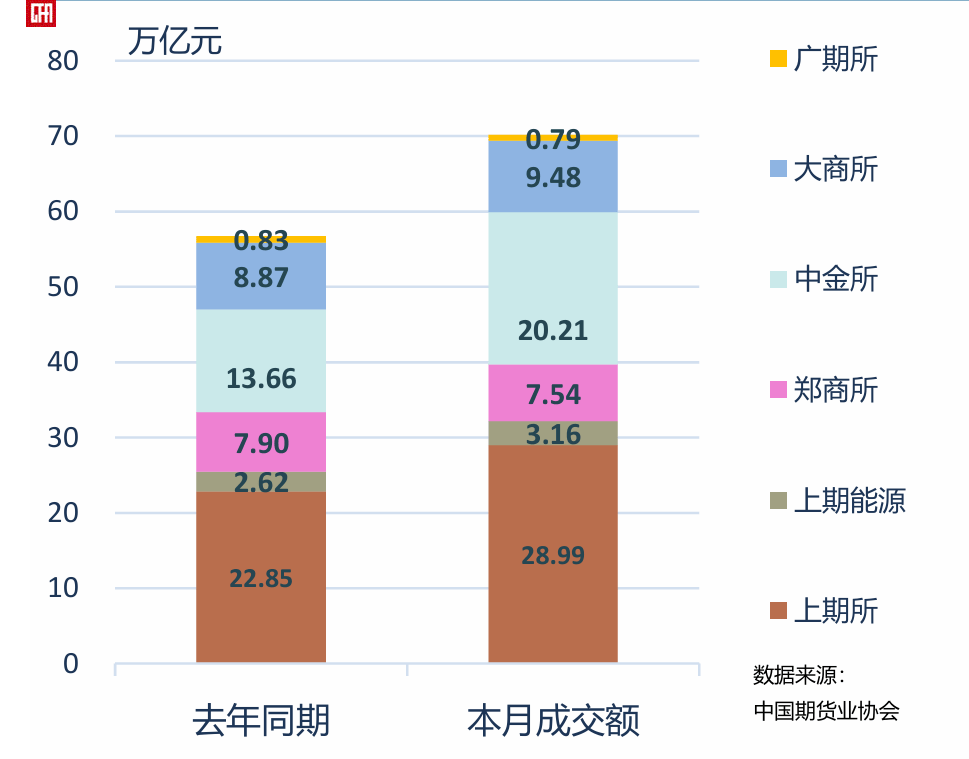
Core Insights - The April futures market data shows a positive trend with significant year-on-year growth in both trading volume and trading value, indicating increased market activity and attractiveness [1][3] Trading Volume and Value - In April, the national futures market recorded a trading volume of 8.09 billion contracts and a trading value of 70.18 trillion yuan, representing year-on-year increases of 21.49% and 23.69% respectively [1] - From January to April, the cumulative trading volume reached 26.58 billion contracts and a cumulative trading value of 232.20 trillion yuan, with year-on-year growth of 22.19% and 28.36% [1] Exchange Performance - The Shanghai Futures Exchange had a monthly trading value of 28.99 trillion yuan, accounting for 41.31% of the national market, with a year-on-year increase of 26.88% [1] - The Dalian Commodity Exchange reported a monthly trading value of 9.48 trillion yuan, representing a year-on-year increase of 6.93% [1] - The Zhengzhou Commodity Exchange's monthly trading value was 7.54 trillion yuan, showing a year-on-year decline of 4.51% [1] Commodity Insights - The top traded commodities included gold, silver, and copper on the Shanghai Futures Exchange, and various agricultural products on the Zhengzhou and Dalian exchanges [3] - The trading volume of precious metals increased significantly, with gold and silver futures rising by 101.36% and 36.66% respectively, driven by heightened demand during economic uncertainty [5] Market Dynamics - Increased trading volume and value suggest a growing participation of funds and investors in the futures market, reflecting its rising importance in economic development [3] - Factors contributing to this trend include improvements in the macroeconomic environment, changes in investor risk appetite, and greater awareness of futures instruments [3]