本土化适配

Search documents
销量持续下滑,捷豹路虎中国区换帅
Guo Ji Jin Rong Bao· 2026-02-26 13:52
Core Viewpoint - Jaguar Land Rover China has announced a personnel adjustment amid ongoing market decline, with former China President and CEO Pan Qing taking on a global procurement role while retaining his position in China, and Tim Howard being appointed as the new CEO for the China region [1][3]. Group 1: Personnel Changes - Pan Qing has been appointed as the global procurement director while continuing as the president of Jaguar Land Rover China, overseeing government affairs and strategic partnerships [1]. - Tim Howard, the new CEO for Jaguar Land Rover China, has a background in finance and has been with the company since 2010, previously serving as CFO for the Greater China region [1][2]. Group 2: Market Performance - Jaguar Land Rover's sales in China have significantly declined from a peak of 146,000 units in 2017, which accounted for nearly a quarter of global sales, to 106,400 units in 2023, marking a drop of 17.4% year-on-year [3]. - The company is projected to see further declines, with estimated retail sales of 14,200 units for the Jaguar brand and 12,300 units for the Land Rover brand in 2025, a decrease of over 20% compared to 2024 [3]. Group 3: Financial Impact - The company's financial performance has deteriorated, with a reported revenue of £4.5 billion in the third quarter, down 39% year-on-year, and a year-to-date revenue of £16 billion, down 24% [6]. - The company has experienced a shift from profit to loss, with a pre-tax loss of £310 million in the third quarter and a total loss of £444 million year-to-date, compared to profits in the same periods the previous year [6]. Group 4: Strategic Challenges - The decline in the Chinese market is attributed to several core issues, including a lag in electric vehicle transition and insufficient localization [5]. - Jaguar Land Rover's product lineup remains heavily reliant on fuel vehicles, with a slower rollout of electric models compared to competitors, and pricing strategies have not adapted to the competitive landscape in China [5].
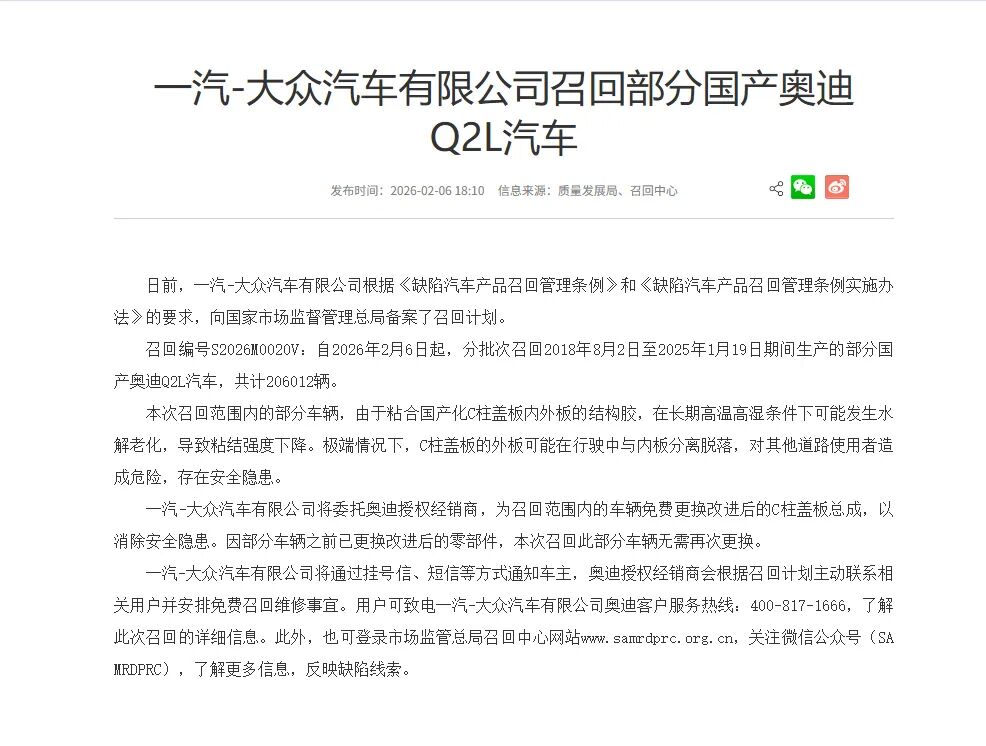
结构胶缺陷致一汽奥迪召回超20万辆Q2L
Guo Ji Jin Rong Bao· 2026-02-10 14:59
Core Insights - Audi is facing significant challenges in its global operations, with a reported global sales decline of 2.9% in 2025, totaling 1.6236 million vehicles, and a 5.0% drop in its largest market, China, where sales reached 617,500 units [1][2] Group 1: Recall Announcement - The recall is due to a durability defect in the adhesive structure of the domestic C-pillar cover, which may lead to a decrease in bonding strength under prolonged high temperature and humidity, posing a safety risk [1] - The recall will involve free replacement of the affected assembly with an improved version using hydrolysis-resistant adhesive, and vehicles that have already been upgraded will not require further action [1] - Prior to the recall announcement, there were 408 complaints related to the C-pillar cover, indicating issues such as natural loosening and detachment during driving, with some incidents occurring at high speeds [1] Group 2: Market Performance - Audi's two joint ventures in China show a divergence in performance, with FAW Audi achieving cumulative sales of 567,000 units and SAIC Audi reaching 47,300 units, a 23% year-on-year increase [2] - Overall, the BBA (BMW, Benz, Audi) group has experienced declining sales in China for two consecutive years, with Audi's sales declining by 5.6%, making it the most stable among the three [2] - The decline in global sales is primarily attributed to the North American and Chinese markets, while the German market saw a 4.0% increase in sales, totaling 206,100 units [2] Group 3: Strategic Adjustments - Audi has acknowledged a misstep in its vehicle naming strategy, particularly the renaming of the A4 to A5, which caused confusion among consumers and dealers, negatively impacting sales [3] - The company plans to revert to the A4 designation for new models, maintaining the A6L's name due to its high recognition in the Chinese market [3] - Audi's cautious approach to electrification includes continued production of gasoline and hybrid models for the next 7 to 10 years, which may widen the competitive gap with new energy vehicle companies [3] Group 4: Local Collaboration - In response to competitive pressures in the Chinese market, Audi is collaborating with local technology firms, exemplified by the SAIC Audi A5L Sportback being the first fuel vehicle equipped with Huawei's advanced driving system [4] - The recall incident and market performance reflect the ongoing restructuring of the luxury car market in China, where traditional German luxury brands are facing declines [4] - To regain consumer favor, BBA must accelerate the launch of dedicated electric vehicle platforms and enhance capabilities in smart driving and cabin interaction to better adapt to the local market [4]

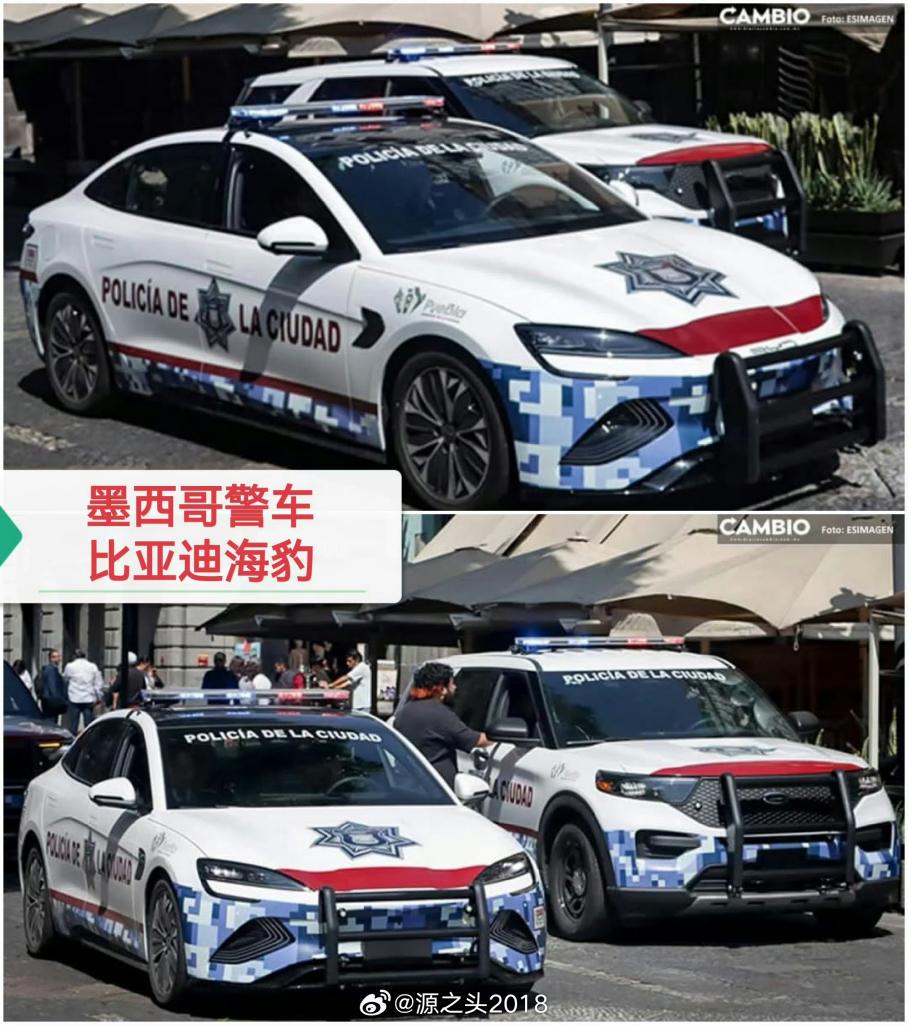
比亚迪:全球公务车市场的新能源破局者
Xin Lang Cai Jing· 2025-12-08 06:53
Core Insights - BYD is transforming the global public vehicle market by leveraging technological innovation and local adaptation, breaking the long-standing dominance of local and traditional luxury brands [1][8][13] Market Penetration - The global public vehicle market has historically been dominated by local brands and traditional luxury brands, with German brands holding over 60% of government procurement in Europe [1][8] - The shift towards electric vehicles is rapidly changing this landscape, with countries like Mexico, Hungary, and Brazil adopting BYD vehicles for various public service roles [3][5][6] Environmental Demand - The global push for low-carbon transitions is driving the adoption of electric vehicles in public fleets, with the EU mandating that by 2027, at least 50% of corporate fleets must be electric [5][6] - Traditional fuel vehicles emit approximately 5.08 tons of CO2 annually, while BYD's hybrid and electric models significantly reduce emissions [5] Technological Innovation - BYD's vehicles meet stringent reliability and safety standards required for public procurement, including rigorous testing for extreme conditions [9][10] - The unique blade battery technology and intelligent vehicle control systems enhance performance and reduce maintenance costs for government fleets [10][11] Sales Growth - BYD's overseas sales reached 417,200 units in 2024, with a significant increase to 917,000 units in the first 11 months of 2025, indicating a successful global strategy [12] - The share of overseas revenue in BYD's total revenue rose from 28% in 2024 to 36.5% in the first half of 2025, reflecting a shift from low-cost volume to technology-driven value [12] Industry Implications - BYD's success in the global public vehicle market illustrates a shift in the competitive landscape, moving from geographical advantages to technological value [8][13] - The transformation of BYD's approach signifies a broader change in the perception of Chinese manufacturing, emphasizing quality and innovation over mere quantity [12][13]

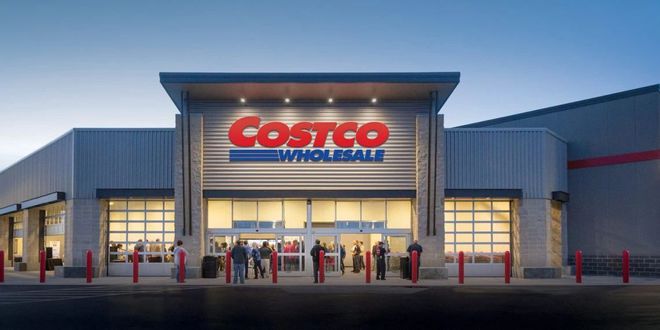
本土化迟缓,美国“一哥”Costco在华难敌山姆
Guan Cha Zhe Wang· 2025-06-05 04:00
Core Insights - Costco demonstrates resilience amid market fluctuations, reporting strong financial results for Q3 of FY2025 [1][3] - The company achieved total revenue of $63.2 billion, an 8% year-over-year increase, and net income of $1.9 billion, up 13% [3][5] - Membership fee income reached $1.24 billion, reflecting a significant increase from $1.12 billion in the previous year, with a global membership renewal rate exceeding 90% [5][6] Financial Performance - Total revenue for the quarter was $63.2 billion, with net sales of $61.97 billion and membership fees contributing $1.24 billion [4] - Operating income rose to $2.53 billion, compared to $2.20 billion in the same quarter last year [4] - The diluted earnings per share were $4.28, surpassing expectations by $0.04 [3] Membership Growth - Costco's global paid membership reached 76.2 million, with a total cardholder count of 137 million, indicating a healthy growth trajectory [5][6] - Membership income grew by 11.4%, with a renewal rate of 92.7% excluding foreign exchange impacts [6] E-commerce Development - The e-commerce segment saw a nearly 16% year-over-year growth, reversing previous negative trends [6][8] - Recent leadership changes have shifted the focus towards technology transformation and enhancing the e-commerce business [7][8] Challenges in China - Despite global success, Costco faces significant challenges in the Chinese market, with only seven stores opened since 2019 and a low membership renewal rate of 62% [9][10] - The company's standardized store model and pricing strategy have not resonated well with Chinese consumers, leading to slower expansion compared to competitors like Sam's Club and Aldi [10][12][16] Competitive Landscape - Sam's Club has rapidly expanded in China, with 56 stores and a strategy that includes flexible store formats and enhanced online services [10][14] - Aldi's community-focused store model has proven effective, achieving high sales volumes and plans for further expansion [16] Strategic Outlook - Costco plans to open nine new stores in FY2025, focusing on markets outside of China, indicating a cautious approach to its expansion strategy [16] - The company must adapt to local consumer preferences and competitive dynamics to improve its market position in China [16]