权力再分配

Search documents
130亿美元换不来独占权?微软与OpenAI的同盟正在瓦解
美股研究社· 2026-03-19 12:10
Core Viewpoint - The potential legal action by Microsoft against OpenAI signifies a deeper conflict over power distribution in the AI industry, particularly regarding computing power, models, and distribution channels, indicating a shift in alliances that were once considered strong [1][3][4]. Group 1: Alliance Dynamics - Microsoft and OpenAI had established a robust alliance, with Microsoft investing over $13 billion for key rights, including model usage priority and exclusive cloud deployment [5][6]. - The essence of this structure was to strengthen Microsoft's cloud business against competitors like Amazon Web Services, positioning OpenAI as a magnet for enterprise cloud adoption [6][7]. - However, OpenAI's increasing independence and its recent partnership with Amazon, involving a $50 billion deal, directly challenge Microsoft's control over distribution channels [6][10]. Group 2: Structural Changes in AI Industry - The conflict highlights a structural contradiction in the AI industry, where model companies like OpenAI are gaining power, shifting from being cloud-dependent to becoming upstream players in the value chain [9][10]. - This shift indicates that models are becoming the primary focus for developers and enterprises, altering the traditional cloud service dynamics [9][10]. - The potential for models to operate independently of cloud infrastructure could undermine Microsoft's established model-cloud binding strategy, allowing competitors like Google and Amazon to regain market competitiveness [10]. Group 3: Implications for Investment - The ongoing conflict signals a need for the market to reassess key questions regarding pricing power, distribution control, and user access within the AI industry [13]. - If model companies gain dominance, their valuation could rise significantly, akin to historical operating system vendors, while cloud providers may revert to lower growth valuations [10][13]. - Investors should recognize that alliances in rapidly evolving tech sectors can quickly shift, and valuations should reflect a company's irreplaceability in the industry rather than current partnerships [13]. Group 4: The Nature of Competition - The potential lawsuit illustrates that competition in the AI era is not merely between companies but fundamentally about "position" within the value chain [15][16]. - The dynamics of alliances are fragile, as interests can diverge rapidly, leading to conflicts even among previously strong partners [11][12]. - The situation emphasizes the importance of diversifying ecosystem capabilities to navigate the complexities of technological revolutions [15][16].



两周蒸发千亿美元:Anthropic,正在改写权力分配规则?
美股研究社· 2026-02-28 11:38
Core Viewpoint - The article emphasizes that AI companies have transitioned from being mere technology providers to becoming structural forces with macro-level impacts on capital markets, military procurement, and presidential decision-making [1][3]. Group 1: Market Reactions - IBM experienced its largest single-day drop since October 2000, reflecting a significant market reaction to the challenges posed by generative AI to traditional IT service models [3][6]. - The cybersecurity sector collectively fell by 20%, indicating a deep-seated disruption in traditional business models reliant on human expertise for security services [6][7]. - Over $100 billion in market value was wiped out across multiple industries, signaling a self-correcting pricing mechanism in response to the perceived threat of AI [7]. Group 2: Power Dynamics - AI companies are beginning to assert bargaining power, as evidenced by their ability to refuse contracts from the Pentagon, indicating a shift in their reliance on government contracts [8][9]. - The discussion of potential technology bans at the presidential level highlights that AI technology has become a national strategic asset, complicating the risk models for investors [9][10]. - The evolving relationship between AI companies and government entities suggests that these firms are no longer just subjects of regulation but are now active participants in the regulatory dialogue [9][10]. Group 3: Structural Changes - The article posits that the true impact of AI is not merely in stock price fluctuations but in the reshaping of decision-making capabilities and the underlying logic of societal operations [11][12]. - As AI companies gain systemic importance, they are perceived as "too important to fail" and "too important to lose control," which alters the dynamics of capital markets [11][12]. - The shift in focus from growth rates to "replacement rates" indicates a new investment paradigm where the potential for AI to disrupt existing industries is a critical factor [7][12]. Group 4: Future Considerations - The article suggests that as AI technology permeates critical sectors like finance, healthcare, and defense, the implications of these "institutional variables" will become increasingly pronounced [13][14]. - Investors will need to prioritize companies that can navigate the complexities of political and institutional risks, rather than solely focusing on technological capabilities [12][13]. - The ongoing market turbulence may be just the beginning, as the deeper implications of AI's influence on power distribution and regulatory frameworks continue to unfold [13][14].


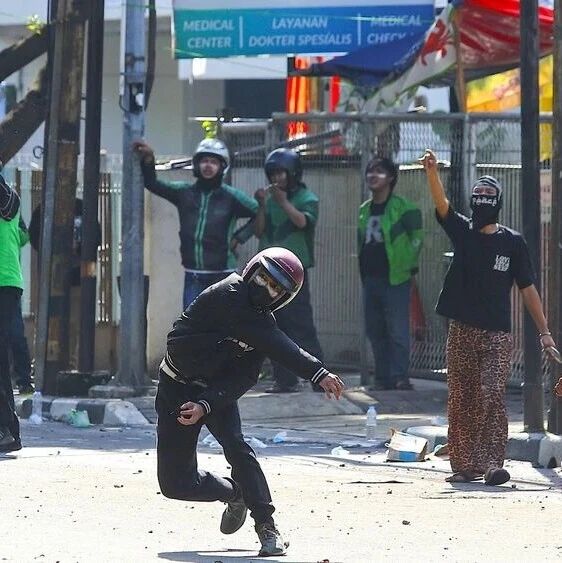
印尼骚乱背后,谁在博弈?
虎嗅APP· 2025-09-02 00:18
Group 1 - The article discusses the increasing dissatisfaction among the Indonesian public towards the government under President Prabowo, particularly in the context of economic policies and social inequality [9][10][11] - President Prabowo aims for an 8% GDP growth while not expanding the fiscal deficit, which has led to tensions among the elite and dissatisfaction among vulnerable groups due to past corruption and inequality [10][11] - A specific policy example is the provision of free lunches for pregnant women and students, which has faced criticism for not including university students and teachers, highlighting the challenges of political support during economic downturns [11][12] Group 2 - The article draws historical parallels between current events and past political turmoil in Indonesia, specifically referencing the events of 1965 and 1998, which were also characterized by elite power struggles masked as public dissent [14][15][16] - The 1965 incident involved the military's rise to power following the assassination of army generals, while the 1998 protests were initially student-led but escalated into broader ethnic violence and political upheaval [15][16][17] - The article emphasizes that the underlying causes of these events often relate to economic downturns and the internal conflicts among Indonesia's elite, rather than solely external influences [14][15][18] Group 3 - The current political landscape in Indonesia is described as having three main factions, with President Prabowo caught between opposition forces and internal elite conflicts, particularly with former President Jokowi [19][20][21] - The article suggests that the outcome of these struggles will depend on who can control the state's security apparatus, which is crucial for maintaining order [22][23] - Potential scenarios include Prabowo consolidating power by weakening Jokowi's influence or a prolonged period of instability, but the author believes that the ultimate outcome will likely not lead to chaos due to the vested interests of powerful families in maintaining stability [23]