比特币四年周期

Search documents
比特币因贸易战担忧下滑,清算规模激增
Sou Hu Cai Jing· 2026-01-23 02:15
Core Insights - Bitcoin experienced a significant decline of approximately 3.1%, dropping from around $95,385 to about $92,415, impacting the global cryptocurrency market [2] - The sell-off occurred during a period of low liquidity due to the U.S. stock and bond markets being closed for Martin Luther King Jr. Day, which often amplifies price volatility in digital assets like Bitcoin [2] - The decline was largely attributed to changing global risk sentiments rather than Bitcoin's fundamentals, with geopolitical tensions, particularly between the U.S. and Europe, being a major concern [3] Market Dynamics - Over $865 million in leveraged positions were liquidated within 24 hours, with nearly 90% of these coming from bullish investors who had bet on Bitcoin's continued upward momentum [2] - The overall cryptocurrency market capitalization fell by approximately 2.8% to $3.26 trillion, with over $111 billion in market value evaporated since the previous Thursday [3] - The decline in Bitcoin's price led to a broader sell-off in altcoins, highlighting Bitcoin's role as a market bellwether [4] Geopolitical Influences - Recent comments from U.S. President Donald Trump regarding potential punitive tariffs on European allies have reignited geopolitical uncertainties, affecting market sentiment [3] - The market is recalibrating its perception of Bitcoin as a risk asset rather than a safe haven in light of renewed trade tensions [3][5] - The geopolitical narrative is rapidly influencing market psychology, with traders increasingly viewing Bitcoin within the context of global risk appetite [7][8] Future Outlook - Analysts expect Bitcoin to maintain a range-bound trading pattern in the latter half of January, with potential support around the mid-$80,000 range if macro conditions do not worsen [7] - The current market reaction indicates that Bitcoin's scarcity alone may not shield it from macro-driven sell-offs, as investors prioritize liquidity and capital preservation during uncertain times [7][8] - The ongoing developments in U.S.-European trade relations and the outcomes of the Davos meeting will be critical factors to monitor [9]


FXGT:比特币减半规律的存与废
Xin Lang Cai Jing· 2025-12-30 11:42
Core Viewpoint - The cryptocurrency market is at a critical juncture, with intense debate over whether the "four-year cycle" has become obsolete, as Bitcoin transitions from a fringe asset to a global macro hedge asset, fundamentally altering its operational logic [1][3]. Market Dynamics - The institutionalization process is identified as the primary driver breaking the cycle, with continuous buying from spot ETFs providing a deep liquidity cushion, contrasting sharply with the previous retail-driven "boom and bust" patterns [4]. - Macro policy easing and global liquidity expansion are emerging as new engines for market trends, with Grayscale data indicating that Bitcoin's macro hedge attributes are becoming more pronounced due to ongoing fiat currency devaluation pressures [4]. Market Sentiment - Despite the shift, there are still voices advocating for the cycle theory, with some institutions noting that the market's trajectory by the end of 2025 exhibits typical bear market characteristics, reflecting the complexity of market psychology [2][4]. - Long-term holders are engaging in preemptive selling based on memories of market trauma from 2021, which may suppress prices in the short term but does not necessarily indicate the long-term validity of the four-year logic [2][4]. Future Outlook - Investors are advised against blindly applying past halving schedules, as the rise of AI and strong performances from traditional safe-haven assets like gold indicate that competition for capital in the crypto market has entered a phase of both stock and flow [5]. - The cycle may not be broken but is being elongated and redefined, suggesting that future opportunities will be more hidden in value reassessments following market fluctuations [5]. - The year 2026 is highlighted as a critical window for validating the new order, necessitating a more inclusive analytical framework that prioritizes policy direction, institutional holding costs, and liquidity trends over halving timelines [5].

巨鲸抛售、ETF失血:比特币闪崩背后是什么?
Sou Hu Cai Jing· 2025-11-23 12:34
Core Insights - Bitcoin has experienced a significant drop, with a decline of up to $11,000 within 24 hours, leading to over 390,000 liquidations in the market [1][2] - The overall cryptocurrency market has seen a total market cap reduction of over $1 trillion, indicating a severe downturn in investor sentiment [1][2] Market Performance - Bitcoin reached a low of $81,111, marking its lowest point since April 7 [1] - Major cryptocurrencies such as Ethereum and SOL also saw declines of 10.8% and 11.7% respectively, contributing to a broader market downturn [2] Liquidation Events - In the past 24 hours, the total liquidation in the cryptocurrency market amounted to $1.914 billion, with 392,000 traders affected [2] - Long positions accounted for $1.78 billion of the liquidations, while short positions contributed $130 million [2] Macro Factors - The expectation of a Federal Reserve interest rate cut has significantly diminished, leading to increased selling pressure on Bitcoin and other risk assets [2] - Morgan Stanley no longer anticipates a rate cut in December, with current futures indicating only a 40% chance of such an event [2] Institutional Movements - Bitcoin ETFs have seen substantial outflows, with a record outflow of $866.7 million on November 13, followed by a total outflow of nearly $2.5 billion for the week [3][5] - Whale investors have sold over $20 billion in assets since September, contributing to the current market conditions [6] Market Sentiment - The fear index has reached extreme levels, indicating a rare low in market sentiment not seen in nearly a decade [7] - Despite the prevailing fear, some analysts suggest that the current situation may lead to a "panic bottom" and risk clearance [7] Diverging Institutional Views - Morgan Stanley's investment strategist suggests that Bitcoin is in a "fall" phase of its four-year cycle, advising investors to prepare for a potential crypto winter [8][9] - Conversely, Standard Chartered's digital asset research head believes the recent adjustments may have ended, indicating that Bitcoin could have reached its bottom [10] Long-Term Investor Behavior - Long-term holders have increased their Bitcoin holdings significantly, from 159,000 BTC to 345,000 BTC since October 6, indicating a potential accumulation phase amidst market pessimism [11] - Predictions suggest that Bitcoin could drop to $75,000 by year-end, although a rebound is expected shortly thereafter [11][12]

大跌!超25万人爆仓
Sou Hu Cai Jing· 2025-11-22 11:12
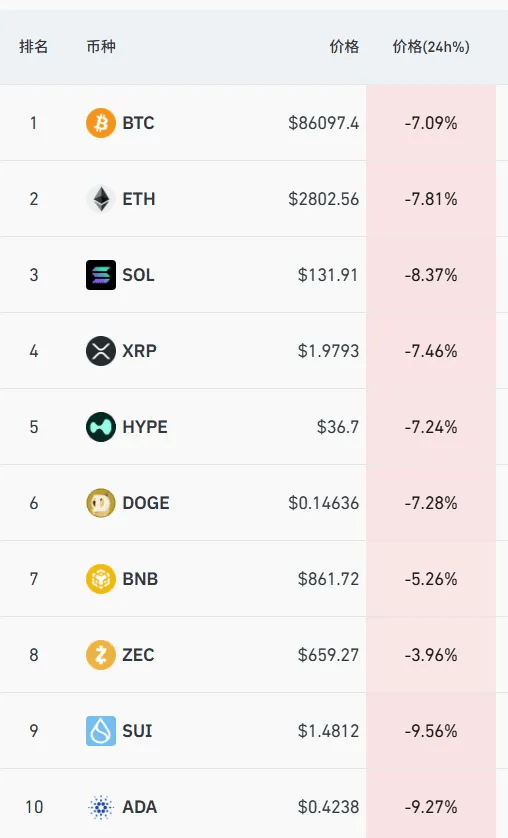
Core Insights - The cryptocurrency market is experiencing a significant sell-off, with Bitcoin dropping over 7% and falling below $87,000 for the first time since April [1][2] - Other cryptocurrencies are also seeing declines, with Ethereum down nearly 8% and Solana down 8.37% [1][2] Market Performance - Bitcoin (BTC) is priced at $86,097.4, down 7.09% in the last 24 hours [2] - Ethereum (ETH) is at $2,802.56, down 7.81% [2] - Solana (SOL) is priced at $131.91, down 8.37% [2] - The total liquidation in the cryptocurrency market over the past 24 hours exceeded $900 million, affecting over 252,000 traders [2][3] Market Trends - Bitcoin has erased all its gains for the year, with a cumulative decline of 7.8% since the beginning of the year, marking the first annual drop since 2022 [3] - Large holders have sold over $20 billion in assets since September, following a four-year cycle logic that typically leads to price declines [3] Analyst Opinions - Morgan Stanley's investment strategist suggests that the cryptocurrency market has entered the "autumn" phase of Bitcoin's four-year cycle, advising investors to take profits in preparation for a potential "crypto winter" [3] - Standard Chartered's digital asset research head indicates that the recent price drop aligns with the third major sell-off in the current cycle, suggesting that Bitcoin prices may have reached a bottom [4]
全线大跌!23万人爆仓!59亿“灰飞烟灭”
Zhong Guo Ji Jin Bao· 2025-11-21 02:19
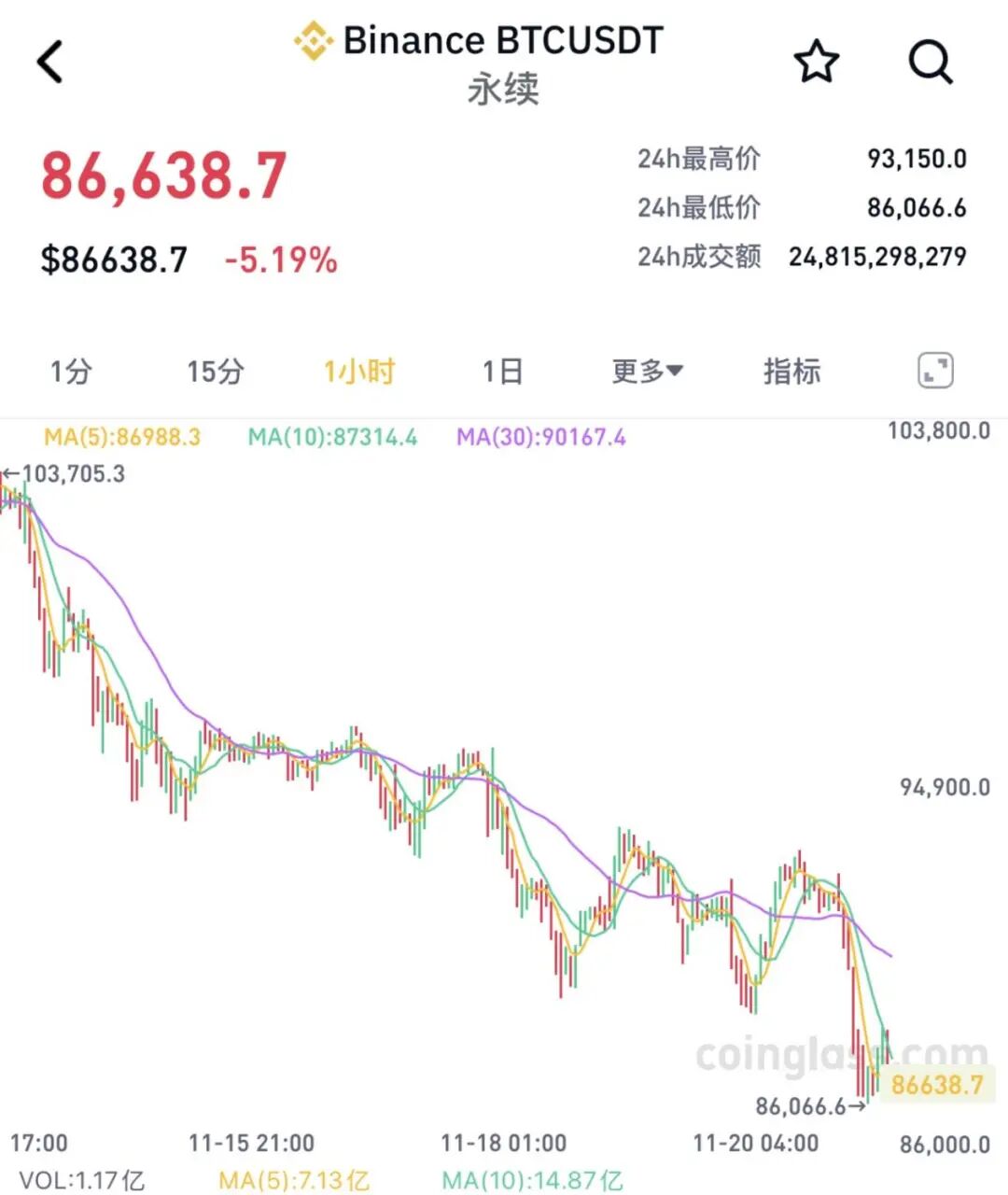
Core Viewpoint - The cryptocurrency market is experiencing a significant downturn, with Bitcoin dropping over 5% and falling below $87,000 for the first time since April, leading to a wave of liquidations affecting nearly 230,000 traders [1][6]. Market Performance - Bitcoin is priced at $87,161.3, down 4.62% in the last 24 hours and 11.92% over the past week, with a market capitalization of $1.74 trillion and a trading volume of $96.99 billion [6]. - Ethereum has also seen a decline, priced at $2,852.22, down 5.46% in 24 hours and 10.90% over the week, with a market cap of $344.81 billion [6]. - Other cryptocurrencies such as BNB, Dogecoin, and Cardano have followed suit, experiencing similar declines [5][6]. Liquidation Data - Approximately 230,000 traders were liquidated in the past 24 hours, with a total liquidation amount of $830 million (approximately 5.9 billion RMB), including $700 million from long positions and $130 million from short positions [6][7]. Market Sentiment and Influences - The market sentiment is cautious due to the cooling expectations of interest rate cuts by the Federal Reserve, with officials expressing concerns over persistent inflation [8]. - The U.S. stock market experienced significant volatility, which has contributed to the negative sentiment in the cryptocurrency market [8]. - Analysts suggest that large investors are selling off assets in line with a four-year cycle logic, leading to a self-fulfilling prophecy of price declines [8]. Future Outlook - There are mixed opinions on Bitcoin's future trajectory, with some analysts suggesting that the market is entering a "winter" phase, advising investors to take profits [8]. - Conversely, others believe that the recent price adjustments may have reached a bottom, indicating a potential rebound by the end of the year [9].
分析师:比特币已进入“四年周期秋季”,当前是“收获季节”
Sou Hu Cai Jing· 2025-11-12 18:06
Core Viewpoint - The cryptocurrency market has entered the "autumn phase" of Bitcoin's four-year cycle, indicating a potential peak before a downturn, according to Morgan Stanley strategist Denny Galindo [1] Group 1: Market Analysis - Historical data shows that Bitcoin's price cycles typically follow a "three up, one down" pattern, suggesting that investors should gradually lock in profits before the "winter" arrives [1] - The current phase is described as a "harvest season," but the duration of this phase and the timing of the subsequent downturn remain uncertain [1] Group 2: Investment Perspective - Analysts believe this metaphor indicates that Wall Street is viewing the Bitcoin market through a cyclical asset framework, similar to commodities or macro liquidity-driven investment cycles [1]

比特币:处于四年周期“秋季”,建议及时获利
Sou Hu Cai Jing· 2025-11-12 14:55
Core Viewpoint - Morgan Stanley strategist Denny Galindo indicates that Bitcoin is currently in the "autumn" phase of its four-year cycle, suggesting it is a good time for investors to take profits [1][2] Summary by Relevant Sections - **Market Phase**: Bitcoin is in the "autumn" stage, which is characterized as a period for profit-taking before a potential downturn [1][2] - **Market Warning**: There is a warning that the market may soon enter the "winter" phase, indicating a price decline [1][2] - **Technical Indicators**: Bitcoin's price has recently fallen below the critical technical indicator of the 365-day moving average, which is viewed as a bearish signal [1][2] - **Liquidity Sources**: The inflow of liquidity from sources such as stablecoins and ETFs has shown signs of stagnation [1][2]


比特币四年周期不再?市场新动态引发深度思考!
Sou Hu Cai Jing· 2025-08-11 08:02
Core Insights - The historical "cycle" of Bitcoin is showing signs of breaking, influenced by changes in investor structure and favorable regulatory policies, which could significantly impact price assessments and investment timing [1] Group 1: Bitcoin Cycle and Market Dynamics - The Bitcoin cycle typically refers to the four-year price fluctuation pattern surrounding the "halving" event, which reduces mining rewards and limits total supply to 21 million coins [3] - Historically, Bitcoin prices tend to reach new highs within 12-18 months post-halving, but recent market reactions have deviated from this pattern, with Bitcoin reaching over $73,000 a month before the next halving [3][4] - The approval of Bitcoin ETFs in January 2024 is a major factor, attracting institutional investors and significantly influencing price dynamics [4] Group 2: Changes in Market Environment - The current market environment is different from previous "crypto winters," with fewer instances of major collapses like the ICO crash in 2018 and the FTX collapse in 2022, alongside a more favorable macroeconomic and regulatory landscape [4] - Regulatory bodies are shifting from strict oversight to a more accepting stance towards cryptocurrencies, which is expected to reduce the risk of future market crashes [4] - Companies are increasingly incorporating cryptocurrencies, particularly Bitcoin, into their strategic plans, indicating a maturation of the market [4] Group 3: Price Predictions and Market Resilience - Historical data suggests that Bitcoin prices typically see the largest increases between 500 to 720 days post-halving, with potential price acceleration expected in late 2025 to early 2026 [5] - The current cycle shows a more subdued price movement compared to previous cycles, with expectations of a maximum drawdown of around 26%, significantly lower than the 70%-80% drops seen in past cycles [6] - Long-term holders and stable institutional inflows are enhancing market resilience, with potential future corrections expected to be less severe than in previous cycles [6]