现货ETF

Search documents
NCE 平台:比特币步入长期筑底期
Xin Lang Cai Jing· 2026-02-27 12:51
Core Viewpoint - The cryptocurrency market is showing signs of stabilization after several weeks of downward volatility, with selling pressure from investors nearing exhaustion, allowing for a potential price range consolidation between $60,000 and $70,000 [1][4]. Market Dynamics - The liquidity in both spot and futures markets has deteriorated recently, explaining why Bitcoin faced resistance around $67,000 while other risk assets strengthened. Data indicates that Bitcoin has struggled to break the $70,000 resistance level for the past three weeks, reflecting an orderly liquidation of prior long positions [1][4]. - The impact of the four-year halving cycle is being digested by the market, and a reallocation of funds between AI startups and digital assets suggests that the most intense phase of selling is likely over [1][4]. Technical Indicators - Historical weekly RSI for Bitcoin has entered an extremely oversold territory, indicating that aggressive selling pressure is on the verge of subsiding. The market may still test support levels between $62,000 and $65,000, but this volatility could help eliminate speculative excess as long as the global macroeconomic environment does not experience a systemic collapse [2][5]. - If macro liquidity tightens more than expected, the $30,000 level will serve as a critical defensive threshold, while the current sideways movement appears to be building momentum for a potential bull market in 2027 [2][5]. Investor Sentiment - Institutional investors are generally cautiously optimistic about the speed of market recovery. Although inflows into spot ETFs have improved, the repair of market sentiment typically requires a "cooling-off period" of three to six months following significant pullbacks [2][6]. - The likelihood of a V-shaped recovery is low in the current environment, with more emphasis on structural consolidation within a wide range. This market condition, while lacking explosive potential, presents a good opportunity for long-term investors to lower their cost basis and make strategic allocations [6]. Market Outlook - The digital asset market is transitioning from a "winter" to an "early spring," and investors are advised to remain patient while closely monitoring ETF inflow sizes and the impact of global macro policies on risk asset pricing. As selling pressure gradually dissipates, the market's focus will slowly shift upward [3][6]. - Throughout the remainder of 2026, this consolidation phase is expected to continue restoring investor confidence until new positive catalysts emerge. The $60,000 level is highlighted as a key support point for assessing the integrity of the long-term bull market trend [3][6].
Vatee:顶级大户审慎面对比特币 14% 反弹
Xin Lang Cai Jing· 2026-02-12 13:08
Core Insights - Bitcoin experienced a significant "stress test," rebounding 14% from a recent low of $60,130 to touch $72,000, yet professional traders have not shown a clear bullish shift, indicating deep uncertainty in the current macro liquidity environment [1][3] Group 1: Market Dynamics - A notable decline in leverage demand marks an important sign of the market entering a cooling period, with Binance's long-short ratio dropping from 1.93 to 1.20, and OKX's ratio falling from a peak of 4.3 to 1.7 after a $1 billion forced liquidation [1][3] - The volatility in these metrics is attributed more to a systemic clearing of excessive leverage rather than active bearish sentiment from investors, suggesting that the deleveraging process, while painful, is building a healthier and more resilient price foundation for the market [1][3] Group 2: Institutional Fund Flows - The spot ETF market recorded a net inflow of $516 million, effectively curbing the previous negative outflow trend [2][4] - Prior outflow pressure of $2.2 billion is likely linked to a collapse of an Asian fund that utilized cheap yen financing for cross-asset leveraged trading, indicating that such non-crypto related selling pressure tends to have a significant short-term impact but weak sustainability [2][4]
ZFX山海证券:即时满足感正蚕食BTC流动性
Xin Lang Cai Jing· 2026-02-02 11:18
Core Insights - Bitcoin has experienced an unexpected decline of over 10% in the past month, contrasting with a more than 12% increase in gold prices and a steady rise in the S&P 500 index, leading to widespread discussion about its market behavior [1][3] - ZFX Shanhai Securities indicates that Bitcoin is undergoing a phenomenon termed "speculative erosion," where speculative capital that previously flowed into the crypto market is being diverted to online sports betting, prediction markets, and zero-day-to-expiration (0DTE) options, driven by a societal craving for instant gratification [1][2] Market Dynamics - The current market environment is increasingly favoring a "winner-takes-all" and rapid stimulation model, rather than long-term investment strategies that require patience [1][2] - Historical data shows that Bitcoin has strong long-term holding value, with investors holding for over five years never experiencing actual losses; however, in a market that prioritizes instant feedback, Bitcoin is perceived as a "slow asset" [1][2] Capital Flow and Investment Behavior - The preference for quick returns has led to marginal capital being absorbed by fast-paced platforms that, while offering lower expected returns, provide continuous engagement, thereby diminishing Bitcoin's explosive potential in speculative cycles [4] - Even anticipated spot ETFs struggle to gain traction under these behavioral constraints, as assets that do not provide short-term emotional closure find it difficult to compete in the increasingly fierce "attention economy" [2][4] Future Outlook - The competitive landscape poses significant short-term challenges for Bitcoin, despite its long-term value logic remaining intact; investors must acknowledge the structural changes in the flow of speculative funds [2][4] - In a context where capital is increasingly drawn to fast-paced, high-reaction markets, Bitcoin needs to find new narratives to reignite market sentiment; otherwise, its liquidity may continue to face marginalization challenges in the absence of instant feedback stimuli [2][4]


沃什终结“美元贬值交易”?币圈周末继续重挫,比特币跌破8万美元大关
Hua Er Jie Jian Wen· 2026-02-01 01:52
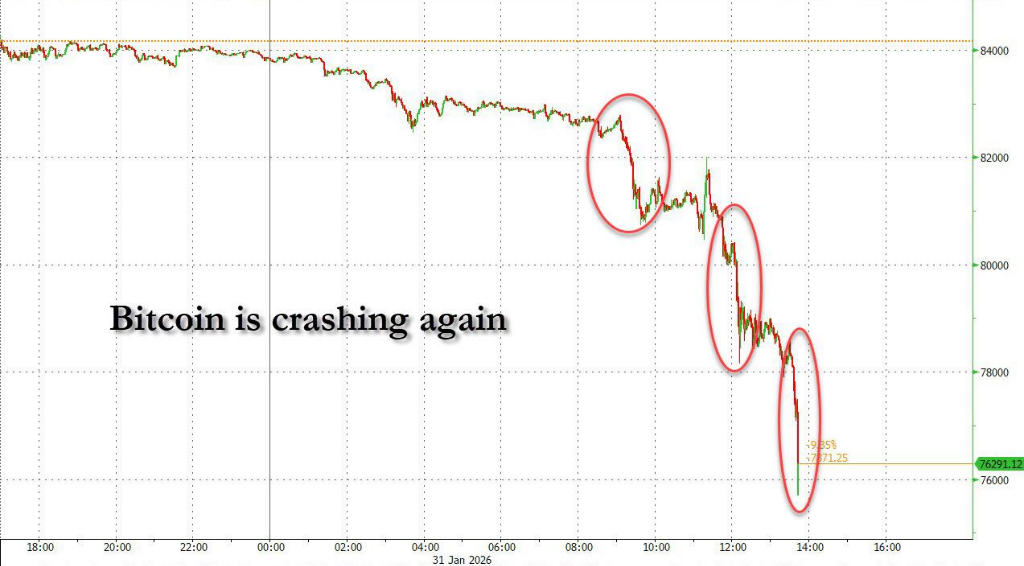
Core Viewpoint - The cryptocurrency market experienced a significant sell-off over the weekend, with Bitcoin dropping below $80,000 to its lowest level since April of the previous year, continuing a month-long downward trend. This sell-off was triggered by the nomination of Waller as the next Federal Reserve Chairman, negatively impacting both cryptocurrencies and precious metals like gold and silver, as market bets on dollar depreciation began to unravel [1][9]. Group 1: Market Performance - Bitcoin's price fell sharply, reaching a low of $75,709.88, with a one-day drop of 10% [1]. - Ethereum and Solana saw even steeper declines, with drops of 17% and over 17%, respectively [1]. - The total market capitalization of cryptocurrencies decreased by approximately $111 billion within 24 hours [1]. Group 2: Market Dynamics - The sell-off occurred in a context of thin liquidity and limited buying interest, leading to a total decline of over 30% for Bitcoin [3]. - Approximately $1.6 billion in long and short positions were liquidated, primarily in Bitcoin and Ethereum, with most liquidations happening in the last four hours [4][3]. - Retail investor interest is reported to be extremely low, with trading volumes expected to remain subdued for the next one to two quarters [6]. Group 3: Regulatory and Geopolitical Factors - The geopolitical tensions between Israel and Iran may also influence Bitcoin prices, as recent events have raised concerns in the market [9]. - Delays in new regulatory frameworks for the cryptocurrency industry have further weakened interest in digital assets, as the Senate committee shifted focus away from cryptocurrency legislation [9]. - Despite Waller's previous positive remarks about Bitcoin, his nomination appears to have reversed the upward momentum in both precious metals and cryptocurrencies [9]. Group 4: Investment Sentiment - Traditional safe-haven assets like gold and silver have regained favor among investors concerned about fiat currency, while Bitcoin has failed to attract significant inflows despite the recent surge in gold prices [7]. - The lack of buying interest highlights the challenges Bitcoin faces in its role within broader investment portfolios, as it struggles to serve as both a momentum trade and a hedge against currency depreciation [8].
FXGT:比特币减半规律的存与废
Xin Lang Cai Jing· 2025-12-30 11:42
Core Viewpoint - The cryptocurrency market is at a critical juncture, with intense debate over whether the "four-year cycle" has become obsolete, as Bitcoin transitions from a fringe asset to a global macro hedge asset, fundamentally altering its operational logic [1][3]. Market Dynamics - The institutionalization process is identified as the primary driver breaking the cycle, with continuous buying from spot ETFs providing a deep liquidity cushion, contrasting sharply with the previous retail-driven "boom and bust" patterns [4]. - Macro policy easing and global liquidity expansion are emerging as new engines for market trends, with Grayscale data indicating that Bitcoin's macro hedge attributes are becoming more pronounced due to ongoing fiat currency devaluation pressures [4]. Market Sentiment - Despite the shift, there are still voices advocating for the cycle theory, with some institutions noting that the market's trajectory by the end of 2025 exhibits typical bear market characteristics, reflecting the complexity of market psychology [2][4]. - Long-term holders are engaging in preemptive selling based on memories of market trauma from 2021, which may suppress prices in the short term but does not necessarily indicate the long-term validity of the four-year logic [2][4]. Future Outlook - Investors are advised against blindly applying past halving schedules, as the rise of AI and strong performances from traditional safe-haven assets like gold indicate that competition for capital in the crypto market has entered a phase of both stock and flow [5]. - The cycle may not be broken but is being elongated and redefined, suggesting that future opportunities will be more hidden in value reassessments following market fluctuations [5]. - The year 2026 is highlighted as a critical window for validating the new order, necessitating a more inclusive analytical framework that prioritizes policy direction, institutional holding costs, and liquidity trends over halving timelines [5].
加密四年周期新论:我问了七位资深从业者现在是什么阶段
3 6 Ke· 2025-12-24 03:48
Core Viewpoint - The "four-year cycle" theory in the cryptocurrency market, which has been a foundational belief since Bitcoin's inception, is being questioned as macroeconomic factors and institutional involvement become more significant than the traditional supply-driven narratives [1][9][18]. Group 1: Four-Year Cycle Discussion - The "four-year cycle" is traditionally driven by Bitcoin's halving events, which reduce supply and influence price dynamics [8]. - Some experts argue that the cycle is now influenced more by political and liquidity cycles rather than just halving events, suggesting a shift in how market participants view Bitcoin's role as a macro asset [9][10]. - The consensus among experts is that while the four-year cycle had a strong supply basis in the past, it is now transitioning to a model influenced by market narratives and macroeconomic factors [11][12]. Group 2: Market Dynamics and ETF Impact - The current market's reduced price volatility and growth are attributed to diminishing marginal effects of halving events and the significant influx of institutional capital through ETFs [12][13]. - Experts note that the previous cycle was driven by retail liquidity, while the current cycle sees over $50 billion in ETF funds entering the market, leading to a more gradual price increase rather than explosive growth [12][13]. - The consensus is that the halving remains a relevant factor but is now secondary to institutional flows and macroeconomic conditions [13][14]. Group 3: Current Market Phase - There is a divergence in expert opinions regarding the current market phase, with some viewing it as a bear market's early stage, while others see it as a correction within a broader bull market [14][15][16]. - The current market is characterized by a technical bear phase, but macroeconomic conditions have not yet confirmed a full bear market [15][16]. - Many experts believe that as long as global liquidity continues to expand, the upward trend in crypto assets is likely to persist [16][17]. Group 4: Future Market Structure - The future of the crypto market may not follow traditional bull-bear cycles but could enter a prolonged period of upward movement with compressed bear markets, driven by institutional adoption and macroeconomic factors [19][20]. - Experts emphasize the importance of stablecoins and institutional investment as key drivers of future market growth, suggesting a shift towards a more integrated financial ecosystem [19][20]. - The market structure is evolving from a retail-driven model to one dominated by institutional investment, which may lead to different dynamics in asset price movements [24]. Group 5: Altcoin Season and Market Behavior - The absence of a traditional "altcoin season" in the current cycle is attributed to Bitcoin's dominance and a more selective investment approach by institutions [23]. - Experts suggest that while new altcoin seasons may emerge, they will likely focus on a few high-utility tokens rather than a broad-based rally [23][24]. - The market's structure has shifted from a retail-driven attention economy to an institution-driven performance economy, impacting how altcoins are perceived and valued [24]. Group 6: Positioning and Investment Strategies - Many experts have reduced their altcoin holdings and are focusing on Bitcoin and Ethereum, reflecting a defensive and long-term investment strategy [25][26]. - The consensus is to avoid leverage and frequent trading, emphasizing disciplined investment approaches in the current market environment [27]. - Some experts believe that while aggressive bottom-fishing may not be advisable, gradual accumulation during this period could be beneficial [27].
8月1日生效!稳定币引爆香港虚拟货币市场
2 1 Shi Ji Jing Ji Bao Dao· 2025-07-02 13:14
Core Viewpoint - The ongoing trend of stablecoins is highlighted, with Hong Kong's new stablecoin regulations set to take effect on August 1, 2023, allowing the Hong Kong Monetary Authority to start accepting license applications [1][27]. Group 1: Regulatory Developments - The Hong Kong Financial Services and Treasury Bureau announced that the stablecoin regulations will officially come into effect on August 1, 2023, marking a significant regulatory framework for stablecoins [1][27]. - As of June 30, 2023, there are 11 licensed compliant virtual asset trading platforms in Hong Kong, including prominent institutions like OSL and HashKey [3]. - The Hong Kong Securities and Futures Commission (SFC) mandates that investors can only trade virtual assets on licensed platforms [2]. Group 2: Market Opportunities - The introduction of compliant trading channels is expected to provide safer and more transparent avenues for investors to engage in virtual asset trading [8]. - The market for virtual currency financial products is diversifying, with direct trading of digital currencies and derivatives like spot and futures ETFs becoming available [16][18]. - The total asset management scale of spot ETFs in Hong Kong has exceeded 3.8 billion HKD as of late May 2023, indicating growing investor interest [20]. Group 3: Stablecoin Market Dynamics - The global stablecoin issuance has surpassed 235 billion USD, with Tether's USDT being the first mainstream stablecoin, currently holding a market share of nearly two-thirds [27]. - Stablecoins are seen as pivotal in reshaping the global payment landscape, presenting significant market opportunities [28]. - Investment strategies for stablecoins differ from volatile cryptocurrencies, focusing on stable returns through decentralized lending platforms and arbitrage opportunities [29]. Group 4: Future Projections - The digital asset market in Hong Kong is projected to grow from 112 billion HKD in 2024 to over 150 billion HKD in 2025, with a compound annual growth rate of over 35% [33]. - The global cryptocurrency spot market capitalization reached 3.26 trillion USD as of June 27, 2025, indicating substantial growth potential for the Hong Kong market [34].