汽车消费结构升级

Search documents
2026年1月乘用车均价升至18.6万元;问界回应惠州M9起火丨汽车早参
Mei Ri Jing Ji Xin Wen· 2026-02-23 23:05
Group 1: Automotive Market Trends - The average price of passenger cars is expected to rise to 186,000 yuan by January 2026, an increase of 15,000 yuan, driven by changes in product structure and sales volume [1] - The exit of tax exemptions for new energy vehicles and upgrades in technical indicators are pressuring certain low-range and high-energy-consuming models to undergo redesigns [1] - The significant increase in the average price indicates a structural upgrade in consumer preferences, shifting from quantity expansion to quality and structure optimization in the automotive market [1] Group 2: Renault Group Acquisition - Renault Group has signed an agreement to acquire 100% of Flexis SAS, a joint venture established with Volvo Group and CMA CGM, pending antitrust approval [2] - The acquisition reflects Renault's strategic focus on electric commercial vehicles, with plans to develop a new series of pure electric light commercial vehicles set to launch by the end of 2026 [2] - This move signifies a shift from broad alliances to concentrated efforts in the electric vehicle sector, highlighting the urgency for technological maturity and commercialization [2] Group 3: Aito M9 Fire Incident - Aito's M9 vehicle caught fire in Huizhou, Guangdong, on February 21, 2026, but initial investigations suggest it was not due to any faults in the vehicle itself [3] - The incident, occurring during a critical sales push, may raise consumer safety concerns regarding the brand [3] - Such safety incidents in the high-end electric vehicle sector prompt increased scrutiny on quality control and crisis management within the industry [3] Group 4: Zhibo Technology IPO Status - Zhibo Technology's Hong Kong IPO application has expired after six months, with Deutsche Bank, CICC, and Guotai Junan International as joint sponsors [4] - The expiration comes at a time when the market is critically assessing the monetization capabilities of the automotive intelligence sector [4] - This delay in the IPO process may lead to a reevaluation of the valuation logic for light asset Tier 1 companies, shifting focus from penetration rates to sustainable profit models [4]
2026汽车新政正式出炉!中创新航“向上走”
Xin Lang Cai Jing· 2026-01-13 11:27
Group 1 - The core policy focuses on large-scale equipment updates and the replacement of consumer goods, particularly emphasizing the scrapping and replacement of automobiles as key support areas [1][3][12] - The policy aims to stimulate consumption and promote green transformation within the macroeconomic framework, reflecting differentiated strategic layouts across various segments of the Chinese automotive industry [3][22] - The new subsidy policy for 2026 features a clear differentiation design, with higher subsidies for new energy vehicles compared to traditional fuel vehicles [9][28][31] Group 2 - The subsidy for scrapping old vehicles is set at 12% for new energy vehicles, while it is 10% for fuel vehicles; for replacement, the subsidy is 8% for new energy vehicles and 6% for fuel vehicles [9][28] - The maximum subsidy for new energy vehicles is capped at 20,000 yuan, while for fuel vehicles, it is 15,000 yuan, indicating a push towards mid-to-high-end new energy vehicle consumption [10][29] - The policy encourages the elimination of old vehicles and promotes the circulation of vehicles, with lower thresholds for replacement updates [11][30] Group 3 - The policy is expected to enhance the competitive edge of companies like Zhongxin Innovation, which has a high-end product structure that aligns with the new policy's direction [12][32] - Zhongxin Innovation's model distribution shows that only 12.7% of its supported models are priced below 100,000 yuan, while 64.7% fall within the 100,000 to 200,000 yuan range, indicating a strategic shift towards higher value segments [5][24] - The company has a market share of 9.5% in the competitive 100,000 to 200,000 yuan price segment, demonstrating its product strength and acceptance by mainstream automakers [6][25] Group 4 - The new policy is seen as a potential turning point for the Chinese battery industry, with a focus on accelerating technological iterations in battery technology [15][34] - Companies that align with the high-end market, like Zhongxin Innovation, are expected to strengthen their partnerships with mainstream automakers, enhancing their market position [17][35] - The shift from being a "cost center" to a "value creation center" will improve the bargaining power and influence of battery companies within the industry [18][36] Group 5 - The overarching significance of the 2026 automotive consumption subsidy policy lies in its ability to clearly define the direction for the transformation and upgrading of the Chinese automotive industry [20][37] - Companies that have prepared in terms of product quality, technological accumulation, and market positioning are likely to gain strategic benefits that exceed the monetary value of the subsidies [20][37]

2026年汽车以旧换新补贴出炉:与车价挂钩 中高端车最受益
Xin Jing Bao· 2025-12-31 06:31
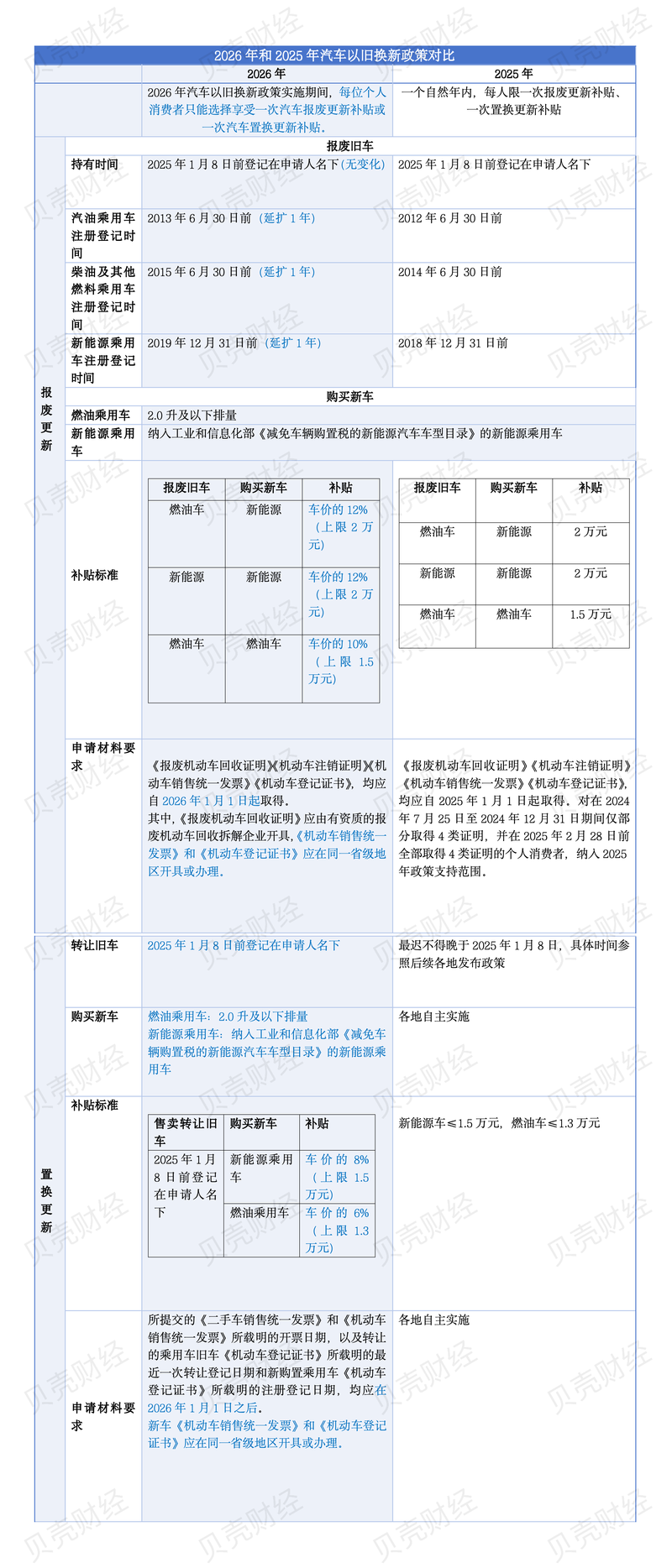
Core Viewpoint - The 2026 "old-for-new" vehicle policy introduces new subsidy measures aimed at promoting the purchase of new energy vehicles and low-emission fuel vehicles, with specific subsidy amounts tied to the vehicle price, maintaining the maximum subsidy limits from 2025. Group 1: Subsidy Details - Consumers scrapping a vehicle registered in their name can receive a subsidy of 12% of the vehicle price, capped at 20,000 yuan for new energy vehicles, and 10% of the vehicle price, capped at 15,000 yuan for fuel vehicles with an engine size not exceeding 2.0 liters [1] - For vehicle trade-ins, consumers can receive a subsidy of 8% of the vehicle price, capped at 15,000 yuan for new energy vehicles, and 6% of the vehicle price, capped at 13,000 yuan for fuel vehicles with an engine size not exceeding 2.0 liters [1] - The subsidy amounts for 2026 remain consistent with those of 2025, but the method of calculation has shifted from fixed amounts to a percentage of the vehicle price [1][4] Group 2: Policy Changes and Impact - The eligibility for scrapping old vehicles has been extended by one year, allowing more consumers to qualify for subsidies [4] - The 2026 policy is expected to benefit over 1,200 million vehicles, potentially driving new car consumption by nearly 1.5 million units [7] - The shift to a percentage-based subsidy is designed to better allocate fiscal resources and encourage the purchase of higher-value, environmentally friendly vehicles [7][8] Group 3: Market Dynamics - The previous fixed subsidy structure led to increased sales of lower-priced models, while the new policy may shift consumer preferences towards mid to high-end vehicles [5][8] - The change in subsidy structure is anticipated to alleviate the pressure of consumption downgrade in the automotive market, particularly benefiting vehicles priced around 150,000 yuan and above [8]
2026年汽车以旧换新补贴出炉:与车价挂钩,中高端车最受益
Xin Jing Bao· 2025-12-31 06:29
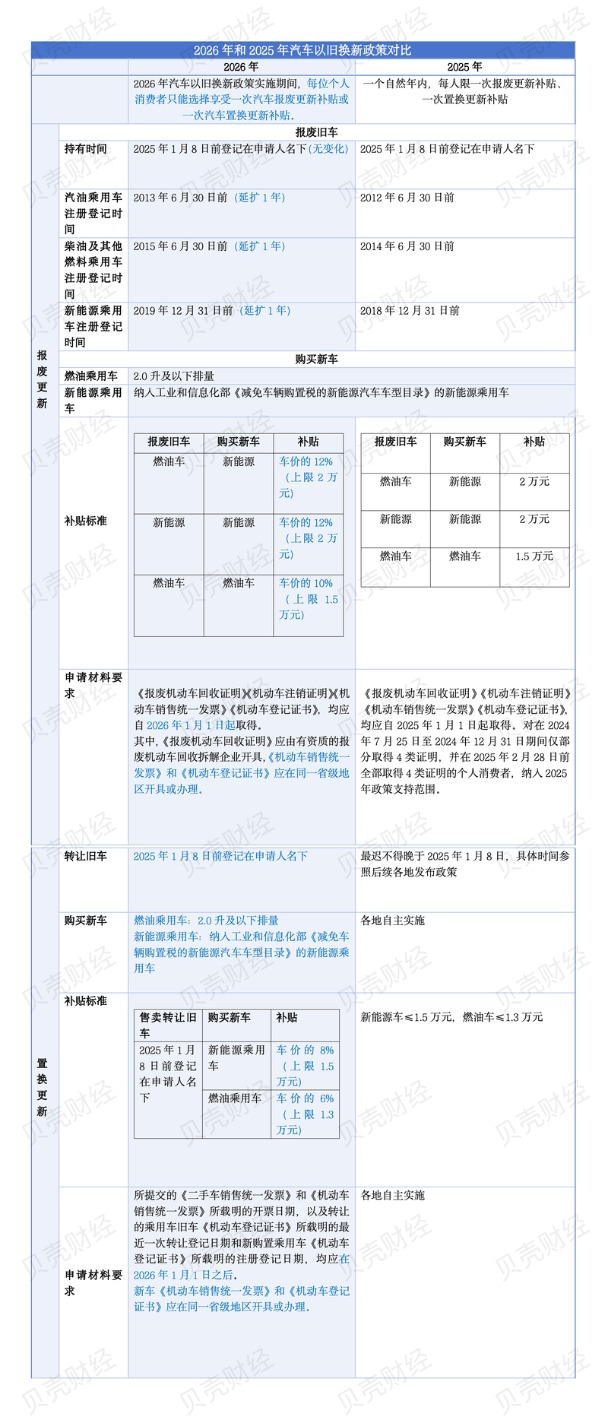
Core Viewpoint - The 2026 "old-for-new" vehicle policy introduces new subsidy measures aimed at promoting the purchase of new energy vehicles and fuel-efficient cars, with subsidies linked to vehicle prices rather than fixed amounts, maintaining the maximum subsidy limits from 2025 [1][4]. Subsidy Details - Consumers scrapping vehicles registered in their name can receive a subsidy of 12% of the vehicle price, capped at 20,000 yuan for new energy vehicles, and 10% of the vehicle price, capped at 15,000 yuan for fuel vehicles with an engine size of 2.0 liters or less [1]. - For vehicle trade-ins, consumers can receive 8% of the vehicle price, capped at 15,000 yuan for new energy vehicles, and 6% of the vehicle price, capped at 13,000 yuan for fuel vehicles with an engine size of 2.0 liters or less [1][4]. Policy Changes Compared to 2025 - The eligibility for scrapping subsidies has been extended by one year, allowing gasoline vehicles registered before June 30, 2013, and diesel vehicles registered before June 30, 2015, to qualify [4]. - The subsidy structure has shifted from fixed amounts to a percentage of the vehicle price, allowing for more precise targeting of subsidies based on vehicle value [4][6]. Impact on Vehicle Sales - The 2025 policy led to over 11.5 million vehicles being traded in, generating new car sales exceeding 1.6 trillion yuan, with more than half of retail sales in the passenger car market participating in the "old-for-new" program [5]. - The shift in subsidy structure is expected to drive sales of mid to high-end vehicles, as the subsidy for lower-priced models may decrease, potentially alleviating pressure on the automotive market from consumer downgrading [7]. Environmental and Structural Benefits - The new subsidy design aims to promote greener, low-carbon, and intelligent vehicle consumption, effectively guiding consumer behavior towards more advanced and environmentally friendly vehicles [6]. - The policy is projected to benefit over 12 million vehicles, stimulating new car consumption by nearly 1.5 million units in 2026, thus expanding the reach of the subsidy program compared to 2025 [6].