
汽车直播

Search documents
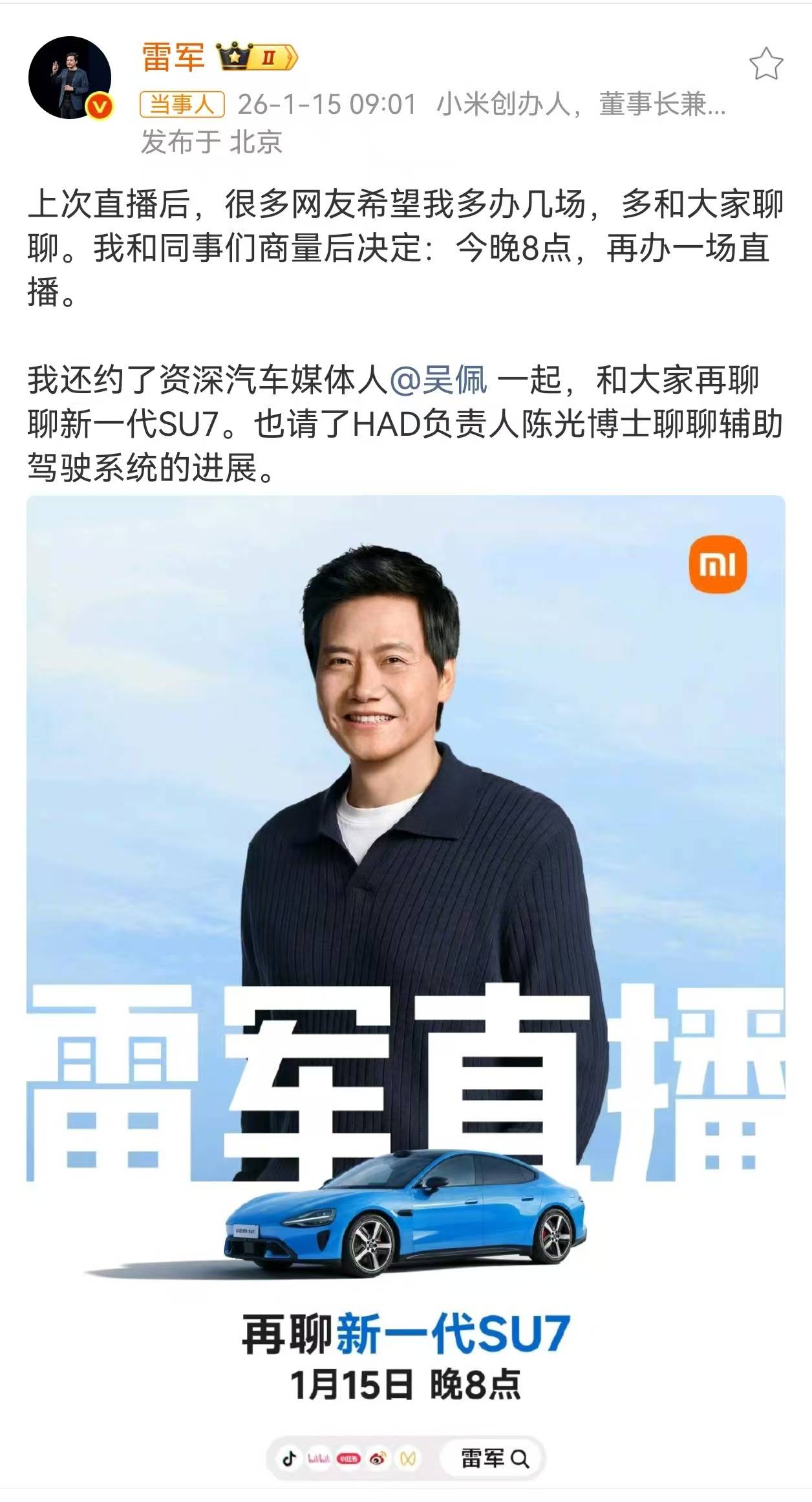
雷军:1月15日晚8点直播 再聊新一代SU7
Sou Hu Cai Jing· 2026-01-15 04:04
Group 1 - The core point of the article is that Lei Jun, the founder, chairman, and CEO of Xiaomi Group, announced a live stream on January 15 to discuss the new generation SU7 model [1] - This live stream will feature guest appearances from senior automotive media person Wu Pei and Dr. Chen Guang, head of Xiaomi HAD, who will explain the latest developments in the assisted driving system [5] - This marks the third live stream hosted by Lei Jun since the beginning of 2026, with previous sessions on January 3 and January 7 focusing on the Xiaomi YU7 model disassembly and addressing online concerns regarding the new generation SU7 [5]


哪种擦边,在卖车直播间流量最大
Hu Xiu· 2025-09-24 05:44
Core Viewpoint - The automotive live-streaming industry has undergone significant changes, moving away from provocative content to more professional approaches, as companies and hosts recognize the importance of genuine engagement over superficial attraction [3][30][31]. Industry Evolution - The automotive live-streaming sector initially thrived on provocative content, with hosts adopting revealing outfits to attract viewers and boost sales [5][11]. - Over time, the industry has shifted towards a more regulated environment, with brands now resisting "borderline" tactics that attract the wrong audience [30][33]. - The rise of regulations and changing viewer expectations have led to a decline in provocative content, with many hosts now opting for professional attire [30][35]. Host Experience - Hosts like Wu Xi have transitioned from traditional jobs to automotive live-streaming, finding it more lucrative, with earnings significantly surpassing previous salaries [14][19]. - The initial success of live-streaming was driven by a surge in demand for used cars, particularly during the pandemic, which allowed hosts to capitalize on market trends [22][23]. - Hosts are now focusing on building genuine connections with potential buyers, emphasizing the importance of lead generation over mere entertainment [26][41]. Market Dynamics - The automotive live-streaming market has become increasingly competitive, with hosts needing to innovate and differentiate themselves to attract and retain viewers [39][43]. - Companies are now setting specific targets for lead generation, reflecting a shift in focus from mere viewership to actionable sales leads [37][36]. - The automotive industry continues to rely on the appeal of female hosts, but the strategies employed have evolved to prioritize substance over style [47][41].
嗓子冒烟,线索掺水,汽车直播的“虚火”还能烧多久?
Hua Xia Shi Bao· 2025-08-06 08:48
Core Insights - The automotive live streaming industry is experiencing a dichotomy where the cost of customer acquisition has decreased significantly, yet the conversion rates remain low, leading to a challenging environment for dealers [1][3]. Group 1: Industry Trends - The automotive live streaming trend emerged during the pandemic in 2020, with dealers viewing it as a potential solution to declining foot traffic [1][2]. - 83% of dealers entered the live streaming space, attracted by the low cost of reaching potential customers compared to traditional advertising [2]. - Major brands like Xiaomi and BYD have successfully leveraged live streaming to boost sales, with Xiaomi's SU7 launch achieving 270 million views and generating 50,000 orders [2]. Group 2: Challenges Faced by Dealers - Despite the initial success, the industry is now facing challenges such as reduced organic traffic due to platform algorithm changes and high customer acquisition costs [3][4]. - The average cost of acquiring a lead through live streaming is 1,367 yuan, significantly higher than the conversion rates seen in traditional 4S dealerships [3][4]. - In lower-tier cities, dealers are struggling to balance sales targets with live streaming commitments, leading to internal conflicts and operational challenges [4]. Group 3: Shifts in Consumer Behavior - The shift from a "car-selling mindset" to a "user-centric mindset" is evident, with live streaming content focusing more on consumer experiences rather than technical specifications [3][5]. - A significant portion of viewers (78%) are in the information-gathering stage when they enter live streams, indicating that live streaming is not effectively catalyzing purchase decisions [4][5]. Group 4: Innovative Strategies - Some brands are exploring innovative strategies, such as integrating technical features into relatable scenarios, which has led to increased conversion rates [6][7]. - Collaborations with lifestyle brands have proven effective, with one brand achieving a 31% conversion rate from viewers to test drivers by showcasing outdoor activities [6][7]. - The introduction of a live streaming certification system by the China Automobile Circulation Association aims to enhance the professionalism and knowledge of live stream hosts [7]. Group 5: Future Outlook - The industry is moving towards a paradigm shift, focusing on quality interactions and effective conversion rather than just maximizing viewer numbers [7][8]. - The ultimate goal is to transform live streaming from a mere lead generation tool into a valuable connection between brands and consumers, emphasizing understanding consumer needs [7][8].