
擦边营销

Search documents
女员工也不放过,椰树越擦边越赚钱
盐财经· 2026-03-04 09:15
Core Viewpoint - The article discusses the ongoing controversies surrounding Coconut Tree Group, highlighting how the company has leveraged these controversies for marketing and brand exposure, despite the potential risks involved [9][10][19]. Group 1: Recent Controversy - During a factory open day, the company faced backlash due to inappropriate slogans displayed in the factory, which many found offensive [5][7]. - The event, initially intended to promote transparency, quickly turned into a public relations issue, with mixed reactions from the public [9][10]. - The company has a history of pushing boundaries with its marketing strategies, often resulting in fines but also increased visibility and sales [11][19]. Group 2: Historical Context - The company has faced multiple controversies since 2009, including provocative advertising that led to fines but also significant revenue growth [11][13]. - Despite facing penalties, the company’s revenue has consistently increased, indicating that controversies may have contributed to brand awareness and sales [11][19]. - The founder, Wang Guangxing, implemented significant changes in the 1980s that turned the company around, focusing on product quality and innovation [37][38]. Group 3: Financial Performance - The company’s revenue reached 50.98 billion yuan in 2023, marking a growth of over 10% compared to the previous year, ending a seven-year plateau [24][25]. - However, the growth has been inconsistent, with revenue stagnating around 40 billion yuan for several years before the recent surge [21][24]. - The company’s reliance on a single product, coconut juice, has become a concern as competition in the beverage market intensifies [26][27]. Group 4: Market Dynamics - The coconut water market has seen a compound annual growth rate of over 60% in recent years, with competitors gaining market share [27]. - Young consumers are increasingly favoring healthier beverage options, which poses a challenge for the company as it has not successfully diversified its product line [27][40]. - The company’s marketing strategies, which have relied heavily on controversy, may be losing effectiveness as consumer attitudes shift towards more respectful and value-driven branding [40][41].


椰树「擦边」近20年,被罚上百万,为何屡教不改?
36氪· 2026-03-03 09:16
Core Viewpoint - The article discusses the controversial marketing strategies of Yesheng Group, highlighting its repeated violations of advertising regulations and the economic value derived from "edgy marketing" tactics [4][12][19]. Group 1: Controversial Marketing Practices - Yesheng Group has faced multiple fines for its provocative advertising, including a 20,000 yuan fine in March 2019 for violating social norms and a 400,000 yuan fine in 2024 for using inappropriate slogans [4][6][8]. - The company has a history of "edgy marketing," with past incidents dating back to 2009, where it was fined for inappropriate advertisements on public transport [5][6]. - Despite the fines, Yesheng Group continues to use controversial slogans, indicating a "recognize the penalty but not the mistake" approach [4][12]. Group 2: Economic Impact and Sales Growth - Yesheng Group's sales have seen significant growth, with a 3.08% increase in 2023, reaching 5 billion yuan, and further growth projected for 2024 [15]. - The company reported a 33.25% increase in sales of its coconut water in 2025, marking a turnaround in its performance [15]. - The controversial marketing strategies have generated substantial traffic and economic value, contributing to the company's sales success [12][15]. Group 3: Leadership and Marketing Strategy - The founder, Wang Guangxing, plays a crucial role in the company's marketing strategies, emphasizing straightforward and visually appealing advertising [18][19]. - Wang has adapted to modern marketing trends, utilizing social media platforms for product promotion, which has led to successful live-streaming sales events [18][19]. - Despite the marketing success, the company has not yet achieved its long-term revenue goals, with a target of 10 billion yuan still unmet after over a decade [19].

“女员工胸这么大”再引争议!椰树“擦边”近20年,被罚上百万,为何屡教不改?
新浪财经· 2026-03-01 08:12
Core Viewpoint - The article discusses the controversial marketing strategies of Coconut Tree Group, highlighting their repeated use of provocative advertising that has led to multiple fines and public backlash, yet has also generated significant economic value and brand visibility [2][10][18]. Group 1: Controversial Advertising Practices - Coconut Tree Group has faced backlash for its advertising slogans, with recent complaints about lowbrow content, including phrases like "Coconut Tree female employees are so big" [2][3]. - The company has a history of being fined for violating social norms, including a 20,000 yuan fine in 2019 and a 400,000 yuan fine in 2024 for using inappropriate advertising language [5][7]. - Despite these penalties, the company continues to engage in "borderline marketing," which has proven effective in attracting attention and driving sales [10][13]. Group 2: Financial Performance and Marketing Impact - The sales revenue of Coconut Tree Group has shown growth, with a 3.08% increase in 2023, reaching 5 billion yuan, and further growth projected for 2024 [14]. - The company has leveraged live streaming and social media to boost sales, achieving significant viewer engagement and sales figures, with single live sessions generating between 100,000 to 250,000 yuan [10][14]. - The marketing strategies, particularly those orchestrated by founder Wang Guangxing, have been pivotal in creating a unique brand identity that resonates with consumers [15][17]. Group 3: Founder’s Vision and Goals - Wang Guangxing's marketing philosophy emphasizes straightforward and visually appealing advertising, which has shaped the company's branding approach [17]. - Despite the innovative marketing tactics, the company has not met its ambitious revenue targets, with a stated goal of reaching 10 billion yuan in revenue by 2020 still unmet [18].

擦边营销推波助澜 警惕“工具基”流量反噬
Zhong Guo Zheng Quan Bao· 2026-01-21 21:56
Core Viewpoint - The rise of "tool-based" funds in the public offering industry is driven by the strong performance of technology sectors, leading to a renewed focus on sector-specific investment strategies and marketing tactics that leverage internet platforms to attract investors [1][2][3]. Group 1: Tool-Based Funds - The strong momentum in technology growth has popularized "tool-based" active funds, which are designed to systematically invest in high-potential sectors [2][3]. - These funds have emerged as key investment vehicles for emerging industries lacking corresponding index products, allowing for concentrated holdings that can outperform traditional index funds [2][3]. - "Tool-based" funds have gained traction in various hot sectors, including AI computing, robotics, and innovative pharmaceuticals, reflecting a trend of increasingly specialized investment products [2][3]. Group 2: Marketing and Sales Strategies - Fund managers are utilizing internet channels, particularly social media platforms, to enhance the visibility and appeal of "tool-based" funds, targeting younger and more active investors [4][5]. - The marketing strategies include leveraging influencers to promote funds and using real-time updates on fund performance to create a sense of urgency and attract investments [4][5]. - The focus on performance marketing has amplified the short-term trading mentality among investors, potentially overshadowing risk considerations [4][5]. Group 3: Impact on Investors and Market Dynamics - The influx of capital into "tool-based" funds has led to significant growth in asset management scale, but it has also diluted the returns for existing investors due to increased competition for fund positions [6][7]. - High levels of concentrated holdings and rapid inflows can complicate fund management, increasing transaction costs and reducing flexibility in portfolio adjustments [6][7]. - The volatility associated with sudden capital inflows can lead to negative experiences for investors, especially if market conditions shift and previously high-performing sectors decline [6][7]. Group 4: Regulatory and Long-Term Considerations - The current marketing practices raise compliance concerns, as they may violate regulations regarding fund promotion and sales [5]. - Industry experts emphasize the need for a balance between short-term growth and long-term investor interests, advocating for a return to sustainable investment practices [7]. - Regulatory bodies are increasingly focused on fostering a healthier industry ecosystem that prioritizes long-term investment strategies and enhances investor satisfaction [7].
擦边营销推波助澜警惕“工具基”流量反噬
Zhong Guo Zheng Quan Bao· 2026-01-21 21:08
Core Viewpoint - The rise of "tool-based" funds in the public offering industry is driven by the strong performance of technology sectors, leading to a renewed focus on thematic investment strategies and aggressive marketing tactics that leverage internet platforms to attract investors [1][2][4]. Group 1: Tool-Based Funds - The strong momentum in technology growth has led to the emergence of "tool-based" active funds, which focus on specific high-growth sectors, providing a systematic approach to investment [1][2]. - These funds are designed to capitalize on emerging industries that lack existing index products, serving as targeted investment vehicles for niche markets [2][3]. - The popularity of "tool-based" funds is further enhanced by their ability to outperform traditional index products through concentrated holdings in high-growth areas [1][2]. Group 2: Market Dynamics - The influx of capital into "tool-based" funds is driven by short-term profit expectations, with significant funds flowing into sectors like AI, robotics, and innovative pharmaceuticals [2][3]. - The marketing strategies employed by fund managers focus on younger, more active investors through social media platforms, enhancing the visibility and appeal of these funds [4][5]. - The competitive landscape encourages fund managers to rapidly scale their operations by targeting trending sectors, often leading to concentrated holdings that may increase investment risks [2][3]. Group 3: Regulatory and Long-Term Considerations - Regulatory bodies are increasingly focused on establishing a healthier ecosystem within the fund industry, promoting long-term investment strategies and improving investor experiences [7]. - Fund managers are encouraged to balance their pursuit of scale and profit with the need to provide sustainable returns to investors, avoiding excessive focus on short-term market trends [7]. - The potential for negative impacts on investor experience and fund performance due to rapid inflows and subsequent outflows is a concern, particularly in volatile market conditions [6][7].
陷“擦边营销”争议 金帝巧克力道歉
Guo Ji Jin Rong Bao· 2026-01-13 07:06
Core Viewpoint - The controversy surrounding Jindi Chocolate's marketing content has led to significant public backlash, particularly due to a perceived inappropriate advertisement that sparked discomfort among consumers [1][2]. Group 1: Marketing Controversy - Jindi Chocolate faced criticism for a promotional post on Xiaohongshu that included the phrase "The bear gets bigger? Is it something you can hold?" which was interpreted as having vulgar implications [1][2]. - Consumers expressed their disapproval, with some parents stating they would not purchase the product for their children due to the inappropriate nature of the marketing [2]. Group 2: Company Response - In response to the backlash, Jindi Chocolate issued an apology on January 12, explaining that the controversial content was generated by an "automatic optimization feature" of their marketing system, which led to unintended display of inappropriate material [2][4]. - The company has since hidden the related content, paused all marketing related to the golden bear chocolate, and formed a special team to review the risks associated with their marketing system [4]. Group 3: Public Reaction - The initial apology did not quell the controversy; instead, it intensified criticism, with many consumers dismissing the "automatic optimization" explanation as an excuse [5]. - Following the backlash, Jindi Chocolate retracted their first apology and issued a second one, clarifying that the controversial image was neither manually written nor AI-generated, and that the content could not be monitored during the marketing process [5]. Group 4: Brand Impact - The incident has negatively impacted Jindi Chocolate's brand reputation, with many consumers expressing their discontent in the comments section of the apology, stating they have removed the brand from their shopping carts and unfollowed it [7]. - Jindi Chocolate, originally established in 1990 and a leading domestic chocolate brand, was acquired by Haolinjia Co. in 2016 and is currently attempting to revive its brand by appealing to consumers' childhood memories [8].
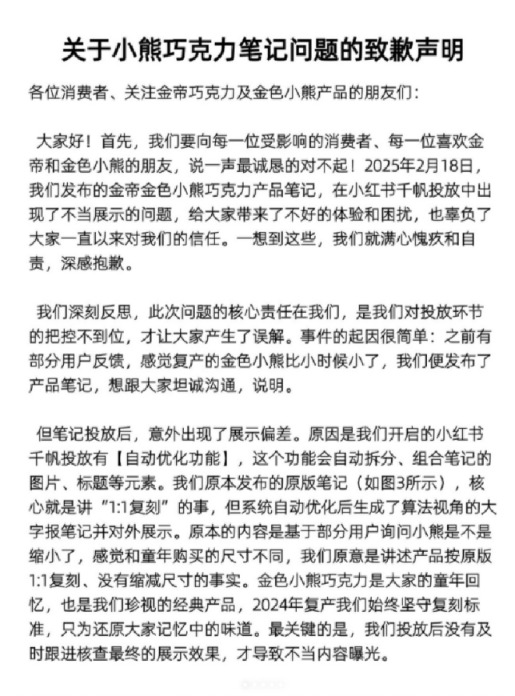
被质疑“擦边营销”,知名品牌致歉:广告内容是系统自动生成,账号运营不是男生
Mei Ri Jing Ji Xin Wen· 2026-01-12 16:54
Core Viewpoint - The recent marketing display by Jindi Chocolate has sparked controversy due to perceived inappropriate advertising language, leading to public backlash and the company issuing multiple apologies [1][5][19]. Group 1: Incident Overview - Jindi Chocolate, a brand associated with childhood memories for many, faced criticism for a social media post that included a phrase interpreted as inappropriate, which was later removed [1][5]. - The controversy arose from a marketing campaign that aimed to address consumer feedback about the size of their product, the "Golden Bear" chocolate, which some customers felt was smaller than they remembered [5][8]. Group 2: Company Response - On January 12, Jindi Chocolate released two versions of an apology statement, with the first acknowledging responsibility for the misunderstanding and outlining corrective measures, including pausing all related advertising and implementing a comprehensive review process [5][6][19]. - The second version of the apology emphasized that the controversial content was generated by an automated system and not manually created by the marketing team, which sparked further debate among consumers [9][19]. Group 3: Brand Background - Jindi Food Co., Ltd. was established in April 2017, with its roots tracing back to a company founded in 1990. It was restructured after being acquired by a parent company in 2016, focusing on reviving childhood memories through its products [20]. - The brand has a history of significant sales, reaching approximately 600 million yuan in national sales around 2012, indicating its strong market presence in the past [20].

椰树彻底不装了,“大尺度”新年挂历炸翻全网!
商业洞察· 2026-01-12 09:26
Core Viewpoint - The article discusses the transformation of the marketing strategy of the company "椰树" (Coconut Tree) in response to regulatory pressures and declining growth, shifting from provocative advertising to a focus on brand storytelling and product quality [4][10][32]. Group 1: Marketing Strategy Shift - The 2026 calendar of椰树 marks a significant change in its marketing approach, moving away from previous provocative imagery to a more inspirational narrative featuring the founder's story [4][10][30]. - The company has abandoned its previous "edgy marketing" style, which included the use of attractive models and suggestive advertising, in favor of a more conservative and motivational presentation [15][21]. - Following a fine of 400,000 yuan in 2024 for violating advertising regulations,椰树 has altered its promotional content to avoid further penalties, indicating a serious response to regulatory scrutiny [18][28]. Group 2: Financial Performance and Market Position -椰树's revenue growth has stagnated, with 2024's revenue at 5.006 billion yuan, only a 0.12% increase from 2023, highlighting the challenges faced by the company in a competitive market [28]. - The company experienced a significant drop in market share from 75% in 1999 to 26.3% in 2019, reflecting increased competition and the need for a strategic pivot [23]. - Despite the challenges,椰树's revenue grew from 4.616 billion yuan in 2021 to 5.099 billion yuan in 2023, with a notable sales volume of 700,000 tons in 2023, indicating a temporary success in leveraging new marketing strategies [27]. Group 3: Product Quality and Brand Narrative -椰树's commitment to product quality is emphasized, with a focus on not using artificial flavors or preservatives, and employing proprietary technology to enhance product shelf life [31]. - The brand narrative now centers around the founder's journey of transforming a struggling factory into a leading industry player, which serves to build a resilient brand image [30][32]. - The positive consumer response to the new marketing approach, as evidenced by high demand for the 2026 calendar, suggests that a focus on genuine storytelling and product integrity resonates more with customers than previous sensational tactics [30][32].

回力男鞋广告黑丝“擦边”被骂上热搜,冤吗?
凤凰网财经· 2025-12-12 13:08
Core Viewpoint - The article discusses the controversial marketing strategies employed by the Chinese footwear brand, Warrior, particularly focusing on the use of provocative imagery in their advertisements, which has sparked public debate about the appropriateness and effectiveness of such tactics in brand promotion [1][8]. Group 1: Marketing Strategies - Warrior's marketing strategy has increasingly involved the use of female models wearing black stockings to showcase men's shoes, which has raised eyebrows and led to accusations of inappropriate advertising [2][4]. - The brand's official Douyin account has consistently featured videos where women's legs in black stockings are prominently displayed alongside the products, indicating a deliberate choice to attract attention through sexualized imagery [2][4][6]. - This approach has not only drawn criticism but also reflects a broader trend in the industry where brands utilize provocative content to capture consumer interest, despite potential backlash [6][8]. Group 2: Brand Perception and Challenges - The use of such marketing tactics risks alienating consumers, particularly women, who may find the objectification offensive, potentially harming brand loyalty and consumer perception [9][22]. - Warrior has a history of controversial marketing, including a previous campaign that was criticized for being overly dramatic and "pity marketing," which suggests a pattern of struggling to find effective promotional strategies [9][12]. - The brand's identity as a nostalgic national product is challenged by its inability to compete with more established sports brands in terms of quality and innovation, leading to a reliance on emotional marketing rather than product excellence [11][12][22]. Group 3: Sales Performance and Market Position - Warrior's online sales have become increasingly significant, accounting for approximately 50% of total sales, with notable successes during major shopping events like Double Eleven [11]. - However, recent reports indicate that Warrior has fallen out of the top rankings in the sports shoe category on platforms like Tmall, suggesting a decline in market competitiveness [11][12]. - The brand's pricing strategy remains focused on affordability, with products typically priced between tens to a little over a hundred yuan, but this low-cost positioning may not be sustainable in the face of rising quality expectations from consumers [13][14].

哪种擦边,在卖车直播间流量最大
Hu Xiu· 2025-09-24 05:44
Core Viewpoint - The automotive live-streaming industry has undergone significant changes, moving away from provocative content to more professional approaches, as companies and hosts recognize the importance of genuine engagement over superficial attraction [3][30][31]. Industry Evolution - The automotive live-streaming sector initially thrived on provocative content, with hosts adopting revealing outfits to attract viewers and boost sales [5][11]. - Over time, the industry has shifted towards a more regulated environment, with brands now resisting "borderline" tactics that attract the wrong audience [30][33]. - The rise of regulations and changing viewer expectations have led to a decline in provocative content, with many hosts now opting for professional attire [30][35]. Host Experience - Hosts like Wu Xi have transitioned from traditional jobs to automotive live-streaming, finding it more lucrative, with earnings significantly surpassing previous salaries [14][19]. - The initial success of live-streaming was driven by a surge in demand for used cars, particularly during the pandemic, which allowed hosts to capitalize on market trends [22][23]. - Hosts are now focusing on building genuine connections with potential buyers, emphasizing the importance of lead generation over mere entertainment [26][41]. Market Dynamics - The automotive live-streaming market has become increasingly competitive, with hosts needing to innovate and differentiate themselves to attract and retain viewers [39][43]. - Companies are now setting specific targets for lead generation, reflecting a shift in focus from mere viewership to actionable sales leads [37][36]. - The automotive industry continues to rely on the appeal of female hosts, but the strategies employed have evolved to prioritize substance over style [47][41].