流动性短缺

Search documents
暴涨暴跌,白银寻底之路为何如此坎坷?
Jin Shi Shu Ju· 2026-02-06 08:46
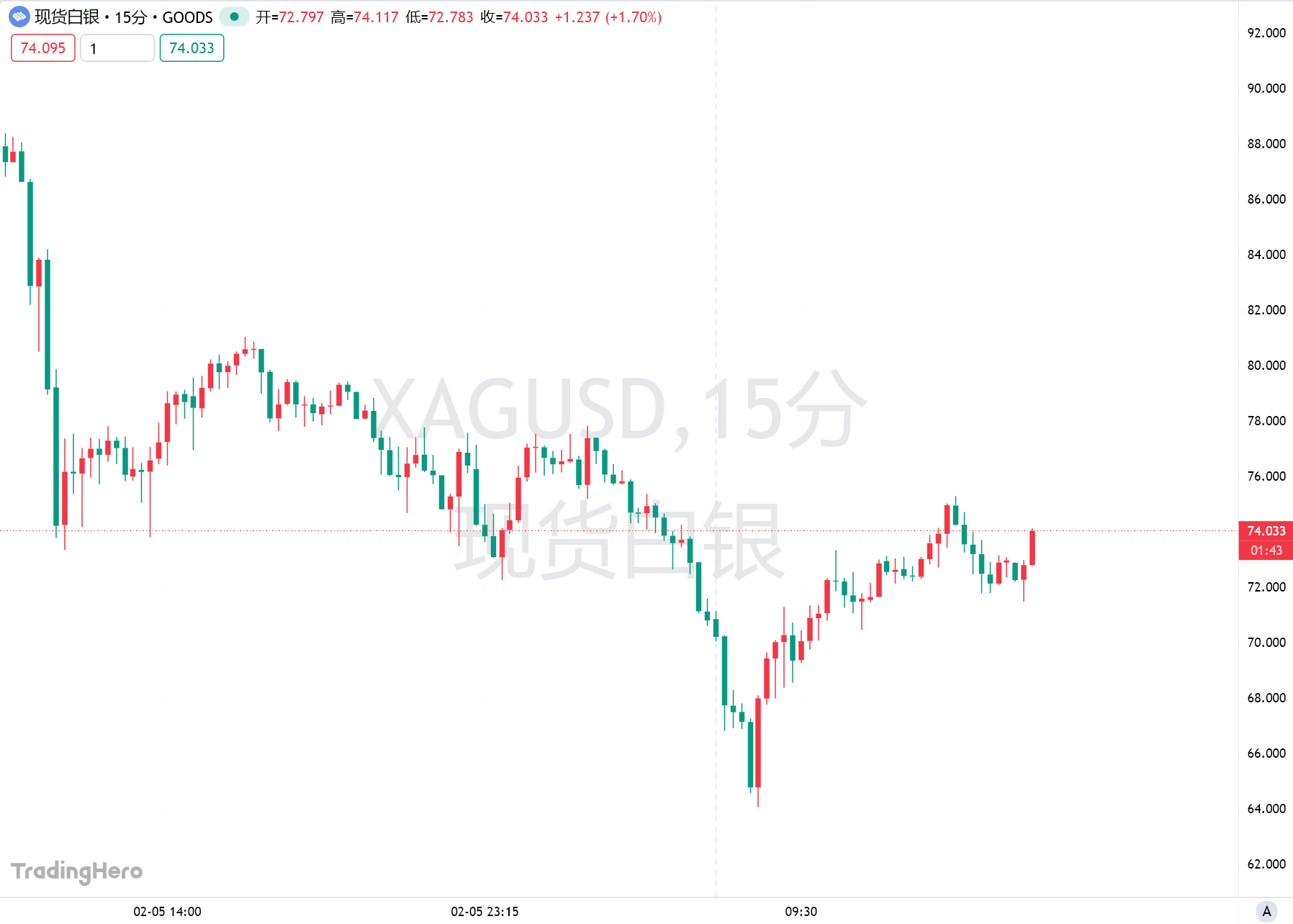
Core Viewpoint - The silver market is experiencing extreme volatility due to liquidity shortages, with prices fluctuating dramatically, including a near 10% drop followed by a rapid rebound, indicating a struggle to find a bottom [1][4]. Group 1: Price Movements and Market Dynamics - Silver prices have seen a maximum increase of 6.2% during Asian trading on Friday, after previously dropping to $64 per ounce, reflecting significant volatility [1]. - The recent price fluctuations have set a record for the largest volatility since 1980, with silver prices down over one-third since reaching a historical peak on January 29 [4]. - The Shanghai Futures Exchange's silver holdings have fallen to a four-year low, indicating that investors are increasingly closing their positions due to market instability [4]. Group 2: Market Participants and Behavior - Analysts note that long positions are being forced to liquidate while short positions are taking profits, as investors prefer to hold lighter positions ahead of the upcoming Chinese New Year holiday [5]. - The extreme movements in silver prices are driven more by positioning and volatility factors rather than sudden changes in the physical metal market [6]. Group 3: Comparison with Gold - The volatility in silver is nearly three times that of gold, with the Chicago Options Exchange silver ETF volatility index around 95, compared to gold's index of approximately 36 [8]. - Despite both metals facing similar macroeconomic conditions, gold is viewed as a more stable investment due to its larger market liquidity and demand from central banks, which helps to support its price [8][10]. - Analysts believe that while silver has entered a bear market, gold is likely to maintain an upward trend, with a potential price target of $6,000 per ounce in the next 6 to 12 months [10][11].

This Has Been A Wild Day Of Trading In The Gold & Silver Markets
Kingworldnews· 2025-12-12 17:34
Core Insights - The recent FOMC statement indicates a resumption of money-printing, which is expected to undermine the dollar by 2026, leading to increased inflation estimates and rising gold and silver prices [3][10] - Silver has shown remarkable price momentum, with significant liquidity shortages in the market, raising concerns about the ability to meet delivery obligations [3][6][9] Group 1: Gold Market Dynamics - Gold prices have risen significantly, with a reported price of $4318, up $220, indicating a positive trend in the market [6] - Open interest in gold on Comex increased by 25,644 contracts, suggesting that investors are beginning to take leveraged positions anticipating higher prices [11] - There is potential for open interest to increase by another 100,000 contracts before reaching overbought conditions, which could drive gold prices even higher [15] Group 2: Silver Market Dynamics - Silver prices have surged to $64.10, up $5.90, driven by strong momentum despite a lack of speculative demand from futures investors [6][7] - The decline in open interest since silver's peak on October 20 indicates that speculative investors have exited the market, leaving it vulnerable to liquidity issues [7] - The current market conditions suggest that silver prices will continue to rise until a significant market disruption occurs or authorities intervene, with potential implications for the broader financial system [9] Group 3: Broader Economic Implications - The tightening of export licenses in China and increased industrial demand in India are contributing to upward pressure on silver prices, highlighting the interconnectedness of global markets [8] - The potential for a financial crisis looms if the silver derivative markets break down, which could have cascading effects on other commodities and metals [9][16] - The resumption of quantitative easing (QE) is expected to have inflationary implications, further influencing the demand for precious metals [10]

突发清盘了。。
Ge Long Hui· 2025-11-14 09:04
Core Viewpoint - Michael Burry, a well-known short-seller, has announced the closure of his fund, Scion Asset Management, raising questions about his market outlook and signaling potential concerns about the current state of the AI and tech stock market bubble [1][8]. Group 1: Michael Burry's Actions - Burry has been betting against U.S. tech stocks, particularly those involved in AI, believing that the market is experiencing an unsustainable bubble similar to the 2000 internet bubble [6][10]. - The closure of his fund means he will no longer be required to publicly disclose his holdings, allowing him to operate privately [9]. - Burry's past experiences during the 2008 financial crisis, where he faced significant pressure and skepticism from investors, may have influenced his decision to exit the market quietly this time [9][10]. Group 2: Market Conditions - The U.S. stock market has recently faced significant declines, with major indices experiencing their worst performance since October 10, 2023, driven by a sell-off in tech stocks [10][12]. - Valuation data indicates that major U.S. indices are at high levels, with the Nasdaq index showing a year-to-date increase of 18.43% and a PE ratio of 41.04, placing it in the 65.43 percentile [14]. - The market is currently under pressure from dual factors: liquidity shortages and unstable interest rate expectations, which have contributed to the recent downturn [20][21]. Group 3: Liquidity and Interest Rate Expectations - A liquidity shortage has worsened due to a 44-day government shutdown, freezing funds that would typically enter the market, while increased U.S. debt issuance has further drained cash from the system [17]. - Recent shifts in interest rate expectations have also impacted the market, with the probability of a Federal Reserve rate cut dropping significantly due to internal disagreements among Fed officials [18][19]. - The combination of liquidity issues and fluctuating interest rate expectations has created a challenging environment for tech stocks, leading to increased volatility and investor caution [20][21].

“避险+降息”双引擎点燃贵金属行情!黄金续创新高站上4180美元 白银同步走强
Zhi Tong Cai Jing· 2025-10-15 02:14
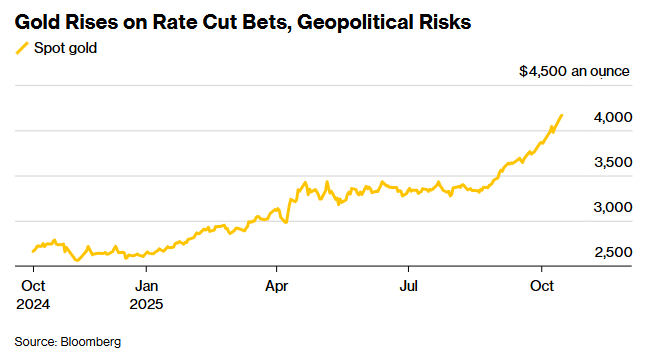
Group 1 - Gold prices have reached record highs due to escalating US-China trade tensions and expectations of further interest rate cuts by the Federal Reserve, with spot gold rising nearly 1% to around $4180 per ounce, previously hitting a high of $4185 per ounce [1] - Silver prices also increased, with spot silver rising 1.5% to $52.2 per ounce after experiencing significant volatility [1] - The US Treasury yields have dropped to their lowest levels in weeks, and Fed Chairman Powell indicated a potential 25 basis point rate cut later this month, despite the government shutdown affecting economic assessments [3] Group 2 - Risk aversion in the market has heightened the appeal of gold as a safe-haven asset, supported by concerns over the independence of the Federal Reserve and the ongoing government shutdown [3] - A liquidity shortage in the London silver market has triggered a global rush for physical silver, causing the benchmark spot price to rise significantly above New York futures prices [3] - The prices of the four major precious metals have increased between 58% to 80% this year, driven by central bank purchases, increased ETF holdings, and the Fed's rate cuts [3]