海南封关政策红利

Search documents
中国中免:Q4盈利能力稳步改善-20260323
HTSC· 2026-03-23 02:40
Investment Rating - The investment rating for the company is "Buy" for both A-shares and H-shares, with target prices set at RMB 101.15 and HKD 93.24 respectively [7]. Core Insights - The company reported a revenue of RMB 53.69 billion for 2025, a year-on-year decrease of 4.92%, and a net profit attributable to shareholders of RMB 3.59 billion, down 15.97% year-on-year, slightly below previous expectations. However, the second half of 2025 showed signs of recovery with a revenue increase of 1.3% year-on-year [1][5]. - The company is effectively leveraging the historical opportunity presented by the Hainan duty-free policy and the full island closure, resulting in record high customer traffic and sales during the Spring Festival [2]. - The gross profit margin improved by 0.51 percentage points year-on-year, reaching approximately 32.5% for the year, with a significant increase of 4.12 percentage points in Q4 2025 [3]. Summary by Sections Financial Performance - For Q4 2025, the company achieved a revenue of RMB 138.31 billion, a year-on-year increase of 2.81%, with a gross profit of approximately RMB 4.5 billion, leading to a gross margin of about 32.7% [1][3]. - The net profit for Q4 2025 was RMB 5.34 billion, reflecting a year-on-year increase of 53.49%, and a significant increase of 150.63% when excluding goodwill impairment [3]. Market Opportunities - The Hainan duty-free market is showing signs of recovery, with shopping amounts reaching RMB 10.59 billion in January-February 2026, a year-on-year increase of 25.9% [4]. - The company is strategically acquiring quality assets such as DFS and introducing LVMH as a strategic shareholder, which is expected to enhance its leadership in the tourism retail sector [2]. Profit Forecast and Valuation - The forecast for net profit attributable to shareholders is adjusted to RMB 3.586 billion for 2025, RMB 5.068 billion for 2026, and RMB 5.987 billion for 2027, with corresponding EPS estimates of RMB 1.73, RMB 2.45, and RMB 2.89 [5][11]. - The target price for A-shares is adjusted to RMB 101.15, reflecting a target PE of 41x for 2026, while the target price for H-shares is set at HKD 93.24, corresponding to a target PE of 34x for 2026 [5].

中国中免涨近4% 海南封关政策红利持续释放 大摩对海南旅游零售业前景持正面看法
Zhi Tong Cai Jing· 2026-01-09 01:51
Core Viewpoint - China Duty Free Group (601888)(01880) saw a nearly 4% increase in stock price, currently at 84 HKD, with a trading volume of 50.17 million HKD, indicating positive market sentiment driven by tourism growth in Hainan [1] Group 1: Tourism Market Performance - During the New Year's holiday in 2026, Hainan's tourism market experienced a strong start, with 2.1716 million visitors, representing a year-on-year increase of 25.2% [1] - The total tourism revenue reached 3.136 billion CNY, marking a year-on-year growth of 28.9%, with revenue growth outpacing visitor growth by 3.7 percentage points, indicating an ongoing optimization of consumption structure [1] Group 2: Industry Outlook - Guoyuan International's report highlights that the benefits of the closure policy and diversified product offerings will drive Hainan's tourism market into a new phase of high-quality development [1] - Morgan Stanley's report expresses a positive outlook for Hainan's tourism retail sector, citing factors such as gradual macroeconomic recovery, positive wealth effects, expansion of product categories, and policy support [1] - Morgan Stanley forecasts that by Q4 2025, China Duty Free Group's revenue, operating profit, and net profit will grow by 19%, 92%, and 135% year-on-year, respectively, although it anticipates a 1% and 9% decline in annual revenue and profit for the full year [1] - Looking ahead to 2026, Morgan Stanley expects Hainan's duty-free market to grow by 25% to 30%, which will drive a 44% increase in profitability for China Duty Free Group [1]
海南封关后,中产和资本抢着南下淘金
Sou Hu Cai Jing· 2025-12-31 04:13
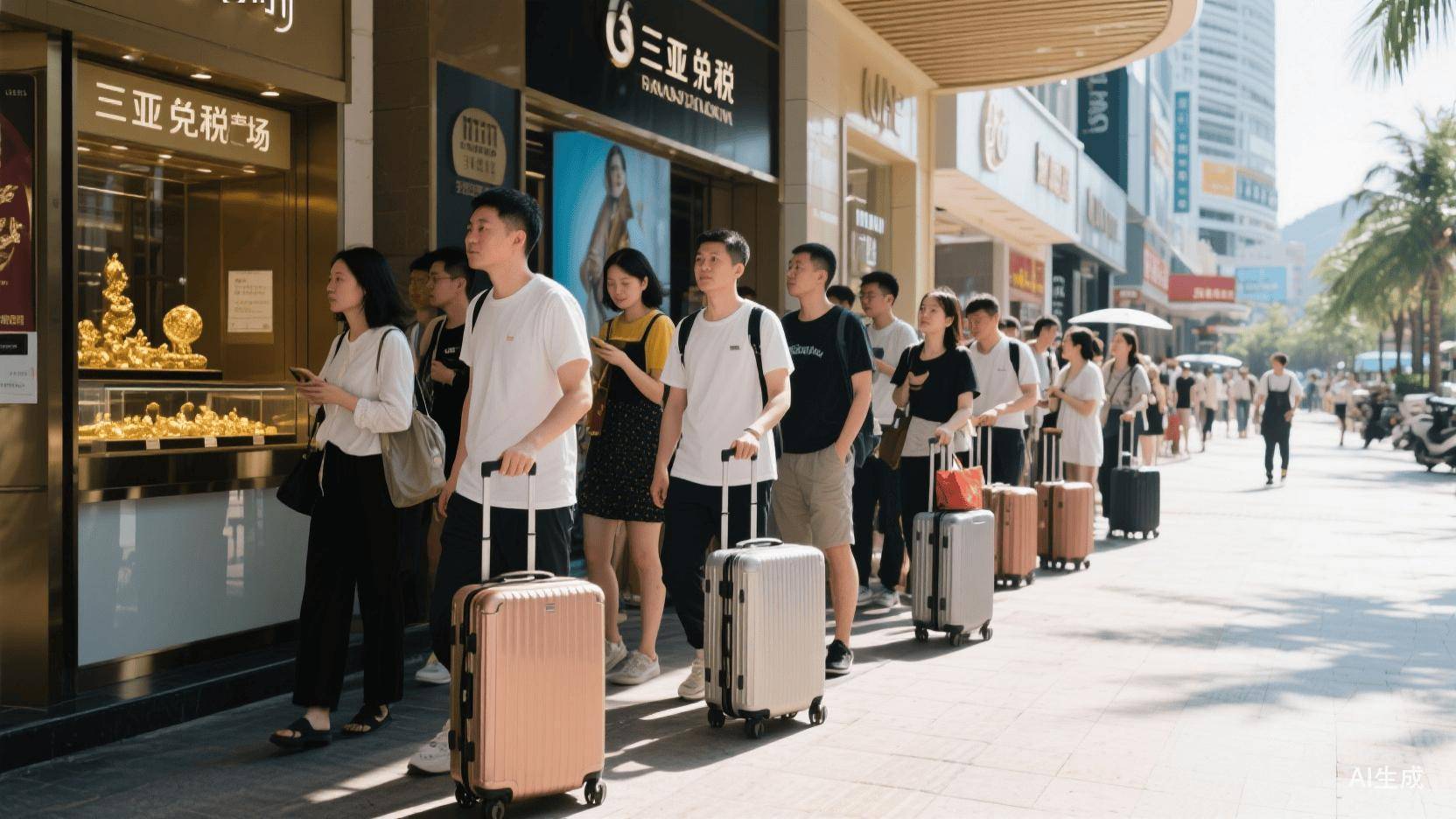
Core Insights - The launch of the Hainan Free Trade Port has opened a low-cost gold purchasing window, leading to a surge in gold consumption and investment opportunities in the region [2][5][7] Policy Changes - Hainan's new policies emphasize "zero tariffs, low tax rates, and simplified tax systems," allowing most imported goods to enter without tariffs, significantly increasing the proportion of zero-tariff items from approximately 21% to 74% [2][6] - The personal shopping tax exemption has been raised to 100,000 yuan per person per year, enhancing consumer purchasing power [2] Market Dynamics - In the first six days post-closure, duty-free sales in Sanya reached 630 million yuan, a 47.2% increase year-on-year, indicating strong consumer demand [3] - The price of duty-free gold in Hainan was significantly lower than taxed prices, creating a compelling incentive for consumers to purchase gold [5] Industry Developments - Major gold companies like Zijin Mining and China Gold are establishing operations in Hainan, focusing on gold processing and regional headquarters [4][8] - The establishment of a new international business headquarters by Zijin Mining in Sanya and a new subsidiary by China Gold highlights the growing interest in the region's gold market [8] Consumer Behavior - The influx of middle-class consumers seeking gold has been noted, with reports of significant savings on gold purchases, further driving demand [7][10] - The trend of purchasing gold for personal asset allocation is becoming more prevalent, with consumers traveling to Hainan specifically for this purpose [6][10] Future Outlook - The ongoing "gold rush" is expected to continue as long as gold prices remain favorable, although market risks and price volatility are acknowledged [14][15] - The long-term opportunities in Hainan's gold market will depend on the overall industrial ecosystem developed post-closure, rather than just price differences [14]



海南封关后,中产和资本抢着南下淘金
投中网· 2025-12-31 03:04
Core Viewpoint - The article discusses the significant opportunities arising from the recent policy changes in Hainan, which have created a favorable environment for gold purchases and investments, particularly benefiting the middle class and the gold industry as a whole [5][6][10]. Policy Changes and Economic Impact - Hainan's free trade port has implemented a "zero tariff" policy, allowing most imported goods to enter without tariffs, VAT, or consumption tax, significantly increasing the proportion of zero-tariff goods from approximately 21% to 74% [5][10]. - The number of foreign-funded enterprises in Hainan surged by 230% in the first week after the closure, indicating a strong interest in the region's economic potential [5]. - The personal shopping tax exemption has been raised to 100,000 yuan per person per year, enhancing consumer purchasing power [6]. Gold Market Dynamics - The gold price in Hainan has seen a significant reduction, with tax-free gold priced at 1,180 yuan per gram compared to 1,356 yuan per gram for taxed gold, creating a price advantage of 176 yuan per gram [9]. - The demand for gold has surged, with sales in Sanya's duty-free shops reaching 630 million yuan in just six days, a 47.2% increase year-on-year [6]. Industry Opportunities - Major gold companies like Zijin Mining and China Gold are establishing operations in Hainan, focusing on gold processing and trading, which indicates a shift towards enhancing the local gold industry [13][14]. - The article highlights the establishment of new companies and investment in gold processing facilities, such as Zijin Mining's international business headquarters in Sanya [13][14]. Consumer Behavior and Market Trends - The influx of middle-class consumers seeking gold has been described as a "gold rush," with reports of significant savings on gold purchases due to the new tax policies [10][19]. - The article notes that the current gold buying frenzy is largely driven by expectations of rising gold prices, with retail prices recently exceeding 600 yuan per gram [20]. Risks and Considerations - The article warns of potential risks associated with gold purchases, including tax implications for exceeding personal exemption limits and the volatility of gold prices [16][19]. - The regulatory environment is tightening, with measures in place to monitor high-frequency buyers in duty-free shops, indicating a need for consumers to be cautious [18].
海南封关消息炸锅!日本人喜忧参半,日企纠结要不要进场捞金?
Sou Hu Cai Jing· 2025-12-25 22:05
Core Insights - The opening of Hainan's zero-tariff policy marks a significant shift in trade dynamics, with the first day seeing a total value of 360 million yuan in goods entering the island, indicating a new era for the region [1] - Japanese companies are weighing the benefits of relocating operations to Hainan to take advantage of tax incentives and reduced costs, despite facing challenges related to regulatory compliance and competition [3][4] Group 1: Economic Impact - The value of zero-tariff goods entering Hainan on the first day reached 360 million yuan, symbolizing the start of a new trade era [1] - The number of zero-tariff products has expanded from 1,900 to 6,600, increasing coverage from 20% to 74%, with an annual tax-free allowance of up to 100,000 yuan per person [3] - Logistics costs are significantly reduced, with fuel prices at Hainan's Yangpu Port being 8% lower than in Singapore, saving up to 240,000 yuan per refueling for large vessels [3] Group 2: Business Opportunities - Japanese companies are exploring the potential of relocating production to Hainan, with one chocolate factory owner estimating an 80% reduction in annual costs by moving operations [3] - The opening of the seventh freedom of the air allows Japanese goods to fly directly from Tokyo to Haikou, facilitating easier access to Southeast Asian markets [4] - Major Japanese firms like Takeda Pharmaceutical are investing heavily in Hainan, with plans to invest over 15 billion USD in three years and a partnership worth 11.4 billion USD for innovative drug development [9] Group 3: Challenges and Considerations - Japanese companies face regulatory hurdles, such as the requirement for a 30% value addition in Hainan to qualify for tax exemptions, which complicates their decision-making [4][6] - Concerns about core technology leakage and the need for comprehensive employee welfare and regulatory compliance are causing hesitation among Japanese firms [6] - The competitive landscape is shifting, with Japan's industrial electricity prices being 60% higher than those in Hainan, and a younger labor force in Hainan presenting a potential advantage [6] Group 4: Strategic Collaborations - A memorandum of cooperation was signed between Hainan's trade promotion agency and the Kansai Chinese Chamber of Commerce, focusing on green energy and healthcare as key collaboration areas [8] - Companies like Mitsubishi Corporation are establishing regional R&D centers in Hainan, while Mizuho Bank is creating a one-stop financial service platform for Japanese businesses [9] - Educational partnerships are forming, such as the joint establishment of a research center by Waseda University and Hainan University to support long-term talent development for Japanese firms [9]