
消费驱动模式

Search documents
专家表示:提升百姓生活水平和消费能力,这是必须解决的后顾之忧
Sou Hu Cai Jing· 2025-11-22 14:08
Group 1 - China's economy is undergoing a profound transformation, shifting from high-speed growth to a focus on high-quality and sustainable development by 2025, with challenges such as insufficient consumer spending and low economic expectations [1] - The Chinese Communist Party's 20th Central Committee meeting has outlined reform directions, emphasizing the need to activate consumer spending and address inefficiencies in resource allocation [1] - The transition from the 1B model (local government-led market) to a more mature 2B model (market economy with macroeconomic regulation) is a core task for China's economic reform [7][9] Group 2 - The 1B model's over-reliance on local government intervention has led to market failures and inefficiencies, restricting the normal functioning of market mechanisms [7] - The 2B model emphasizes the market's leading role in resource allocation, with the government acting as a referee to ensure stable economic growth [9] - The government is encouraged to ensure fair competition for private enterprises and address financing and approval obstacles they face [11] Group 3 - China's historical focus on infrastructure and industrial investment has neglected consumer spending, which remains low and is a significant constraint on healthy economic growth [13] - Over-investment in industries like real estate and infrastructure has not effectively improved the living standards and consumption capacity of the general public [15] - Reforming the economic structure to shift focus from industrial investment to consumption-driven growth is crucial for China's economic transition [17] Group 4 - Increasing investment in social security, particularly in areas like elderly care and healthcare, is essential to enhance consumer confidence and purchasing power [19] - Tax and financial policies need to support consumer spending while ensuring fiscal revenue, presenting a challenge for the government [19] - Technological innovation is a vital component of China's economic transformation, requiring a shift from imitative to disruptive innovation to enhance core competitiveness [21] Group 5 - The government should promote reforms in the technology innovation system, providing more freedom for researchers and encouraging original and breakthrough innovations [23] - Current research evaluation systems need reform to support deep innovation and long-term investment, with more support for innovative enterprises and research institutions [23] - China's future economic growth will rely on promoting consumption and innovation, transitioning from a high-investment, low-consumption model to a consumption-driven model [25]


华尔街谈LABUBU与茅台:似曾相识还是范式转移?
Hua Er Jie Jian Wen· 2025-06-24 02:18
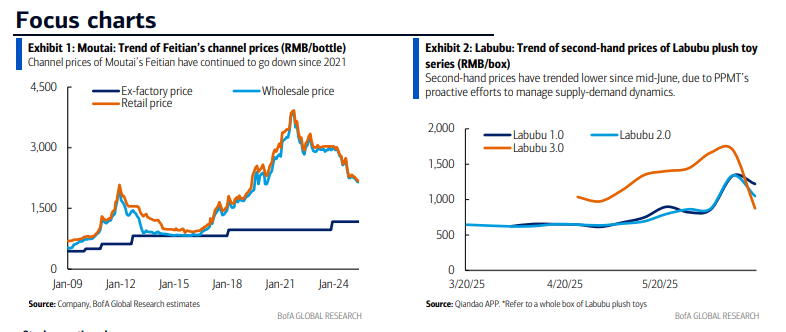
Core Insights - The report from Bank of America compares Labubu, a trendy IP, to the traditional liquor giant Moutai, highlighting the differences in their social currency attributes and consumer engagement [1][2] - Labubu's appeal is rooted in the interests and values of the younger generation, while Moutai's social function is tied to power and hierarchy, reflecting a shift from traditional to new consumption patterns [1][2] Group 1: Social Currency and Consumer Behavior - Labubu and Moutai both possess social currency but differ in generational appeal; Moutai serves as a "social/business lubricant," while Labubu caters to emotional value in a digital social media context [2] - The transition from an investment-driven model to a consumption-driven model in China is indicated by Labubu's success, which aligns with global trends [2] Group 2: IP Lifecycle and Investment Attributes - Both Bubble Mart and Moutai face challenges related to IP lifecycle and investment attributes, with the potential for slowed global growth if there is a long gap between Labubu and the next hit IP [3][4] - The historical resilience of Moutai, with its centuries of legacy, contrasts with the relatively short histories of Bubble Mart and Labubu, which are 15 and 10 years old respectively [4] Group 3: Regulatory and Market Risks - Regulatory risks are significant for both Moutai and Bubble Mart, with the latter facing scrutiny as its consumer base diversifies; however, its growing overseas business may mitigate some risks [7] - The phenomenon of "crowded trades" in capital markets, similar to the influx of funds into Moutai from 2016 to 2021, is now observed in the new consumption sector represented by Bubble Mart [8]

美国GDP现负增长,美经济真已陷入滞胀困境?消费驱动模式还能支撑多久?点击查看详细解读!
news flash· 2025-05-09 12:49
Core Insights - The article discusses the recent negative growth in the U.S. GDP, raising concerns about whether the economy has entered a state of stagflation [1] - It questions the sustainability of the consumer-driven economic model in light of these developments [1] Economic Growth - The U.S. economy has reported negative GDP growth, indicating potential stagnation [1] - This negative growth raises alarms about the overall economic health and future prospects [1] Consumer-Driven Model - The article explores how long the consumer-driven model can continue to support economic growth amidst rising inflation and negative GDP [1] - There is skepticism regarding the ability of consumer spending to sustain the economy in the current environment [1]