渐进式延迟退休

Search documents
北京市将出台平台经济吸纳就业指导意见
Xin Lang Cai Jing· 2026-01-22 23:18
Core Insights - The Beijing Human Resources and Social Security Work Conference has outlined a comprehensive plan for 2026, focusing on attracting talent in critical industries and enhancing employment opportunities in the city [1][2] Group 1: Employment and Labor Market - The city aims to create 450,000 new jobs across various sectors, including emerging economies such as night economy and silver economy [2] - In 2025, the city achieved a total of 330,000 new urban jobs and maintained an average urban survey unemployment rate of 4.1%, the best in the country [1] - The city has implemented measures to support flexible employment and new employment forms, encouraging participation in employee insurance [1][3] Group 2: Social Security and Welfare - The social security system is undergoing reforms, including a gradual increase in the retirement age and improvements in social security benefits [1][3] - The city has issued 8.2 million third-generation social security cards, enhancing the social security safety net [1] - There is a focus on expanding the coverage of occupational injury insurance and implementing a "quick compensation for minor injuries" mechanism, which has already covered 1.65 million people [1][3] Group 3: Training and Skills Development - The city plans to enhance the "Beijing Housekeeping" skills brand by developing specialized training programs for various household services, aiming to train 15,000 housekeeping service personnel annually [3] - The "Skills Illuminate the Future" training initiative will be a key focus, aimed at improving workforce skills and employability [2]
43岁也能考公了,机会多了VS竞争大了?
21世纪经济报道· 2025-10-17 12:55
Group 1 - The core point of the article is the significant change in the 2026 National Examination for civil service, where the age limit has been raised to 38 years, allowing more candidates, particularly those born in the 1980s, to apply [1][4] - The rationale behind this change is aligned with the gradual retirement age increase, aiming to provide opportunities for experienced social talents and diversify the civil service workforce [1][3] - The total recruitment for the 2026 National Examination is planned at 38,100 positions, a decrease of approximately 1,600 from 2025, marking the first notable reduction in a decade [2][3] Group 2 - Despite the overall reduction in recruitment numbers, there are still over 26,000 positions reserved specifically for fresh graduates, accounting for nearly 70% of the total [2][3] - The government is addressing the shortage of personnel at the grassroots level by allocating over 28,000 positions to county-level and below institutions, along with targeted recruitment for specific programs [3][4] - The examination's difficulty is expected to increase, with 14 departments adding specialized subjects in the written test and 56 departments conducting professional ability assessments in interviews, indicating a more refined talent selection process [3][6] Group 3 - The three major trends for the 2026 National Examination include a slight decrease in recruitment numbers but an optimized structure, the lifting of age restrictions breaking barriers, and an emphasis on professional qualifications [4][6] - This shift suggests that younger candidates need to build their professional expertise earlier, while seasoned professionals may find a second chance for career advancement [4][6]


43岁也能考公了!机会多了VS竞争大了?
2 1 Shi Ji Jing Ji Bao Dao· 2025-10-17 10:09
Core Points - The 2026 National Examination has introduced significant changes, including raising the age limit for applicants to 38 years and for fresh graduates to 43 years, which expands the pool of potential candidates [1][2] - The rationale behind this change aligns with the trend of gradual retirement age increases, aiming to provide opportunities for experienced professionals and diversify the civil service workforce [2] Recruitment Trends - The planned recruitment for the 2026 National Examination is 38,100 positions, a decrease of approximately 1,600 from 2025, marking the first notable reduction in a decade [3] - Despite the overall reduction, there are over 26,000 positions specifically reserved for fresh graduates, accounting for nearly 70% of the total recruitment, indicating a stable opportunity for new entrants [3][4] Regional Focus - More than 28,000 positions will be allocated to county-level and below institutions, with an additional 3,000 positions targeted for specific programs like "Three Supports and One Assistance" and for veterans, reflecting a focus on grassroots recruitment [4] Examination Difficulty - The 2026 National Examination will see an increase in specialization, with 14 departments adding specialized subjects to the written exam and 56 departments conducting professional ability tests in the interview phase, indicating a shift towards more refined talent selection [4][5] Conclusion - The three major trends for the 2026 National Examination include a slight decrease in recruitment numbers but an optimized structure, a relaxed age limit breaking barriers, and an increased emphasis on examination difficulty and specialization [5]
泰康资产上半年净利润13.16亿
Nan Fang Du Shi Bao· 2025-09-11 23:09
Core Viewpoint - In the first half of 2025, Taikang Insurance Group's core business segments showed significant performance, with Taikang Asset's management scale surpassing 4.5 trillion, and all three insurance subsidiaries achieving positive profit growth [2][3]. Financial Performance - Taikang Asset reported a revenue of 3.005 billion and a net profit of 1.316 billion in the first half of 2025, reflecting a year-on-year increase of 8.34% and 20.67% respectively [3]. - The asset management scale increased by 300 billion in the first half of 2025, reaching over 4.5 trillion by June 30, 2025 [3]. - Taikang Life's insurance business revenue was 130.973 billion, a year-on-year decline of 5.8%, while net profit surged by 164.5% to 15.997 billion, attributed to new accounting standards and improved investment performance [6]. - Taikang Pension achieved a net profit of 422 million, reversing a loss of 1.45 billion from the previous year, with a stable investment return rate of 1.29% [7]. - Taikang Online's insurance business revenue grew by 5.76% to 7.252 billion, with net profit nearly doubling to 195 million, marking a historical high for the same period [7]. Industry Trends - Insurance asset management has become a cornerstone of China's large asset management industry, with a total asset management scale of approximately 163.16 trillion, and insurance funds accounting for 33.26 trillion, the largest in the sector [4]. - The share of insurance asset management in the overall asset management industry has steadily increased from 11.46% in 2016 to 21.18% by the end of 2024 [4]. Strategic Developments - Taikang's "New Life Insurance" model emphasizes transforming insurance funds into real services, creating a "funding-service-profit" closed loop [8]. - The company has expanded its physical asset layout in elderly care communities, with 45 projects across 37 cities, serving over 18,000 residents [8]. - The binding model of "insurance + elderly care services" has effectively driven premium growth, with significant sales of linked savings insurance products [8]. Investment Management - Taikang Asset is leveraging technology to enhance traditional investment management models, integrating research, investment, risk, and trading processes [9]. - The company is addressing challenges related to diverse funding sources and complex account structures through a self-developed investment management platform [9]. Challenges - The "New Life Insurance" model faces challenges such as slow investment returns, sensitivity to interest rates, and operational complexities due to its heavy asset and long-cycle nature [10].

辅导员,60岁
Hu Xiu· 2025-04-10 06:48
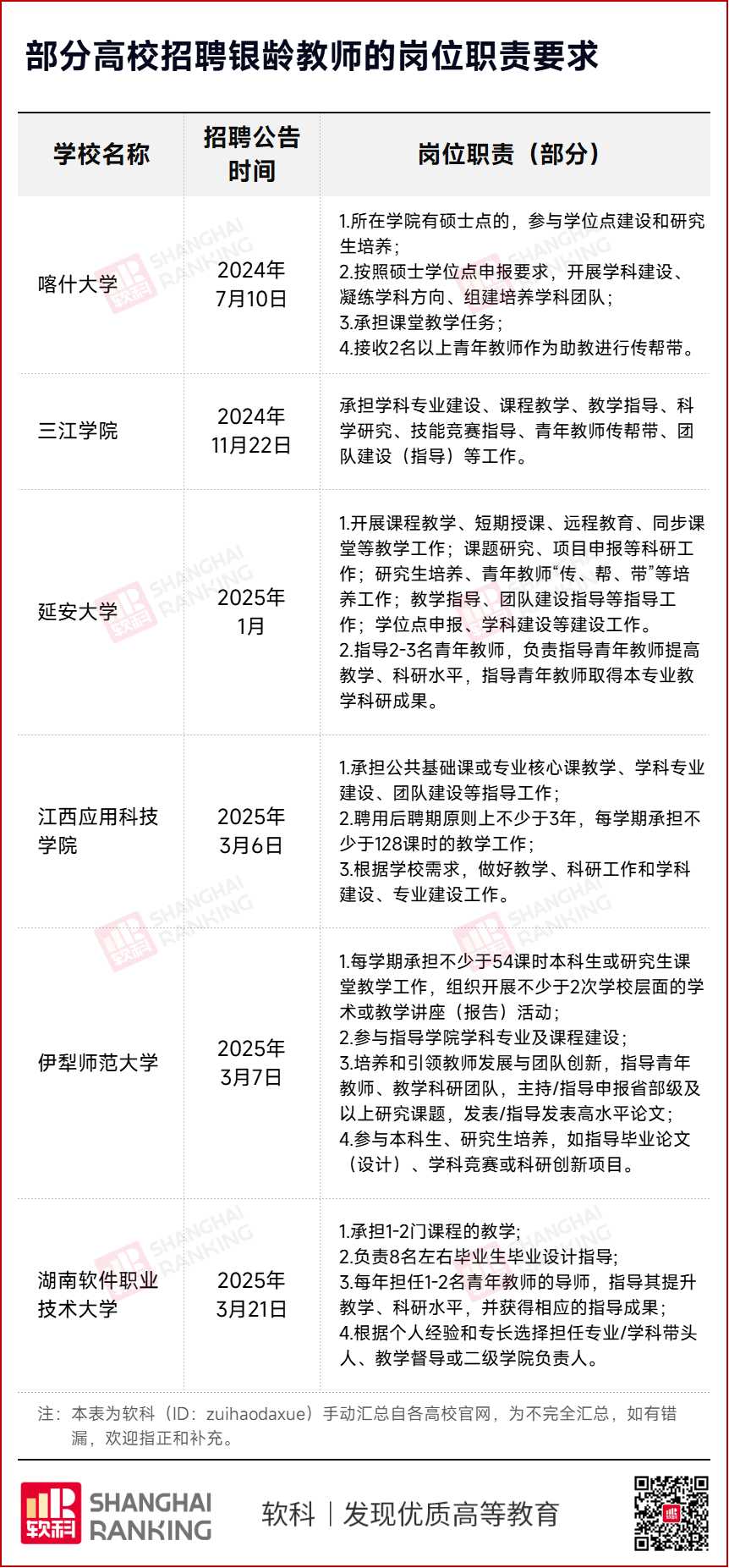
Core Viewpoint - The "Silver Age" counselor program initiated by Northwest A&F University aims to optimize the structure of the counseling team by incorporating retired faculty members who are politically steadfast, experienced, and passionate about student work, thereby forming a multi-generational educational team [1]. Group 1: Background and Policy - The "Silver Age" teacher trend in higher education has emerged against the backdrop of an aging population and policies like delayed retirement, leading to an increase in retired teachers returning to universities [3][8]. - The Ministry of Education's "Silver Age Teaching Plan" aims to recruit 10,000 excellent teachers to improve rural education quality, which has since expanded to higher education [3][4]. - The "Silver Age" teachers are generally required to be under 65 or 70 years old, while most teachers retire around 55 for women and 60 for men, indicating a trend of retired teachers being rehired [4][7]. Group 2: Responsibilities and Roles - Various universities have specific responsibilities for "Silver Age" teachers, including participating in degree program construction, conducting classroom teaching, and mentoring young teachers [5][6]. - The roles often include guiding 2-3 young teachers, enhancing their teaching and research capabilities, and contributing to academic and professional development [6][10]. Group 3: Perspectives on Retired Teachers - There is a debate regarding the impact of retired teachers on job opportunities for younger faculty, with concerns that their presence may limit the growth space for younger educators [15][22]. - However, the integration of "Silver Age" teachers can create a balance, allowing for mentorship and knowledge transfer without occupying formal positions that could hinder younger teachers' advancement [15][22]. Group 4: Future Implications - The gradual implementation of delayed retirement policies is expected to continue, particularly in institutions with a high concentration of intellectuals and professionals, such as universities and research institutes [8][9]. - The trend of retaining experienced teachers is seen as beneficial for academic quality and institutional development, as they contribute significantly to teaching, research, and mentoring [9][10].