
港股生物医药IPO

Search documents
2025港股生物医药IPO激增背后:Biotech如何从“上市热”到“生存战”?|2025中国经济年报
Hua Xia Shi Bao· 2025-12-25 05:21
Core Insights - The Hong Kong stock market remains a primary fundraising venue for innovative biopharmaceutical companies, with nearly HKD 30 billion raised and 26 companies listed in 2025, over half of which are unprofitable biotech firms [2][4][10] - The true challenge for these companies lies in crossing the profitability threshold post-IPO, which has become a key measure of value realization [2][11] - The IPO landscape is evolving, with a trend towards companies with mid-to-late stage pipelines and products nearing commercialization, as well as increased cases of overseas licensing [2][4][7] Fundraising and IPO Trends - In 2025, the Hong Kong stock market is expected to see around 100 IPOs, with total fundraising estimated at approximately HKD 272.1 billion, marking a year-on-year increase of 43% and 210% respectively [4][10] - The biopharmaceutical sector is a significant driver of this growth, with 26 companies (including 8 medical device firms) listed, a rise of 17 from 2024, and total fundraising reaching HKD 29.265 billion, a substantial increase of 751.7% year-on-year [4][10] - Notably, 16 unprofitable biotech companies raised a total of HKD 13.771 billion, accounting for 47.06% of the total fundraising, compared to only 4 such companies in the same period of 2024 [4][11] Performance of Leading IPOs - Leading IPOs have shown remarkable performance, with Heng Rui Pharmaceutical raising HKD 11.374 billion, representing about 40% of the sector's total fundraising and ranking among the top ten global IPOs of the year [5][10] - Other notable contributions include Jingfang Pharmaceutical-B, Ying'en Biotechnology-B, and Weili Zhibo-B, which collectively contributed around 20% of the sector's fundraising [5][10] Market Dynamics and Challenges - The capital is increasingly concentrated in high-barrier areas such as cancer treatment, ADCs, metabolic diseases, and gene therapy, with AI drug development emerging as a focal point [7][10] - Despite overall market activity, there is a growing internal differentiation, where leading companies with mature pipelines and commercialization capabilities attract funding, while those lacking innovative pipelines face challenges in passing IPO reviews [7][11] - The Hong Kong Stock Exchange and the Securities and Futures Commission have expressed concerns over the declining quality of some new listings, emphasizing the need for maintaining quality standards while encouraging applications [9][10] Future Outlook - The 2025 IPO market for biopharmaceuticals is characterized by a high volume of listings, a focus on innovative sectors, and a significant presence of unprofitable companies seeking funding through the 18A rule [10][11] - The market is expected to remain active in 2026, but with a more stable growth pace and structural deepening, as companies will need to focus on enhancing intrinsic value to navigate increased competition [15][16]

港股生物医药IPO热潮背后:从华芢生物与明基医院破发看资本的理性回归
Xin Lang Zheng Quan· 2025-12-23 02:31
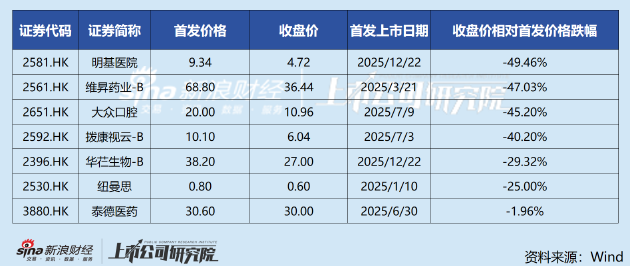
Group 1 - Four new stocks were listed on December 22, 2025, including two from the healthcare sector: Huashan Bio and Mingji Hospital [1] - Huashan Bio experienced a significant increase of over 30% in dark market trading prior to its public offering, with a subscription ratio reaching nearly 792 times and over 500 billion HKD in frozen funds [1] - Despite initial excitement, both Huashan Bio and Mingji Hospital saw their stock prices drop significantly upon listing, with Huashan Bio falling over 11% and Mingji Hospital dropping more than 30% [1] Group 2 - Huashan Bio is positioned as the first PDGF stock in Hong Kong, targeting a blue ocean market for wound healing with seven PDGF candidate drugs, including Pro-101-1, which is noted for its rapid clinical development [1][2] - The potential market size for PDGF drugs in burn treatment is only about 6.66 million RMB by 2033, and the diabetic foot ulcer market is highly competitive with existing treatment options [2] - Huashan Bio lacks commercialized products, revenue, and profit, categorizing it as a "three-no company" [1][2] Group 3 - Mingji Hospital is the largest private profit-making hospital group in East China, with over 2 million outpatient visits in 2024 and the highest revenue per bed among similar hospitals in the country [3] - However, Mingji Hospital's revenue has stagnated, with a 1.1% decline in 2024 and a further 1.34% drop in the first half of 2025, alongside a significant decrease in net profit from 167 million RMB in 2023 to 109 million RMB in 2024 [3] - The static P/E ratio for Mingji Hospital in 2024 is estimated to be between 25x and 31x, which is significantly higher than the average for the Hong Kong healthcare sector [3] Group 4 - Early investors, such as CDH Medical Services Limited, exited before the IPO, indicating cautious expectations regarding the company's value [4] - CDH invested 100 million USD in 2014 and sold its shares for 195 million USD in 2023, realizing a profit of 95 million USD [4] - The cases of Huashan Bio and Mingji Hospital reflect a broader trend of market sentiment diverging from asset fundamentals, with recent IPOs in the Hong Kong biotech sector being driven by external liquidity and market corrections [4][5] Group 5 - As of early 2025, 24 biotech companies have successfully listed on the Hong Kong stock market, with 7 currently trading below their IPO prices [5] - Notable declines include Mingji Hospital, which has seen a drop of 49.46% from its IPO price of 9.34 HKD to a closing price of 4.72 HKD [6]
港股IPO冷热博弈:6天6家申请上市,“明星”药企缘何临门停步?
2 1 Shi Ji Jing Ji Bao Dao· 2025-11-14 00:20
Core Viewpoint - The Hong Kong stock market is experiencing a surge in IPO applications from biotech companies, but the recent delay in the IPO of Baile Tianheng highlights potential risks and challenges in the market [1][7][11]. Group 1: IPO Activity - Six biotech companies, including Mindray Medical and Insilico Medicine, submitted IPO applications to the Hong Kong Stock Exchange within six days, marking a record high for the year [1][2]. - The Hong Kong Stock Exchange's support for the biotech sector, particularly the 18A listing rule allowing unprofitable biotech firms to go public, has attracted these companies [2][3]. Group 2: Company Profiles - Mindray Medical, a leading medical device company, aims to enhance its international strategy and brand influence through its IPO, with a projected international revenue share exceeding 50% by Q3 2025 [3]. - Other companies like Kexing Pharmaceutical and Real Bio are also seeking to expand their international presence and fund R&D through their IPOs [4]. Group 3: Market Environment - The influx of southbound capital into the Hong Kong market has reached a historic high, with net inflows exceeding HKD 5 trillion, boosting investor confidence [5][6]. - Despite the positive fundraising environment, there is a shift in investment strategies towards high-dividend stocks, which may impact the biotech sector's attractiveness [5][11]. Group 4: Challenges and Risks - Baile Tianheng's delayed IPO raises concerns about high entry barriers and insufficient valuation discounts, which may deter retail investors [8][9]. - The company's volatile financial performance and reliance on a significant one-time transaction for revenue have led to skepticism about its long-term profitability [9][10]. - The market's increasing focus on stable cash flows and product commercialization capabilities may pose challenges for companies lacking clear market positioning [11].
港股IPO冷热博弈:6天6家上市,“明星”药企缘何临门停步?
2 1 Shi Ji Jing Ji Bao Dao· 2025-11-13 05:40
Core Viewpoint - The Hong Kong stock market is experiencing a surge in biotech IPO applications, with companies eager to capitalize on the favorable listing environment, despite some unexpected delays in the process [1][2]. Group 1: IPO Activity - Six biotech companies, including major players like Mindray Medical and innovative firms like Insilico Medicine and Anxuyuan Technology, have submitted IPO applications to the Hong Kong Stock Exchange within a short span, indicating a strong demand for capital [2][3]. - The Hong Kong Stock Exchange's 18A listing rule, introduced in 2018, allows unprofitable biotech companies to raise funds, which has attracted many innovative firms to the market [2]. Group 2: Company Strategies - Mindray Medical, a leader in the medical device sector, aims to enhance its international strategy through its IPO, with plans to increase its global revenue share and invest in R&D and sales networks [3]. - Smaller biotech firms like Sinovac Biotech and Real Bio are also seeking to expand internationally through their IPOs, with specific plans to fund product development and market expansion [4]. Group 3: Market Environment - The influx of southbound capital into the Hong Kong market has reached a historic high, with net inflows exceeding HKD 5 trillion, providing a solid foundation for biotech IPOs [5][6]. - Recent market dynamics show a shift in investor strategy from aggressive tech investments to defensive high-dividend stocks, impacting the appetite for biotech IPOs [5]. Group 4: Valuation Concerns - The delay in the IPO of Baillie Gifford is notable, as it highlights valuation challenges in the biotech sector, with concerns over high entry barriers and insufficient valuation discounts compared to A-shares [7][8]. - Baillie Gifford's fluctuating performance raises questions about its long-term profitability, as its recent revenue surge is tied to a one-time transaction rather than sustainable growth [9][10]. Group 5: Industry Outlook - The case of Baillie Gifford serves as a warning for other biotech firms, emphasizing the importance of clear market positioning, valuation strategies, and stable performance to succeed in the Hong Kong IPO landscape [10][11]. - The market is becoming more discerning, favoring companies with genuine technological advantages and commercialization potential, signaling a return to rationality in the biotech sector [11].
医药IPO“挤爆”港交所
2 1 Shi Ji Jing Ji Bao Dao· 2025-07-04 00:11
Core Viewpoint - The Hong Kong biopharmaceutical market is experiencing a significant resurgence in IPO activity, with a notable increase in both the number of companies going public and the total amount of capital raised in the first half of 2025 [1][2][4]. Group 1: IPO Activity - In the first half of 2025, 10 biopharmaceutical companies successfully listed on the Hong Kong Stock Exchange, compared to only 12 for the entire previous year [1] - The medical and pharmaceutical sectors accounted for the highest number of IPOs, with 6 companies in biopharmaceuticals and 4 in medical devices and services [1] - A total of 39 healthcare companies are currently waiting to go public on the Hong Kong Stock Exchange [3] Group 2: Fundraising and Market Performance - The biopharmaceutical sector raised 15.6 billion HKD in the first half of 2025, making it the second-highest fundraising sector during this period [2] - Heng Rui Medicine raised 9.89 billion HKD, representing a significant portion of the total fundraising in the sector [2] - The IPO of Heng Rui Medicine was the largest in the Hong Kong medical sector in nearly five years, with a subscription rate of 454.85 times [4] Group 3: Market Trends and Investor Behavior - The influx of southbound capital has significantly improved liquidity in the Hong Kong market, with net purchases reaching nearly 730 billion HKD in 2025, the highest for the same period in history [7] - Southbound funds now account for over 40% of trading volume in the Hong Kong market, indicating their growing influence on market pricing [7][8] - The biopharmaceutical sector's valuation has rebounded to near three-year highs, with innovative biotech companies seeing an overall increase of approximately 70% [8] Group 4: Challenges and Strategic Moves - Many biopharmaceutical companies are facing urgent financing needs due to high R&D costs and ongoing losses, leading them to pursue IPOs as a necessary funding avenue [9][10] - The trend of dual listings in both A-share and H-share markets is becoming more common, as companies seek to broaden their financing channels and enhance international visibility [5] - Despite the positive trends, the overall IPO market remains fragile, with concerns about post-listing stock performance and limited financing scale [10]