
煤炭新周期

Search documents
迎接煤炭新周期-逢跌必买在当下
2026-03-30 05:15
Summary of Coal Industry Conference Call Industry Overview - The coal market is entering a new cycle with prices accelerating upward, driven by geopolitical factors, domestic and international price differentials, and replenishment demand. [1][2] - Current spot coal prices are expected to break 1,000 RMB/ton in May-June due to reduced imports from Indonesia and energy substitution demand caused by the blockade of the Hormuz Strait. [1][3] Key Insights and Arguments - **Price Trends**: - Recent price increases are consistent with expectations, with significant rises in both thermal and coking coal prices. For instance, the price of 5,500 kcal thermal coal at Qinhuangdao port rose by 26 RMB/ton in the last week of March. [2] - The market anticipates a price center around 800-850 RMB/ton, with potential for it to exceed 900 RMB/ton, indicating over 50% upside for high-elasticity stocks like Yanzhou Coal Mining Company. [1][5] - **Supply and Demand Dynamics**: - The Indonesian RKAB policy is expected to reduce coal imports, while the long-term blockade of the Hormuz Strait will shift energy supply towards coal, increasing demand across Asia. [3] - The domestic market is experiencing structural changes, with many companies locked into long-term contracts for overseas coal, leading to increased reliance on domestic spot coal. [4] - **Investment Strategy**: - The investment strategy emphasizes "elasticity first," recommending Yanzhou Coal and Guanghui Energy for thermal coal, and focusing on high-elasticity coking coal stocks like Lu'an Environmental Energy and Huabei Mining. [1][8] - The recommendation is to buy on dips, particularly in April when prices may temporarily decline due to seasonal factors and weaker Q1 earnings reports. [8] Additional Important Points - **Market Sentiment**: - There is a general concern among investors regarding the valuation of coal stocks, but the current price center is expected to rise, which could lead to significant upside in stock prices. [6][7] - The market is currently underestimating the potential for further price increases, with expectations that the price center could exceed 850 RMB/ton. [6] - **Coking Coal vs. Thermal Coal**: - The investment opportunity in the coking coal sector is considered lower than in thermal coal due to weaker consensus on demand recovery and ongoing supply from Mongolia. [9] - Recommendations for coking coal include Lu'an Environmental Energy and Huabei Mining, with a focus on companies that can benefit from both industry recovery and production increases. [9] Conclusion - The coal industry is poised for significant price increases driven by supply constraints and rising demand, particularly in the context of geopolitical tensions and domestic market dynamics. Investors are encouraged to focus on high-elasticity stocks and to view any price corrections as buying opportunities.

迎接煤炭新周期-煤炭价格将加速上涨
2026-03-24 01:27
Summary of Conference Call on Coal Industry Industry Overview - The coal industry is entering a new cycle with domestic coal prices expected to rise significantly due to various factors including geopolitical tensions and supply constraints [1][2][3] Key Points and Arguments Price Dynamics - The price gap between domestic and imported coal has widened to 60-70 RMB, driven by rising international coal prices due to geopolitical conflicts [1][2] - Domestic coal prices are expected to follow international trends, with projections indicating prices could exceed 800 RMB and potentially reach 1,000 RMB [1][4][5] Supply and Demand Factors - Geopolitical tensions are causing a shift in energy consumption patterns, with increased reliance on coal as oil and gas supplies tighten [2][3] - The upcoming summer season in China is expected to drive demand as traders begin to stockpile coal in anticipation of shortages [4][5] - Europe is also entering a gas replenishment phase, which may lead to increased coal purchases if gas supplies are disrupted [5] Import Trends - Despite potential adjustments in Indonesia's RKEB policy, coal exports to China are expected to decline marginally due to strong domestic energy demands in Indonesia [3][4] Investment Strategy - The investment strategy emphasizes prioritizing companies with high price elasticity, recommending Yanzhou Coal Mining Company, Yancoal Australia, and Guanghui Energy as top picks [6][7] - Companies with significant earnings elasticity in the pure thermal coal sector, such as Huayang Co., Jinkong Coal Industry, and Shanxi Coal International, are also highlighted [6][7] - Coking coal companies are expected to have high earnings elasticity but are ranked lower due to less certainty in their fundamentals compared to thermal coal companies [6][7] Additional Insights - The current geopolitical landscape and energy market dynamics suggest that the upward trend in coal prices will be steeper than market expectations [2][3] - The potential for a severe energy crisis is indicated, with the International Energy Agency suggesting that recovery of oil and gas supplies could take up to six months [3] This summary encapsulates the critical insights from the conference call regarding the coal industry, highlighting the expected price movements, supply-demand dynamics, and strategic investment recommendations.
迎接煤炭新周期 - 煤价回落是否应该担心?
2026-03-10 10:17
Summary of Coal Industry Conference Call Industry Overview - The conference focused on the coal industry, specifically addressing concerns regarding the recent decline in coal prices and its implications for the market [1][2]. Key Points and Arguments Current Coal Price Trends - The Newcastle coal price has dropped to around $130, significantly lower than the peak of $400 in 2022 [1][2]. - Domestic coal prices have also seen a decline, with Qinhuangdao 5500 thermal coal prices dropping from 745 RMB to 743 RMB, and coking coal prices decreasing from 1660 RMB to 1580 RMB [2]. Supply and Demand Dynamics - The current coal market is characterized by high inventory levels and weakening prices, contrasting with the tight supply and high prices seen in 2021 and 2022 [3][4]. - The supply situation is expected to tighten due to a gradual exit from pre-approved production capacity, leading to a marginal contraction in supply [6][9]. - The coal supply is currently in a weaker state compared to 2022, which may support future price increases despite current price declines [5][9]. Import Dynamics - In 2022, coal imports were restricted, particularly from Australia, but are expected to increase significantly in 2023 and beyond [10][11]. - The supply from Indonesia is currently constrained, with expectations of limited increases until mid-year due to regulatory controls [12]. Demand Drivers - Domestic demand for coal is expected to rise, particularly from the chemical sector, which has seen a significant increase in coal consumption due to disruptions in oil and gas supplies [14][15]. - The steel industry is also anticipated to increase its coal demand, especially if geopolitical tensions escalate [17]. European Market Influence - European natural gas demand is a critical factor; if gas supplies are disrupted, coal demand in Europe is likely to increase, driving up global coal prices [19][20]. - The ongoing geopolitical situation, particularly regarding sanctions on Russian energy, may further influence coal demand dynamics [21][22]. Investment Recommendations - The analysis suggests that coal stocks are currently undervalued and presents a strong buying opportunity, with expectations of price increases leading to significant earnings growth for coal companies [22][23]. - Specific companies recommended for investment include Yanzhou Coal Mining Company and Guanghui Energy, which are expected to benefit from market dynamics and have high earnings elasticity [24][25]. Additional Insights - The potential for structural shortages in high-quality coal due to increased demand from the chemical sector could lead to price increases across the board [15][16]. - The overall sentiment is that while current price declines may cause concern, the long-term outlook for coal prices remains positive, and investors are encouraged to act quickly to capitalize on potential gains [22][28].
迎接煤炭新周期-库存再降与预期升温
2026-02-02 02:22
Summary of Conference Call on Coal Industry and Key Companies Industry Overview - The coal market is experiencing a new cycle with decreasing inventories and rising expectations for prices, driven by rising crude oil prices and geopolitical risks, indicating that coal is currently undervalued and has significant upside potential [1][3] - The overall performance of the coal industry in 2026 is expected to be optimistic, with a slight increase in coal prices leading to significant improvements in production and sales [6] Key Companies and Performance China Shenhua - Expected to achieve a profit of 49.5 to 54.5 billion yuan in 2025, with a quarterly profit of 12.95 billion yuan in Q4, aligning with market expectations [4][5] - Anticipated 10% growth in 2026 post-asset injection, potentially reaching 57 to 58 billion yuan, with a possible increase to 60 billion yuan if prices rise slightly [5] - Projected market capitalization could reach 1 trillion yuan, with dividend yields of 4.4% and 4.7% in A-shares and H-shares respectively [5] Shanxi Coking Coal - Forecasted profit for 2025 is between 970 million to 1.358 billion yuan, representing a year-on-year decline of 56.3% to 68.75% [5] - Expected to see a price increase in coking coal in 2026, indicating a potential turning point for performance [5] Panjiang Coal and Electricity - Projected profit for 2025 is between 318 million to 380 million yuan, with a year-on-year increase of 205.3% to 264.83% [5] - Q4 profit approached 400 million yuan, exceeding market expectations, indicating strong future growth potential [5] Huai Bei Mining - Expected to see significant growth in 2026, with total production capacity projected to reach 42.25 million tons, a year-on-year increase of 23.36% [15][18] - The company is also expected to benefit from its electricity business and sand and gravel aggregate operations, contributing to overall profitability [17][18] Market Dynamics - Recent trends show a divergence in prices: crude oil prices increased by 15.7%, natural gas by 9.4%, while coal prices decreased by 7.8% [3] - The demand for coal is expected to remain strong due to high consumption levels in power plants, with coal inventories at power plants decreasing by 2.4% week-on-week [9] - The cold wave in February is expected to maintain high daily consumption levels in power plants, further tightening supply and demand dynamics, which is favorable for coal prices [12] Investment Opportunities - The coal sector is viewed positively for investment, with recommendations for China Shenhua and Yanzhou Coal Mining as key stocks to watch [2][13] - Other companies with strong growth potential include Huai Bei Mining, which is expected to benefit from market trends and management initiatives [19] - The overall sentiment is optimistic, with expectations of price increases and improved performance across the coal sector in 2026 [14][19] Additional Insights - The geopolitical landscape, particularly tensions involving the U.S. and Iran, could further elevate crude oil prices, which historically correlate with coal prices [3] - The coal market is currently seen as undervalued, presenting a compelling investment opportunity as prices are expected to align with rising crude oil prices [3]



迎接煤炭新周期 - 煤价分化与龙头并购解读
2025-12-22 01:45
Summary of Conference Call Records Company and Industry Involved - The conference call primarily discusses **China Shenhua Energy Company** and the **coal industry** in China. Key Points and Arguments 1. **Acquisition Details**: China Shenhua plans to acquire an asset package for a total consideration of **1,335.98 billion yuan**, which includes an investment of **49.27 billion yuan** in a chemical company. The overall premium rate is **59.52%**, and when excluding the investment portion, the premium rate is approximately **50%**. The price-to-book (PB) ratio is about **1.5 times**, lower than the current **2.0 times** PB level of listed companies in A-shares, indicating a relatively reasonable acquisition price [1][2][3]. 2. **Payment Structure**: The payment plan consists of **70% cash** (approximately **93.935 billion yuan**) and **30% through share issuance** (totaling **400.8 billion yuan** at a share price of **29.4 yuan**). The accompanying fundraising will not exceed **200 billion yuan**, and even with full fundraising, the dilution ratio is only about **3%**, which has a limited impact on earnings per share (EPS) [1][2][3]. 3. **Market Capitalization and Resource Increase**: Post-acquisition, the company's market capitalization is expected to reach around **900 billion yuan**, with a potential to exceed **1 trillion yuan** by **2026**. The coal recoverable reserves will increase by **97.71%**, significantly enhancing the company's intrinsic value, with a future market value expected to reach at least **1.5 trillion yuan** [1][2][3]. 4. **Shareholder Structure**: The major shareholder's stake will increase from **69.58%** to **71.53%**, which is expected to enhance the stability and certainty of dividends [1][2][3]. 5. **Coal Price Trends**: Recently, the price of thermal coal at ports has dropped to **703 yuan**, a decrease of **42 yuan**, while coking coal prices have increased by **110 yuan** to **1,740 yuan**, indicating a divergence in price trends. Both thermal and coking coal prices are on a downward trend at the pit level, but there are expectations for a rebound in port prices [1][4]. 6. **Coal Supply and Production**: In November, the average daily production of raw coal was **14.23 million tons**, with a year-on-year decline of **0.5%**, which is a narrowing of the decline compared to **2.3%** in October. This is attributed to increased production efforts and regulatory impacts from earlier periods [2][7]. 7. **Impact of Clean Energy**: The cumulative power generation from thermal power plants has decreased by **0.7%** year-on-year from January to November, while clean energy generation has significantly increased, putting competitive pressure on thermal power [9]. 8. **Future Market Outlook**: The weather is a key variable affecting thermal coal prices. Predictions indicate that cold air masses arriving at the end of December may support coal prices. The demand for high-quality coking coal remains strong, and prices are expected to stabilize or increase [10]. Other Important but Possibly Overlooked Content - The overall coal market is experiencing a divergence in price trends, with thermal coal prices declining while coking coal prices stabilize. This reflects broader market dynamics and the need for investors to monitor fluctuations closely [4][5]. - The coal inventory levels at power plants have shown a slight decrease, but remain at high levels, indicating a balanced supply-demand scenario [5]. This summary encapsulates the critical insights from the conference call, highlighting the strategic moves by China Shenhua and the broader implications for the coal industry.
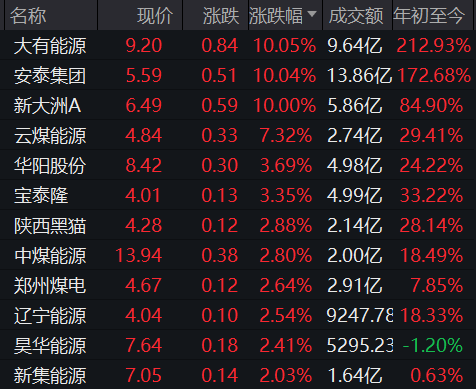
煤炭板块逆势拉升,大有能源、安泰集团、新大洲A涨停
Jin Rong Jie· 2025-12-03 03:27
Group 1 - The coal sector is experiencing strong performance, with companies like Dayou Energy, Antai Group, and New Dazhou A hitting the daily limit, while Yunmei Energy rose over 7% [1] - Year-to-date performance shows significant increases in stock prices for major coal companies, with Dayou Energy up 212.93%, Antai Group up 172.68%, and New Dazhou A up 84.90% [2] - The market is optimistic about coal prices due to a tight supply-demand balance, with expectations of continued strong pricing trends into 2026 [1][3] Group 2 - Guotai Junan Securities highlights that coal prices have exceeded expectations since the fourth quarter, with a year-on-year increase in thermal power generation of 7.3% in October [1] - The report indicates that inventory levels across various segments remain below last year's figures, suggesting a potential for price increases as seasonal demand rises in late November [1] - Zhongtai Securities recommends a three-pronged investment strategy for the coal sector, focusing on high dividend, low valuation stocks, companies with growth potential, and those benefiting from improved profitability in coking coal [3]


中泰证券2026年煤炭行业投资策略:看好板块投资机会 把握三条主线
Zheng Quan Shi Bao Wang· 2025-12-03 00:20
Core Viewpoint - The report from Zhongtai Securities indicates a positive outlook for the coal industry in 2026, suggesting a new cycle for coal with both short and long-term investment strategies [1] Investment Strategy - The investment strategy focuses on three main lines: - The increasing investment value of coal due to "high dividends and low valuations," encouraging active allocation towards stocks with strong dividend attributes [1] - Emphasizing companies with growth in production capacity and significant profit elasticity, highlighting those that can benefit from the resonance of alpha and beta [1] - Identifying coking coal as a potential beneficiary due to bottoming coal prices and improving profitability, particularly focusing on companies experiencing a turnaround from difficulties [1]

2026年煤炭行业投资策略:新周期:长短结合,进退皆宜
ZHONGTAI SECURITIES· 2025-12-02 12:37
Group 1 - The report highlights the beginning of a new upward cycle in the coal industry, driven by supply-demand improvements and price stabilization [3][5][10] - Coal prices showed a significant decline in the first half of 2025 but began to recover in June, with the average price for thermal coal (Q5500) at 695 CNY/ton, down 19% year-on-year, and coking coal at 1497 CNY/ton, down 28% year-on-year [4][5] - The report anticipates a sustainable improvement in supply-demand dynamics, with a potential reduction in domestic coal supply exceeding 100 million tons due to the exit of pre-approved production capacity [5][49] Group 2 - The demand for coal is expected to rebound, particularly in the electricity sector, with a projected growth in coal consumption if electricity generation increases by over 3% in 2026 [7][9] - The chemical sector is also expected to maintain strong coal consumption growth, supported by China's strategic focus on coal chemical development [9] - The steel industry is projected to see increased coal demand due to government initiatives aimed at stabilizing growth, with an average annual increase of around 4% in value added expected from 2025 to 2026 [9] Group 3 - Investment recommendations include focusing on companies with high dividend yields and low valuations, such as China Shenhua Energy and Zhongmei Energy, which are expected to benefit from the new coal cycle [11] - Companies like Yanzhou Coal Mining and Huayang Co. are highlighted for their potential due to their own capacity growth and significant profit elasticity [11] - The report suggests that companies in a turnaround situation, particularly in the coking coal sector, such as Lu'an Environmental Energy and Pingmei Shenma Energy, are likely to benefit from improved profitability [11]
迎接煤炭新周期 - 港口煤价震荡,需求提升可期
2025-12-01 00:49
Summary of Conference Call on Coal Industry Industry Overview - The coal industry is experiencing a new cycle with fluctuations in port coal prices and an anticipated increase in demand due to winter heating needs [1][11] - Major coal-producing regions such as Shanxi, Inner Mongolia, and Xinjiang are facing production constraints, with no significant increase expected from November and December [1][2] Key Points and Arguments - **Production Changes**: In the first ten months of the year, coal production in Shanxi decreased by 2.0%, Inner Mongolia by 4.6%, and Xinjiang by 8.3%. In contrast, Shaanxi saw a 3.1% increase [2] - **Government Regulations**: The National Development and Reform Commission (NDRC) is taking measures to control disorderly competition and low pricing in the coal market, indicating strict future capacity controls [3][4] - **Price Fluctuations**: Recent declines in thermal and coking coal prices were attributed to warmer weather in southern regions and various market factors, including futures trading and production limits in northern areas [1][8] - **Inventory Levels**: National power plant inventories are stable, with port inventories rising. However, coking coal inventories at ports have decreased year-on-year, while steel mill inventories have increased [9][10] Future Outlook - **Demand Projections**: Winter heating demand is expected to drive coal demand higher, with prices likely to remain strong from December to January due to increased power plant loads [11] - **Supply Constraints**: The ongoing implementation of anti-overproduction policies and reduced imports are expected to limit domestic supply increases [11] - **International Market Impact**: Global commodity prices are rising, with energy demand in the Northern Hemisphere supporting coal demand in the domestic market [12] Recommendations - **Investment Opportunities**: Companies with significant elasticity such as Yanzhou Coal Mining, China Coal Energy, and Lu'an Environmental Energy are recommended for investment. Additionally, stocks like Shanghai Energy and Lanhua Sci-Tech, currently undervalued, are highlighted as potential buys [14] - **Market Sentiment**: The overall sentiment remains positive for the coal market, with suggestions for investors to capitalize on current price corrections to prepare for potential upward trends [15]
迎接煤炭新周期 - 超跌布局时点?
2025-11-24 01:46
Summary of Conference Call on Coal Industry Industry Overview - The coal industry is entering a new cycle with significant changes expected in 2026, including a more market-oriented long-term contract mechanism that allows for floating pricing and negotiation between supply and demand parties, eliminating annual minimum requirements while granting priority in transportation allocation to long-term contract holders [1][3][4]. Key Points and Arguments - **Market Dynamics**: The flexibility in pricing and contract terms is expected to enhance profit elasticity for coal companies during high price periods, but may weaken profit guarantees during price declines due to potential non-fulfillment by power plants [1][5]. - **Futures Price Movements**: Recent significant declines in coking coal futures prices are attributed to both fundamental factors (domestic mine restarts, increased imports, and reduced steel mill profits) and technical factors (changes in delivery standards by the Dalian Commodity Exchange) [1][6]. - **Price Trends**: Current port prices for thermal coal remain stable, while coking coal prices have decreased, indicating a divergence in supply and demand across different segments [1][7]. - **Inventory Levels**: Power plant inventories across 25 provinces are slightly lower than last year, with a decrease in available days and an increase in daily consumption. Port inventories have increased, but year-on-year comparisons show a decline [1][9]. - **International Market Influence**: International thermal coal futures prices have shown slight increases, while crude oil prices have decreased, with northern heating demand positively impacting thermal coal prices [1][10]. Additional Important Insights - **Electricity Generation Trends**: A decline in hydroelectric power growth and a negative growth rate for thermal power generation indicate a competitive disadvantage for thermal power due to the encroachment of clean energy [1][11]. - **Future Coal Market Outlook**: The coal market is expected to remain strong, with anticipated increases in demand during the winter peak. Supply constraints due to production checks and safety inspections will likely keep prices elevated, with forecasts suggesting prices could range from 800 to 1,000 RMB depending on weather conditions [1][12][13]. - **Investment Recommendations**: In the current oversold state, it is suggested to focus on high-value investments in coal companies, particularly those with strong profit elasticity. Recommended stocks include Yanzhou Coal, Shanxi Coal, and leading firms like China Shenhua and China Coal Energy [1][15][18]. Conclusion - The overall sentiment towards the coal market remains optimistic, with expectations of price increases driven by seasonal demand and supply constraints. Investors are encouraged to monitor market dynamics closely for potential investment opportunities [1][19].