物理仿真

Search documents
协创数据20260223
2026-02-24 14:16
Summary of Key Points from the Conference Call Company and Industry Overview - The conference call discusses **协创数据 (Cohere Data)**, focusing on trends in the **AI computing**, **storage**, and **robotics** industries, highlighting the company's strategic positioning and growth potential in these sectors [2][3][4]. Core Insights and Arguments AI Computing Trends - **Significant Increase in Rental Prices**: During the Spring Festival, rental prices for AI computing resources like A100 and H100 increased by over 10%, with some platforms seeing A100 prices rise by 30%, indicating a surge in token demand and the rapid emergence of agent applications [2][3]. - **Investment in Infrastructure**: The company has procured 30 billion yuan worth of servers over the past year, with over 10 billion yuan in purchases in the first two months of the current year. Plans include a cumulative investment of 200 billion yuan from 2025 to 2027 for capital expenditures [3][4]. Storage Market Dynamics - **Surge in Storage Demand**: The storage market is experiencing unprecedented demand, with U.S. and Korean storage stocks reaching new highs. Major manufacturers expect storage prices to rise significantly through 2026-2027 due to extreme shortages [2][3]. - **Strategic Partnerships**: The company has secured the largest agency for 3D storage in mainland China and has deep collaborations with manufacturers, which may lead to underestimated profit elasticity in the storage business [2][3][6]. Robotics Sector Developments - **Increased Interest in Robotics**: The visibility of robots during the Spring Festival has heightened public awareness of the importance of AI in robotics. NVIDIA is focusing on non-interface AI and robotic brains, which may have a market potential 10 to 100 times greater than language models [4][5]. - **Partnership with NVIDIA**: The company collaborates closely with NVIDIA, positioning itself as a key player in the AI demonstration projects in mainland China, which is expected to drive business growth over the next five years [4][5][7]. Additional Important Insights - **AI Model Advancements**: Domestic AI models have made significant breakthroughs in inference capabilities, with companies like ByteDance and Alibaba releasing competitive models that enhance cloud pricing logic and drive token demand growth by several multiples annually [5][6]. - **Price Trends for High-Performance Cards**: Prices for older high-performance cards like H100 are rising, contrary to expectations of depreciation, due to a reassessment of their residual value. This trend is driven by the explosive demand for computing power from domestic AI model iterations [5][6]. - **Physical Simulation in Robotics**: The company has proactively developed a robotics service platform based on NV Physical AI, focusing on physical simulation as a critical bridge for training robots, which is expected to provide a competitive edge in the upcoming robotics era [7]. Conclusion - The company is strategically positioned to benefit from the convergence of trends in AI computing, storage, and robotics, with significant growth potential that may currently be undervalued by the market [2][3][4][5][6][7].

基于真实数据和物理仿真,国防科大开源具身在线装箱基准RoboBPP
具身智能之心· 2025-12-20 01:02
Core Viewpoint - The article discusses the introduction of RoboBPP, a comprehensive benchmarking system for robotic online bin packing, which integrates real industrial data, physics-based simulation, and embodied execution evaluation, addressing the limitations of existing research in the field [4][28]. Group 1: RoboBPP Overview - RoboBPP is developed by a collaboration between National University of Defense Technology, Institute of Industrial Artificial Intelligence, Wuhan University, and Shenzhen University [2][4]. - It features a highly realistic physics-based simulation environment to assess the physical feasibility and embodied executability of online bin packing algorithms [4][10]. - The system includes three large-scale diverse datasets derived from real industrial processes, which are essential for systematic benchmarking [4][13]. Group 2: Testing and Evaluation Framework - The project employs a scientifically designed multi-level testing setup, progressing from pure mathematical evaluations to physical constraint simulations and finally to robotic execution [15][16]. - Three distinct testing settings are established: Math Pack (pure geometric placement), Physics Pack (introducing physical effects), and Execution Pack (full robotic execution) [16][18]. - A multi-dimensional evaluation metric and normalization scoring system are implemented to provide a comprehensive analysis of algorithm performance across different scenarios [19][20]. Group 3: Experimental Results - The team conducted extensive experiments across three testing settings and three datasets, ranking algorithms based on their overall performance scores [22][23]. - Specific algorithms such as PCT and TAP-Net++ excel in highly repetitive production environments, while transformer-based reinforcement learning strategies are effective in diverse logistics scenarios [24][29]. - The analysis of individual metrics like Occupancy, Trajectory Length, and Collapsed Placement reveals performance characteristics that are not captured in overall scores, guiding algorithm selection for practical packing tasks [24][30]. Group 4: Practical Implications - The findings suggest that algorithms prioritizing compact and efficient space utilization tend to achieve higher occupancy rates [26]. - Stability-related metrics are evaluated for their effectiveness in guiding learning-based methods towards more robust and physically feasible strategies [27][30]. - RoboBPP provides a reproducible and scalable foundation for future research and industrial applications in robotic online bin packing [28].

基于真实数据和物理仿真,国防科大开源具身在线装箱基准RoboBPP
机器之心· 2025-12-19 03:42
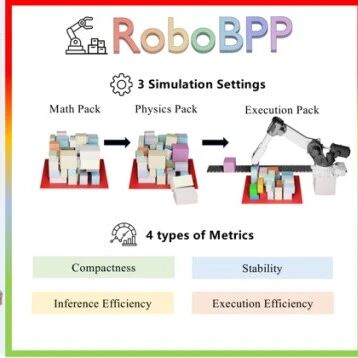
Core Insights - The article discusses the importance of physical feasibility and embodied executability in the 3D bin packing problem (3D-BPP) for modern industrial logistics and robotic automation, highlighting the need for a unified benchmark system to evaluate algorithm performance and real-world applicability [2][31] - RoboBPP, a comprehensive benchmarking system developed by several academic institutions, aims to address existing challenges by utilizing real industrial data, physical simulation, and embodied execution modeling [3][31] Benchmark System Overview - RoboBPP includes a physics-based high-fidelity simulator that replicates the industrial bin packing process using real-scale boxes and industrial robotic arms, allowing for effective evaluation of algorithms under realistic conditions [3][12] - The system features multiple categories of benchmarks, including overall algorithm performance rankings and detailed metrics across various test settings and datasets [7] Testing Framework - The testing framework consists of three progressive settings: Math Pack (pure geometric placement), Physics Pack (introducing physical constraints), and Execution Pack (full embodied execution with robotic operations) [18] - Each setting is designed to assess algorithm adaptability and robustness under increasing levels of physical realism [17] Evaluation Metrics - A multidimensional evaluation system has been established, incorporating traditional metrics and new execution-related indicators such as Collapsed Placement and Dangerous Operation, which reflect potential risks during the placement process [21][22] - The scoring system normalizes all metrics to provide a comprehensive score, facilitating systematic comparisons of different algorithms [21] Experimental Results - The team conducted extensive experiments across three test settings and three datasets, ranking algorithms based on their overall scores and analyzing performance across different industrial scenarios [24][25] - Algorithms that prioritize compact and efficient space utilization tend to achieve higher occupancy rates, while those that focus on stability and physical feasibility exhibit lower collapse rates [28][33] Dataset Diversity - The real industrial datasets used in RoboBPP capture the diversity of item sizes, shapes, and arrival sequences, which are critical for evaluating the embodied executability of algorithms [15] - Three representative task scenarios were identified: Repetitive Dataset (consistent item sizes), Diverse Dataset (varied item sizes), and Wood Board Dataset (irregular shapes) [15] Conclusion - RoboBPP represents the first comprehensive benchmarking system for robotic online 3D bin packing tasks, combining real industrial data, physical simulation, and embodied execution assessment, thus providing a reliable and realistic evaluation framework for future research and industrial applications [31]
服装行业退货率高,问题出在AI上?
虎嗅APP· 2025-12-08 10:03
Core Viewpoint - The article discusses the challenges and opportunities of integrating AI into the fashion industry, highlighting the limitations of AI in understanding fabric dynamics and the potential of companies like Style3D to revolutionize the production process through advanced simulation technologies [2][4][20]. Group 1: AI Challenges in Fashion - AI can generate designs quickly but struggles with the complexities of fabric behavior and human movement, leading to discrepancies between AI-generated images and actual products [3][7]. - The fashion industry is characterized by a fragmented production process, where design, sampling, and production are often disconnected, resulting in inefficiencies and high return rates [5][11]. - Current AI design tools often produce visually appealing but impractical designs that cannot be manufactured, highlighting the gap between aesthetic and functional design [7][8]. Group 2: Style3D's Approach - Style3D aims to address the limitations of AI in fashion by developing a flexible physical simulation engine that accurately models fabric behavior, enabling better integration of design and production processes [9][20]. - The company utilizes AI and 3D technology to streamline the design process, allowing designers to quickly generate production-ready designs from initial concepts [13][14]. - By creating a digital twin of garments, Style3D facilitates seamless communication between designers and manufacturers, reducing lead times and improving accuracy in production [16][18]. Group 3: Future of AI in Fashion - The integration of high-precision physical simulation into the fashion industry is expected to transform traditional workflows, enabling on-demand production and reducing inventory risks [18][25]. - Style3D's advancements in simulation technology position it as a leader in the flexible body simulation space, with potential applications extending beyond fashion to robotics and other industries [25][27]. - The company's approach to creating a closed-loop system for training robots in handling flexible materials could significantly enhance the capabilities of automation in manufacturing [24][25].

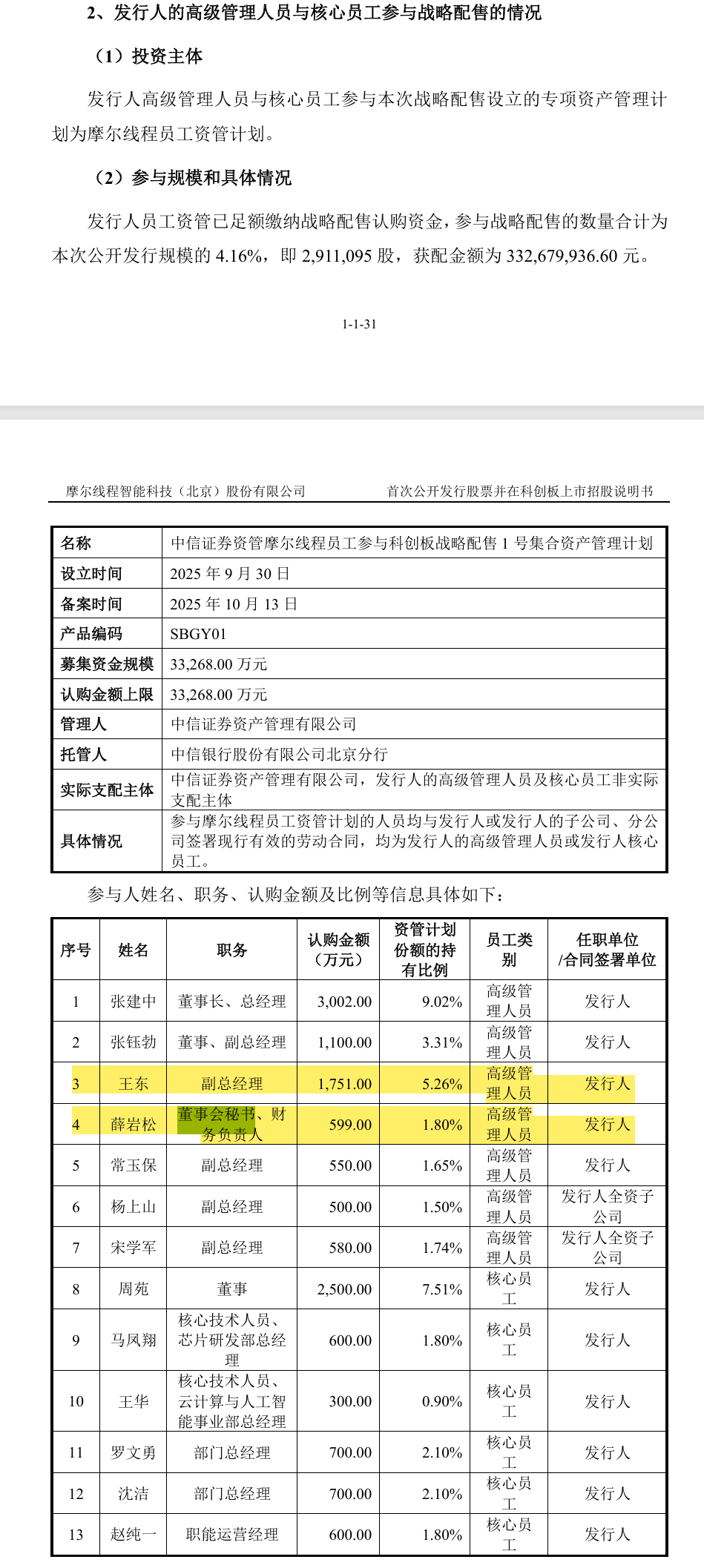
罕见!一家刚IPO的企业两任董事会秘书合计超过20亿元!
Sou Hu Cai Jing· 2025-12-05 00:00
Core Viewpoint - The newly listed company "Moore Threads" has created significant wealth effects, with both current and former secretaries of the board (known as "Dongmi") becoming billionaires due to their shareholdings following the company's IPO [6]. Group 1: Key Individuals and Their Holdings - Current Secretary - Xue Yansong holds an indirect shareholding of 0.3041%, valued at approximately 163 million RMB based on the company's post-IPO market capitalization of about 53.7 billion RMB [2]. - Former Secretary - Wang Dong holds an indirect shareholding of 4.8894%, valued at approximately 2.626 billion RMB under the same market conditions [2]. - Xue Yansong joined the company over two years ago and has been the financial head for more than a year, while Wang Dong is a co-founder who has been with the company since its inception in 2020 [2][9]. Group 2: Company Background and Market Position - Moore Threads is recognized as a potential "NVIDIA of China," focusing on GPU and related product development, design, and sales [6][29]. - The company has successfully launched four generations of GPU architectures, targeting high-performance computing fields such as AI and digital simulation [29]. - The company operates under a Fabless model, outsourcing manufacturing and assembly processes while focusing on R&D and design [31]. Group 3: Financial Performance and Future Plans - The company reported significant revenue growth, with a compound annual growth rate of 208.44% over the last three years [39]. - The company plans to use the funds raised from its IPO for various R&D projects, including AI training chips and graphics chips, to enhance its competitive position in the market [49][51]. - The company aims to become a leading GPU enterprise with international competitiveness, providing robust AI computing support for digital transformation across various industries [51].