
特许经营权

Search documents
巴拿马强行接管长和两港口,香港特区政府严正抗议,中方坚决维护企业权益
Huan Qiu Shi Bao· 2026-02-24 22:59
Core Viewpoint - The Panamanian government has forcibly taken control of two ports operated by Hong Kong's CK Hutchison Holdings in the Panama Canal, leading to strong protests from both the Hong Kong government and CK Hutchison [1][4]. Group 1: Government Actions - On January 23, the Panamanian Supreme Court declared the contract granting CK Hutchison's subsidiary the right to operate the ports invalid, citing "unconstitutionality" [1][3]. - President Laurentino Cortizo ordered the temporary takeover of Balboa and Cristobal ports, claiming it was necessary for "public interest" and that the takeover would not imply a permanent loss of ownership [1][3]. - The ports will be temporarily managed by subsidiaries of Maersk and Mediterranean Shipping Company for a period of 18 months, with plans for a public bidding process to award the operating rights to independent companies [3]. Group 2: Company Response - CK Hutchison stated that the Panamanian government's actions were illegal and posed serious risks to the operational order, health, and safety of the ports [4]. - The company has initiated arbitration proceedings against Panama, claiming damages of $2 billion due to the forced termination of its operating rights [4]. Group 3: Industry Impact - The takeover has already caused delays in shipments from China to Panama, leading to increased logistics costs and freight rates due to port congestion [5]. - There is a general sentiment among the Panamanian public against the government's actions, with concerns about significant economic losses resulting from the takeover [5].


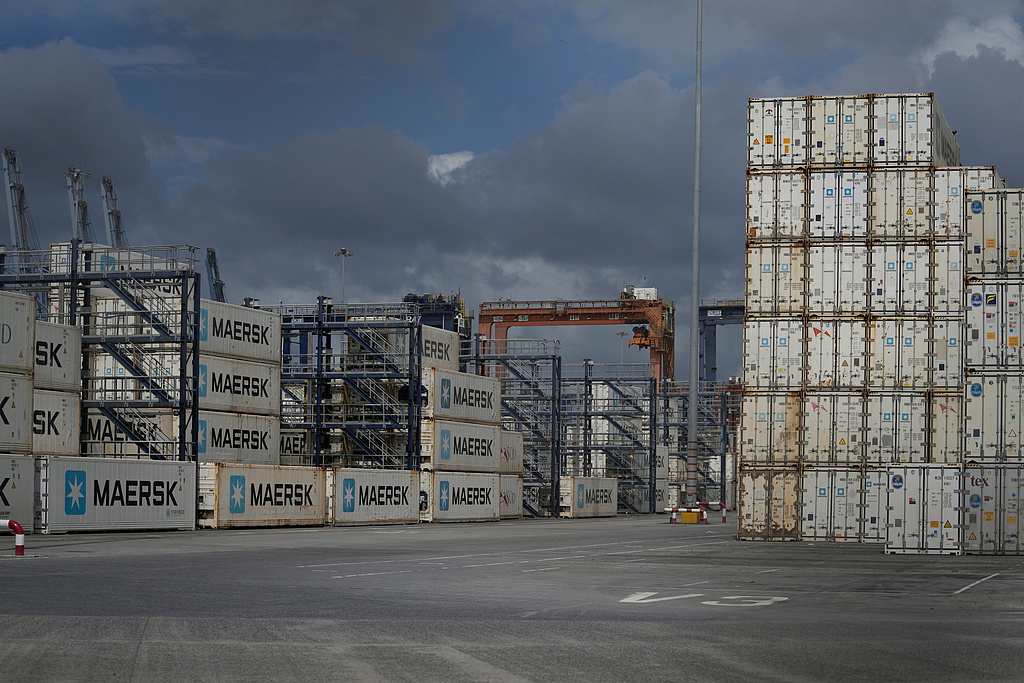
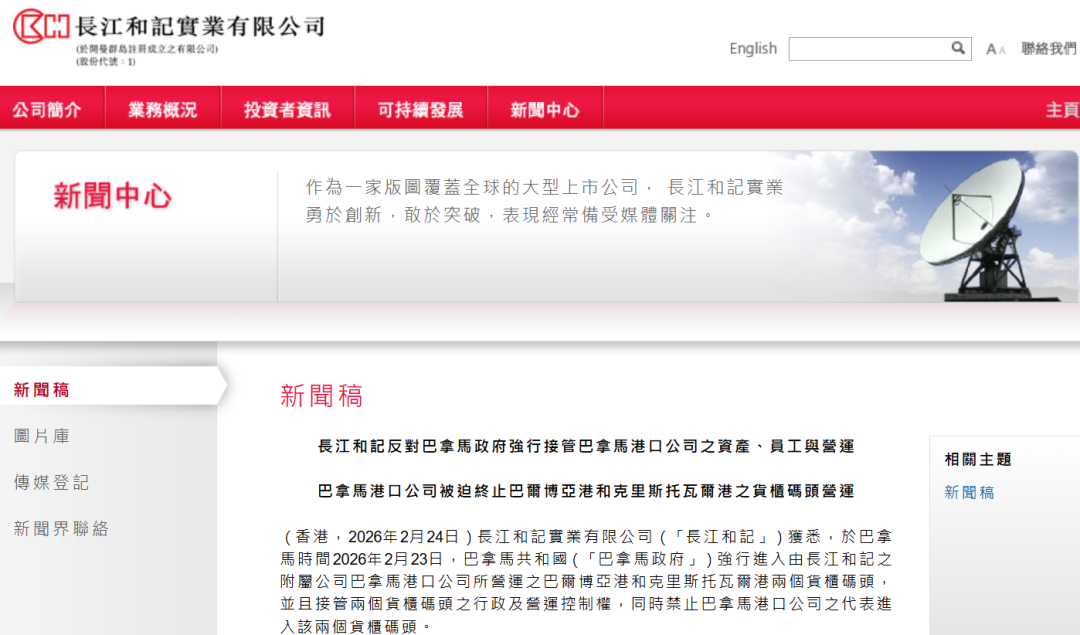
突发!巴拿马政府强行进入并接管港口,李嘉诚旗下长和回应:相关行动不合法,构成严重风险,将研究所有可行途径!公司股价跳水
Mei Ri Jing Ji Xin Wen· 2026-02-24 05:04
Core Viewpoint - The company, CK Hutchison Holdings, opposes the Panamanian government's forced takeover of the assets, employees, and operations of the Panama Ports Company, which has led to the termination of operations at the Balboa and Cristobal container terminals [1][4]. Group 1: Company Actions and Responses - On February 24, 2026, CK Hutchison announced its opposition to the Panamanian government's actions, which included the forced entry and takeover of the Balboa and Cristobal container terminals [1][2]. - The company stated that the government's actions are illegal and pose serious risks to the operations, health, and safety of the terminals [4]. - CK Hutchison plans to consult legal advisors regarding the forced takeover and the termination of the Panama Ports Company's operating rights, exploring all possible legal avenues [4]. Group 2: Government Actions - The Panamanian government executed a series of actions over the past year, culminating in the forced takeover of the Panama Ports Company on February 23, 2026, which included a court ruling and an administrative decree [3]. - The government has prohibited representatives of the Panama Ports Company from entering the terminals and has instructed employees to cease communication with the company [3]. Group 3: Financial Impact - Following the announcement of the government's actions, CK Hutchison's stock price fell nearly 2%, resulting in a total market capitalization of HKD 241.5 billion [5].
杨岳斌:巴菲特如何看待创造性破坏之“矛”和护城河之“盾”
Sou Hu Cai Jing· 2026-02-07 19:53
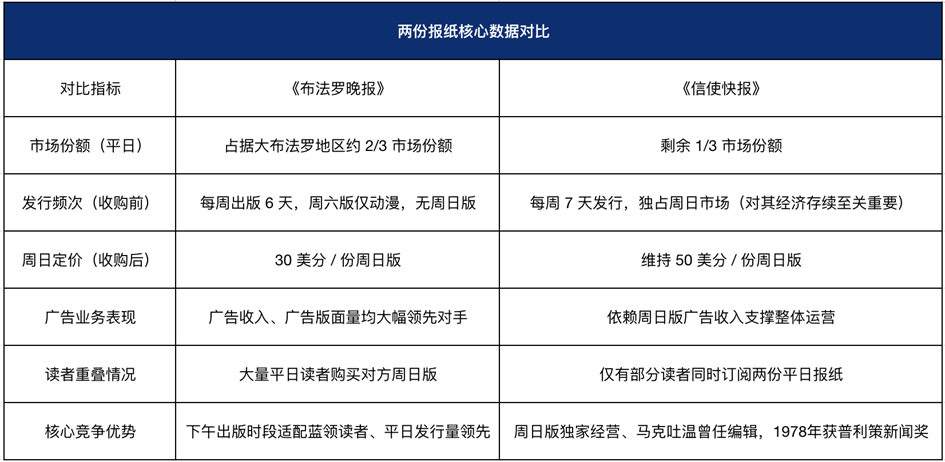
Core Viewpoint - The article discusses the relationship between Joseph Schumpeter's "creative destruction" theory and Warren Buffett's investment philosophy, emphasizing the importance of a sustainable competitive advantage or "moat" for long-term investment success [1][2][3]. Group 1: Creative Destruction Theory - "Creative destruction" highlights the dual nature of market economies, where innovation leads to both the emergence of new products and the failure of existing businesses [2]. - Buffett believes that while innovation drives economic growth, it also creates uncertainty for investors, making it crucial to identify companies with enduring competitive advantages [2][3]. Group 2: Importance of Moat - A strong "moat" is essential for protecting businesses from disruptive innovations, and it can stem from various sources such as brand recognition or cost advantages [4][5]. - Buffett categorizes businesses into two types: "franchise" businesses with pricing power and "commodity" businesses with low-cost advantages, emphasizing the need for a sustainable competitive edge [5][6]. Group 3: Case Studies - The article presents See's Candies as an exemplary "franchise" business, showcasing its strong brand loyalty and pricing power, which contribute to its competitive moat [9][10]. - In contrast, the case of the Buffalo Evening News illustrates how even a previously strong moat can erode due to "creative destruction" from the internet, leading to significant losses [11][18]. Group 4: Consumer Behavior and Moat - Consumer habits and emotional connections to brands create a robust moat, making it difficult for competitors to penetrate the market [19]. - Buffett's investment strategy focuses on companies that have embedded themselves in consumer habits, as this leads to a more resilient business model [19].
杨岳斌:巴菲特如何看待创造性破坏之“矛”和护城河之“盾”
点拾投资· 2026-02-07 11:00
Core Viewpoint - The article discusses the relationship between Joseph Schumpeter's "creative destruction" theory and Warren Buffett's investment philosophy, emphasizing the importance of a sustainable competitive advantage or "moat" for long-term investment success [1][2][3]. Group 1: Creative Destruction and Investment - "Creative destruction" highlights the dual nature of market economies, where innovation leads to both failures and new products/services [2]. - Buffett believes that while innovation drives economic growth, it also creates uncertainty for investors, making it crucial to identify businesses with enduring competitive advantages [2][5]. Group 2: Moat Characteristics - A sustainable moat can stem from various sources, including low-cost production advantages or strong brand recognition [5][7]. - Buffett categorizes businesses into two types: "franchise" businesses with pricing power and "commodity" businesses with low-cost advantages [6][7]. - "Franchise" businesses possess three key characteristics: they are desired or needed, have no close substitutes, and are not subject to price control [7][11]. Group 3: Case Studies - See's Candies exemplifies a "franchise" business with strong consumer demand, brand loyalty, and pricing power, establishing a solid moat [11][12]. - The Buffalo Evening News initially had a strong moat but ultimately lost it due to the disruptive impact of the internet, illustrating the vulnerability of even seemingly robust businesses [14][21]. Group 4: Consumer Behavior and Moat - Consumer habits and emotional connections to brands create a formidable moat, making it difficult for competitors to penetrate the market [22][23]. - Buffett's investment strategy focuses on companies that occupy a significant share of consumer "mind space," translating into stable consumer habits and loyalty [22][23].
被收回的特许经营权:湖北12亿燃气资产的政企博弈
Sou Hu Cai Jing· 2026-01-23 06:42
Core Viewpoint - The article discusses the transition of gas supply management in Lichuan, Hubei, from Minsheng Energy to a newly established company, Liangli Energy, due to a supply crisis and ongoing disputes over gas pricing and supply policies [6][14][21]. Group 1: Company Transition - Minsheng Energy had a 25-year history of gas supply in Lichuan but faced significant operational challenges leading to a supply crisis in 2021 and 2022, resulting in numerous complaints from residents [8][12]. - In March 2023, the local government took over the gas supply operations, establishing Liangli Energy to ensure reliable gas supply for residents [14][18]. - The transition involved a complex negotiation process regarding asset compensation and operational responsibilities between Minsheng Energy and the local government [21][24]. Group 2: Supply Crisis and Government Response - The supply crisis was attributed to a combination of unreasonable gas pricing policies and high procurement costs, leading to financial losses for Minsheng Energy [10][12]. - The local government implemented measures to stabilize gas supply, including the establishment of a new company to manage operations and address public grievances [6][14]. - The government’s actions were framed as necessary for ensuring public welfare, despite Minsheng Energy's claims of unfair treatment and financial strain [6][12]. Group 3: Financial and Operational Challenges - Minsheng Energy reported significant financial difficulties, including a loss of nearly 1 billion yuan due to price discrepancies and operational inefficiencies [15][30]. - The company faced multiple lawsuits and financial liabilities, including over 2.8 billion yuan in court-ordered payments and tax debts [27][30]. - The gas industry, particularly for private companies in remote areas, is characterized by high operational costs and regulatory challenges, making profitability difficult [36][37]. Group 4: Industry Context - The article highlights broader issues within the gas supply industry, where many private companies are struggling with financial viability due to rising costs and regulatory constraints [32][36]. - The challenges faced by Minsheng Energy reflect a trend among private gas companies in China, where several have entered bankruptcy or restructuring due to similar financial pressures [32][36]. - The article suggests potential strategies for improvement, including collaboration between urban and rural gas companies and diversification of services to enhance profitability [38].
股市必读:龙建股份发布2025年度业绩快报,盈利4.045亿元
Sou Hu Cai Jing· 2026-01-04 18:21
Core Viewpoint - Longjian Road and Bridge Co., Ltd. (龙建股份) is experiencing a slight decline in net profit and revenue for the year 2025, while maintaining a stable asset growth and focusing on optimizing its capital structure and expanding into new business areas [2][3][6]. Trading Information Summary - On December 31, 2025, Longjian shares closed at 4.33 yuan, up 2.61%, with a turnover rate of 4.09%, trading volume of 414,600 shares, and a total transaction value of 178 million yuan [1]. - The net inflow of main funds was 21.43 million yuan, accounting for 12.06% of the total transaction value, while retail investors saw a net outflow of 13.77 million yuan, representing 7.75% of the total [1]. Performance Disclosure Summary - The estimated net profit attributable to shareholders for 2025 is 404.5 million yuan, a decrease of 2.05% year-on-year [2][6]. - Total operating revenue is projected to be 1,768.49 million yuan, down 3.31% year-on-year, with operating profit at 50.38 million yuan, a decline of 3.69% [2][6]. - Total assets at the end of the reporting period are 3,880.32 million yuan, an increase of 3.44% from the beginning of the year, while equity attributable to shareholders grew by 9.82% to 405.58 million yuan [2][6]. Institutional Research Summary - The company has received approval from the CSRC for the issuance of convertible bonds, with the issuance process actively progressing [3][5]. - The business structure is divided into domestic (60%), foreign (30%), and overseas markets (10%), with significant projects located in regions such as Xinjiang, Henan, Shandong, and Hainan, as well as overseas in Africa, West Asia, and Mongolia [3]. - The company is focusing on its core business while exploring extensions into green building materials, high-standard farmland, and franchising [3]. - The company is working on optimizing its capital structure, with a decreasing debt-to-asset ratio, which is characteristic of the industry [3]. - The company maintains a competitive advantage through its self-managed construction system, brand reputation, advanced equipment, and professional team, capable of providing full industry chain services [3].

军信股份:湖南固废龙头,或许行业还有看点
市值风云· 2025-11-25 10:07
Core Viewpoint - The article discusses the potential for asset value reassessment in the context of franchise rights, particularly focusing on the solid waste management industry and the performance of Junxin Co., Ltd. amid industry challenges [1][3]. Group 1: Industry Challenges - The waste incineration industry is facing saturation and subsidy reductions, leading to a slowdown in growth, prompting some companies to seek cross-industry transformations [3]. - Junxin Co., Ltd. stands out with a different growth trajectory, reporting a revenue of 2.16 billion yuan in the first three quarters of 2025, a year-on-year increase of 23.2% [5]. Group 2: Company Performance - The company achieved a net profit of 610 million yuan, up 48.7%, significantly outpacing revenue growth, indicating strong profit quality with low non-recurring gains [7]. - The acquisition of Hunan Renhe Environment is identified as the primary driver of this performance improvement [9]. Group 3: Acquisition and Financing - Junxin Co., Ltd. acquired 63% of Hunan Renhe Environment through a combination of share issuance and cash payment, which allowed for consolidation of the new business segments [11]. - The company conducted two rounds of private placements in late 2024 and early 2025, raising a total of 2.54 billion yuan [12]. - Post-acquisition, the company's asset scale increased by 40%, net assets by 33%, revenue by 55%, and net profit by 29% [14]. Group 4: Dividend Policy - The company has maintained a high dividend payout ratio, exceeding 70%, with a planned distribution of 510 million yuan in 2024, resulting in a dividend payout ratio of 95% [17][18]. Group 5: Business Model and Market Position - Junxin Co., Ltd. operates primarily in waste incineration, sludge disposal, leachate treatment, and landfill, utilizing BOT and TOT franchise models, which require significant upfront capital investment [26][27]. - The company holds a dominant market share in Changsha, with its top two clients contributing 96.1% of revenue, indicating a strong reliance on government contracts [28][29]. Group 6: Growth Opportunities - The company faces limitations in regional expansion due to local government restrictions on new projects, necessitating further acquisitions and potential overseas expansion [30]. - Junxin Co., Ltd. is actively pursuing international projects, including a waste disposal project in Kyrgyzstan with a total processing capacity of 7,000 tons per day [30]. Group 7: Future Considerations - The company is preparing for an H-share listing to enhance its financial capacity for growth [33]. - There is speculation on whether the franchise-based business model could lead to a reassessment of asset prices, similar to REITs [33].
贵州燃气集团股份有限公司关于子公司签订管道燃气特许经营协议的公告
Zhong Guo Zheng Quan Bao - Zhong Zheng Wang· 2025-08-08 23:56
Core Viewpoint - The signing of the franchise agreement by Guizhou Gas Group Co., Ltd. and the Xishui Comprehensive Law Enforcement Bureau will expand the operational area and scale of the subsidiary, Xishui Gas Co., Ltd., enhancing the company's business development and aligning with its strategic goals [1][32]. Summary by Sections 1. Overview of the Franchise Rights - The franchise agreement was signed on August 8, 2025, covering six towns in the southern part of Xishui County, with a validity period of 30 years, from August 8, 2025, to August 7, 2055 [1][3]. - The agreement allows for exclusive investment, construction, operation, maintenance, and renovation of natural gas facilities, supplying gas to users via pipelines [1][5]. 2. Key Contents of the Franchise Agreement - **Franchise Rights Grant and Cancellation**: The signing of the agreement is considered the authorization date for the franchise rights [2]. - **Performance Guarantee and Franchise Fee**: A performance guarantee of 10 million yuan is required during the construction phase, and 5 million yuan during the operation phase, with a one-time franchise fee of 2,450,000 yuan to be paid to the government [2][3]. - **Geographical Scope**: The franchise rights are limited to the administrative areas of the six specified towns [4]. - **Business Scope**: The agreement specifies the exclusive rights to invest, construct, and operate gas facilities, and to provide emergency repair services [5]. - **Transfer and Pledge Restrictions**: The franchise rights cannot be transferred, leased, or pledged to third parties during the franchise period [6]. - **Termination Conditions**: The agreement outlines conditions under which the franchise rights may be revoked, including failure to comply with operational standards [7][8]. 3. Impact on the Company - The signing of the franchise agreement is expected to enhance the operational scale and area of Xishui Gas Co., Ltd., which is beneficial for the company's business growth and aligns with its development strategy [32].

她卖掉湖人,赚了148倍
投中网· 2025-06-26 02:29
Core Viewpoint - The sale of the Los Angeles Lakers to Mark Walter for $10 billion marks a significant moment in sports history, making the Lakers the most expensive team ever sold, surpassing the previous record set by the Boston Celtics at $6.05 billion [5][9]. Group 1: Historical Context - The phrase "Beat LA" originated in the 1980s during the rivalry between the Boston Celtics and the Lakers, symbolizing the competitive spirit in the NBA [4][5]. - The Lakers, under the ownership of the Buss family, have a storied history, including 10 championship titles and significant cultural impact in the NBA [7][8]. Group 2: Financial Aspects of the Sale - The Lakers' valuation has increased dramatically, with the Buss family initially purchasing the team for $67.5 million in 1979, which would be approximately $290 million today when adjusted for inflation [7]. - The sale to Walter reflects the increasing financial pressures on the Buss family, as operational costs have risen significantly, with the team spending $1.5 billion on player salaries and luxury taxes since 2013 [11][12]. Group 3: New Ownership and Future Prospects - Mark Walter is a prominent sports investor with stakes in various sports franchises, including the Los Angeles Dodgers and Chelsea FC, indicating a strong potential for future success [13][17]. - Walter's background in asset management and understanding of the sports industry positions him well to lead the Lakers into a new era, potentially expanding their fan base and revenue streams [16][17].

新疆火炬: 新疆火炬关于上海证券交易所《关于对新疆火炬燃气股份有限公司收购股权暨关联交易事项的问询函》的回复公告
Zheng Quan Zhi Xing· 2025-05-30 11:21
Core Viewpoint - Xinjiang Torch Gas Co., Ltd. is responding to the Shanghai Stock Exchange's inquiry regarding its acquisition of equity and related party transactions, emphasizing the evaluation methods and financial metrics used in the assessment of the target company, Yushan Litai [1][2]. Group 1: Acquisition and Valuation - The company received an inquiry letter from the Shanghai Stock Exchange on May 16, 2025, regarding the acquisition of Yushan Litai and related transactions [1]. - The valuation of Yushan Litai was conducted using both the income approach and the asset-based approach, with the income approach yielding a valuation of 129.46 million yuan and an appreciation rate of 203.20%, while the asset-based approach resulted in a valuation of 43.74 million yuan and an appreciation rate of 2.44% [1]. - The final transaction price was negotiated at 125 million yuan, although the evaluation process and basis were not disclosed [1]. Group 2: Financial Metrics and Projections - The evaluation process involved forecasting key parameters such as revenue, costs, expenses, net profit, and cash flows, with a focus on the future cash flow discounting method (DCF) [2][3]. - The forecast period for Yushan Litai's operations is set until 2030, with a stable profit level expected in the perpetual phase starting from 2031 [3]. - The weighted average cost of capital (WACC) was used as the discount rate, calculated based on the company's specific financial characteristics [3][4]. Group 3: Historical Performance and Future Outlook - Yushan Litai's historical revenue is derived from gas sales, installation services, and value-added services, with gas sales being the primary business [5][6]. - The company has experienced fluctuations in gas supply and sales due to changes in supply sources and market conditions, with a notable recovery in user numbers and consumption expected following the integration into the national pipeline network [6][7]. - Future sales volume is projected to increase due to the addition of new residential and commercial users, driven by lower gas costs and government initiatives [7][8]. Group 4: Cost and Profitability Analysis - The main costs associated with the gas business include natural gas procurement, depreciation, operational labor costs, and safety production expenses [8][9]. - The management anticipates maintaining a stable gross margin, with projections indicating a gradual increase in profitability over the forecast period [9][10]. - The installation business, which supports gas user acquisition, is expected to see growth due to the ongoing demand for new installations [10][11].
