
现代化水网

Search documents
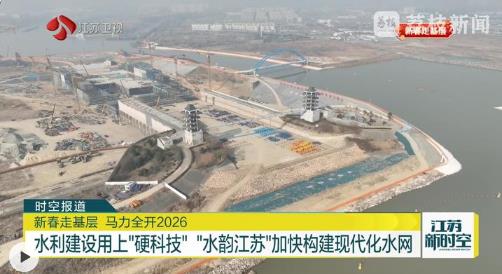
【新春走基层 马力全开2026】水利建设用上“硬科技” “水韵江苏”加快构建现代化水网
Xin Lang Cai Jing· 2026-02-23 14:33
Core Viewpoint - The article highlights the modernization of water management in Jiangsu, showcasing significant investments and technological advancements in water infrastructure projects, particularly the construction of the Huaihe River to the Sea Waterway Phase II project. Investment and Infrastructure Development - Jiangsu has accelerated the construction of a modern water network, completing key water conservancy projects with an investment of 22.33 billion yuan, exceeding investment targets [2] - The Huaihe River to the Sea Waterway Phase II project is set to become the world's largest waterway interchange, enhancing flood control standards from a 100-year to a 300-year event [4] Technological Advancements - The project utilizes new materials, equipment, technologies, and processes, significantly improving construction efficiency [4] - A smart cloud factory for rebar production operates with only 12-13 workers, achieving an output of 40-50 tons of rebar per day, compared to the previous 10 tons with more labor [6][8] - The factory employs IoT, cloud computing, big data, and modern logistics for digital management of the entire production process, increasing efficiency by over 60% [9] Safety and Monitoring Innovations - Drones are used for real-time safety inspections and monitoring, creating a traceable evidence chain for future smart water management [11] - The project incorporates numerous safety monitoring devices to ensure the structural integrity and safety of the water conservancy project [11][12] Project Progress and Future Goals - As of now, approximately 60% of the main structure of the Huaihe River to the Sea Waterway Phase II has been completed, with plans to restore navigation by the end of May [13] - Jiangsu is actively promoting technological and management innovations, exceeding targets for various water conservancy projects, contributing to a more resilient and intelligent modern water network [13]

江西深化实施项目带动战略 “十五五”期间计划完成投资超6万亿元
Zhong Guo Xin Wen Wang· 2026-01-27 07:59
Core Insights - Jiangxi Province plans to invest over 10 trillion yuan in more than 10,000 major projects during the "14th Five-Year Plan" period, with an investment target exceeding 6 trillion yuan [1][2] - The province's GDP has reached 3.6 trillion yuan, with per capita GDP surpassing 11,200 US dollars, indicating significant economic growth [1] - Jiangxi's industrial output value has reached 1.19 trillion yuan, with the electronics and non-ferrous metals industries each exceeding 1 trillion yuan, solidifying its status as a new industrial powerhouse [1] Investment Strategies - The Jiangxi Development and Reform Commission will enhance project-driven strategies to stabilize total investment, optimize structure, stimulate vitality, and improve efficiency, aiming to expand domestic demand comprehensively [2] - Infrastructure development will focus on improving transportation capabilities, with plans to construct key railways and highways, targeting over 6,000 kilometers of railway and 8,400 kilometers of highways by 2030 [2] Energy and Water Infrastructure - Jiangxi aims to accelerate the construction of a new energy system, with plans to add over 18 million kilowatts of new energy capacity during the "14th Five-Year Plan" period [2] - The province will enhance its water security by constructing major water conservancy projects and developing a modern water network, aiming for a comprehensive water safety improvement [2]
为保障防洪安全、供水安全、粮食安全、生态安全作出贡献——国新办发布会介绍国家水网建设成果
Xin Hua She· 2026-01-09 12:49
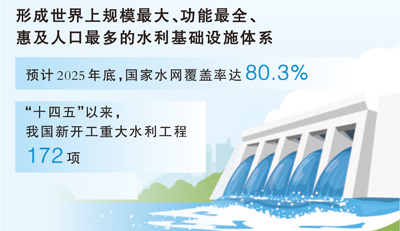
Core Insights - The news highlights the progress and achievements of China's national water network construction, emphasizing its role in ensuring flood control, water supply, food security, and ecological safety [1][2][3] Group 1: National Water Network Construction Progress - During the 14th Five-Year Plan period, a total investment of 5.68 trillion yuan was made in water conservancy construction across the country [1] - The national water network now covers 80.3% of the country's land area, providing water security for major national strategies and key economic zones [1][2] - In the past year, significant projects such as the Huanghe Guxian Water Conservancy Hub and the Chongqing Yuxi Water Resource Allocation Project were completed, contributing to the overall goals of the water network [2] Group 2: Agricultural Water Security - By the end of 2025, the irrigated area of arable land is expected to reach 109 million acres, an increase of over 5.3 million acres compared to the end of the 13th Five-Year Plan [3] - The Ministry of Water Resources has initiated the construction of seven large irrigation districts and modernized 157 medium and large irrigation districts [3] - A comprehensive reform of agricultural water pricing has been implemented over an area of 108.6 million acres, promoting water-saving practices in agriculture [3] Group 3: Disaster Prevention and Ecological Benefits - In the past year, 6,894 large and medium-sized reservoirs stored 120.2 billion cubic meters of floodwater, reducing urban flooding incidents by 1,082 times and protecting 8.3 million acres of farmland [4] - The Ministry of Water Resources has made significant progress in groundwater management, with shallow and deep groundwater levels in North China rising by 3.76 meters and 7.65 meters, respectively, compared to 2020 [6] Group 4: Future Plans and Investments - The Ministry of Water Resources plans to implement a series of major water conservancy projects by 2026, focusing on flood safety and water resource allocation [7] - Investment in water conservancy infrastructure is supported by local government bonds, bank loans, and social capital, which accounted for 36.1% of the total investment during the 14th Five-Year Plan [7]
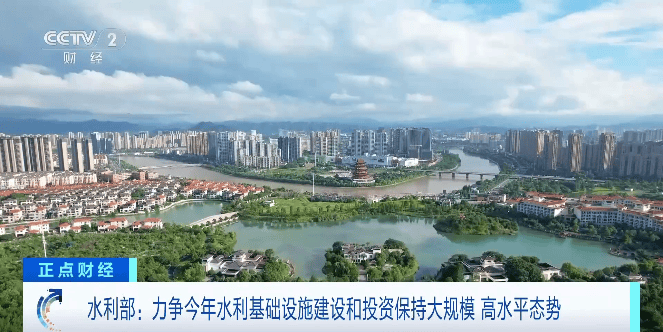
水利部:力争今年水利基础设施建设和投资保持大规模 高水平态势
Sou Hu Cai Jing· 2026-01-09 11:35
Core Viewpoint - The Ministry of Water Resources aims to maintain large-scale and high-level investment in water infrastructure construction as the starting year of the 14th Five-Year Plan approaches in 2026 [1][5]. Group 1: Investment and Infrastructure Development - The Ministry of Water Resources plans to implement the national "River Strategy" this year, focusing on both existing and new projects, as well as "hard investment" and "soft construction" to enhance the national water network [3]. - The goal is to ensure that water infrastructure construction and investment remain at a large scale and high level, promoting high-quality water development and ensuring water security in China [5]. Group 2: Modernization and Coverage Goals - During the 14th Five-Year Plan period, China will accelerate the construction of a modern water network that is comprehensive, safe, efficient, green, intelligent, and well-regulated [7]. - Key projects include the completion of the South-to-North Water Diversion Middle Line and the promotion of major inter-basin and inter-regional water diversion projects [7]. - The plan includes modernizing irrigation areas to add 40 million mu of irrigated farmland, increasing rural tap water coverage to 98%, and ensuring that large-scale water supply projects cover 78% of the rural population [7].
一组数据看2025年我国水利工作新成效
Xin Hua Wang· 2026-01-07 10:25
Core Viewpoint - The National Water Resources Work Conference emphasizes the importance of high-quality water resource development and security in China, aiming to enhance disaster prevention capabilities and optimize water resource management by 2025 [1][2]. Group 1: Investment and Financial Goals - By 2025, China plans to complete water resource construction investments totaling 12,848 billion yuan, marking the fourth consecutive year of investments exceeding 1 trillion yuan [1]. - The China Water Rights Exchange achieved a record high with 14,000 transactions and a total water volume of 16.1 billion cubic meters traded [1]. Group 2: Disaster Prevention and Management - The conference highlighted the effective management of 913 rivers experiencing floods above warning levels and 42 rivers exceeding historical flood records [1]. - A strategic goal is to modernize the flood disaster prevention system, improving monitoring and forecasting systems for flood and drought management [2]. Group 3: Infrastructure and Technological Development - The construction of a modern water network is prioritized, focusing on creating a comprehensive, safe, efficient, and environmentally friendly system [2]. - The development of a digital twin water management system is underway, integrating advanced monitoring and simulation technologies to enhance operational capabilities [3]. Group 4: Resource Utilization and Conservation - The conference aims to establish a robust system for water resource conservation, implementing national water-saving actions and developing strict resource management frameworks [3]. - A comprehensive reform of agricultural water pricing has been initiated, covering an area of 10.86 million acres [1].
水利部:构建现代化水旱灾害防御体系 加快建设现代化水网
Zheng Quan Shi Bao Wang· 2025-12-12 14:03
Core Viewpoint - The Ministry of Water Resources emphasizes the integration of problem-oriented and goal-oriented approaches to enhance water management and support economic and social development [1] Group 1: Policy and Strategy - The meeting focuses on constructing a modern disaster prevention system for water and drought, accelerating the development of a modern water network, and promoting comprehensive rural revitalization through water management [1] - There is a call to improve the total water resources management and comprehensive conservation system, as well as to advance the governance and ecological protection of rivers, lakes, and reservoirs [1] Group 2: Technological Integration - The Ministry plans to systematically promote the digital twin water management system to enhance operational efficiency and decision-making [1] Group 3: Implementation and Accountability - The meeting stresses the importance of ensuring that the decisions and policies of the Central Committee are effectively implemented within the water resources system, emphasizing hard work and practical results [1]
水利部党组学习贯彻中央经济工作会议精神
Shui Li Bu Wang Zhan· 2025-12-12 13:55
Core Viewpoint - The meeting emphasized the importance of implementing the spirit of the Central Economic Work Conference, guided by Xi Jinping's thoughts on water management and economic development, to ensure a strong start for the 14th Five-Year Plan [1][2] Group 1 - The meeting highlighted the need to unify thoughts and actions based on the Central Committee's scientific judgment of the economic situation and the decision-making for next year's economic work [1] - It stressed the importance of adhering to the principles of "water conservation first, spatial balance, systematic governance, and dual efforts" in water management [1] - The meeting called for a focus on modernizing water disaster prevention systems and accelerating the construction of a modern water network [2] Group 2 - The meeting outlined the necessity of improving water resource management and promoting ecological protection of rivers, lakes, and reservoirs [2] - It emphasized the importance of ensuring water supply security during winter and managing river conditions to maintain social stability [2] - The meeting urged practical efforts to ensure that the Central Committee's decisions are effectively implemented within the water sector [2]
水网密织,将惠泽皖北超三千万群众(迈向“十五五”的发展图景)
Ren Min Ri Bao· 2025-12-11 22:11
Core Viewpoint - The construction of the Yangtze River to Huai River water diversion project is crucial for enhancing water resource management, flood disaster prevention, and urban-rural water supply security in Anhui Province, with significant benefits expected for over 30 million residents in the northern Anhui region [3][4][5]. Group 1: Project Overview - The first phase of the Yangtze River to Huai River project was completed by the end of 2022, enabling water resource allocation across river basins [4]. - The second phase of the project is underway, focusing on urban and rural water supply and irrigation support, with a goal to connect over 30 million people to the new water supply [4][5]. - The project includes the construction of water plants, pipelines, and pressure stations to ensure stable water supply, particularly in areas previously reliant on groundwater [3][6]. Group 2: Economic and Social Impact - The project is expected to improve water quality significantly, as residents report better drinking water since the introduction of the new supply [5]. - By the end of 2025, the second phase is projected to have completed investments totaling 11.457 billion yuan, with water source replacement tasks in 28 counties expected to be finished [6]. - The project aims to enhance regional economic and social development by ensuring water security, with plans for further infrastructure improvements by 2028 [6][7]. Group 3: Construction and Management Strategies - Innovative construction techniques were employed to overcome challenges, such as using heating methods to protect concrete during cold weather [6]. - The project emphasizes a coordinated approach to water resource management, integrating large-scale infrastructure with local supply systems to ensure effective distribution [7]. - The government is encouraged to balance its role in water management with market mechanisms to foster private investment in water infrastructure [7][8].
织密现代化水网保障生产生活用水
Liao Ning Ri Bao· 2025-12-09 00:56
Group 1 - The company is actively maintaining and repairing water supply pipeline valves to ensure the safety and efficiency of the water supply system in Liaoning Province [1] - The Panjin water supply project aims to address water resource shortages and improve groundwater conditions, playing a significant role in the overall water network construction in the province [1] - As of October 1, the project has officially entered the operational phase, having already supplied 15 million cubic meters of water to the Panjin area, enhancing the living conditions for urban residents and supporting regional economic development [1] Group 2 - The company plans to increase efforts in high-quality infrastructure projects related to cross-regional water resource allocation, urban-rural integrated water supply, and rural water supply during the 14th Five-Year Plan period [2] - The company emphasizes the collaborative development of water resource allocation, ecological protection, engineering construction, hydropower, and smart water management [2]
现代化水网如何越织越密(政策问答·回应关切)
Ren Min Ri Bao· 2025-12-05 21:57
Core Viewpoint - The construction of a modern water network is essential for addressing water resource management, ecological balance, and disaster prevention in China, as highlighted in the "14th Five-Year Plan" and ongoing projects [1][5]. Group 1: Modern Water Network Construction - The modern water network aims to enhance flood disaster defense, water resource allocation, and urban-rural water supply capabilities, with significant projects already completed or underway [1]. - The network's development is crucial for addressing the uneven distribution of water resources across regions, particularly in light of increasing extreme weather events [1][2]. Group 2: Investment and Financing Reforms - The water sector is exploring integrated construction and management models, utilizing public-private partnerships (PPP) to attract social capital for water network projects [3]. - The Dashi Gorge Water Conservancy Project in Xinjiang exemplifies a successful PPP model, addressing investment recovery challenges and expected to be fully operational by October 2026 [3]. Group 3: Digital Empowerment - The water sector is advancing digital technologies, including digital twin models for water networks, to enhance monitoring and operational efficiency [4]. - Initiatives include the establishment of a national water network scheduling center and a big data center to support the integration of physical and digital water networks [4]. Group 4: Public Benefits - The focus is on improving water resource management in key urban areas, energy bases, and agricultural regions, ensuring water safety and quality public services [5]. - Efforts are being made to extend the water network to smaller rivers and rural areas, enhancing accessibility and service quality for local communities [5].