
电网储能

Search documents
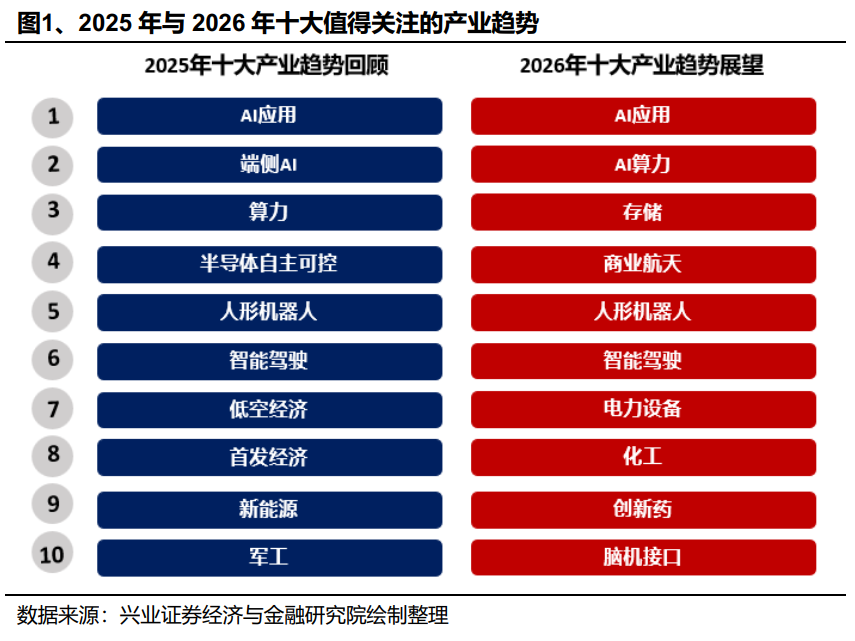
兴业证券:2026年值得关注的十大产业趋势
智通财经网· 2026-02-18 03:45
Group 1: AI Applications - The global AI competition is intensifying, with model iterations driving deeper application scenarios, and the focus is on whether significant capital expenditures by tech giants can lead to commercial applications [2][3] - The competitive landscape for AI applications is shifting from dominance by OpenAI to a more multipolar environment, with major players like Google and Meta integrating AI into their ecosystems [3] - In China, AI applications are experiencing a breakthrough, with major tech companies accelerating model iterations and application deployments, leading to a transformation from model landing to scenario monetization [5] Group 2: AI Computing Power - Overseas, major cloud service providers are maintaining high capital expenditures, with a projected increase of 67% in 2026, reflecting a strong demand for AI computing power [7][8] - In China, leading tech companies are increasing capital expenditures and accelerating the iteration of domestic large models, promoting the performance of domestic chips amid tightening supply from foreign sources [9] Group 3: Storage - The demand for storage is entering a new super cycle driven by AI training and inference needs, with AI servers consuming significantly more memory than traditional servers [11][16] - Supply constraints are expected to persist, leading to continued high prices for storage components, as major manufacturers shift production focus to advanced memory types [16] Group 4: Commercial Aerospace - Commercial aerospace is becoming a key battleground in US-China competition, with significant policy support and funding initiatives in both countries to accelerate industry development [19][21] - Domestic companies are achieving breakthroughs in satellite mass production and reusable rocket technologies, transitioning from technical validation to commercialization [22] Group 5: Humanoid Robots - Major overseas companies are ramping up production plans for humanoid robots, benefiting domestic component suppliers, with Tesla aiming for a production capacity of 500,000 units by 2026 [27][30] - Chinese manufacturers are leading in humanoid robot shipments, with significant contracts and production milestones achieved in 2025 [30] Group 6: Intelligent Driving - Domestic policies are expected to facilitate the commercialization of L3 autonomous driving in 2026, with several manufacturers preparing to launch L3 models [32][33] - Tesla's Full Self-Driving (FSD) technology is setting the direction for autonomous driving, with significant advancements in AI capabilities [35] Group 7: Energy Storage - The expansion of AI computing power in North America is driving electricity demand, with domestic power equipment expected to accelerate exports [37][40] - China's "14th Five-Year Plan" includes significant investments in the power grid and energy storage, creating a favorable environment for industry growth [40][43] Group 8: Chemicals - The chemical industry is undergoing a transformation driven by policies aimed at supply-side reform, with a focus on optimizing supply structures and reducing excess capacity [44][47] - New economic sectors are boosting demand for chemical materials, particularly in AI, renewable energy, and robotics, leading to a favorable outlook for new materials [47][48]


研判2026!中国锂电池制造设备行业产业链、发展现状、出海规模及未来发展趋势分析:出海拓局开辟增量蓝海,海外市场规模有望达到1266.5亿元[图]
Chan Ye Xin Xi Wang· 2026-01-29 01:08
Core Insights - The lithium battery manufacturing equipment industry in China has established a complete industrial chain, with upstream components and materials, midstream equipment R&D and manufacturing, and downstream battery production and applications [1][6] - The industry has experienced rapid growth since 2020, with expected shipments reaching 1888.6 GWh by 2025, accounting for 82.8% of global shipments [1][8] - Domestic investment in the lithium battery industry is projected to exceed 820 billion yuan by 2025, with over 282 investment projects [1][9] - The overseas market is emerging as a new growth area, with the overseas lithium battery equipment market expected to reach 1266.5 billion yuan by 2030 [1][12] Industry Overview - Lithium battery manufacturing equipment is essential for producing lithium-ion battery cells and includes various specialized machinery for different production processes [1][3] - The equipment can be categorized based on production processes (front-end, mid-end, back-end), functionality, automation level, and battery type [3][4] Industrial Chain - The industrial chain consists of upstream core components and materials (40-60% of total equipment cost), midstream equipment R&D and manufacturing, and downstream battery production [6] - Key downstream customers include major battery manufacturers like CATL and BYD, with demand driven by the rapid growth of electric vehicles and energy storage [6][8] Market Dynamics - The domestic lithium battery equipment market has shown phase fluctuations, with a projected market size of 660 billion yuan in 2024 and a rebound to 850 billion yuan by 2027 [11] - The export value of lithium batteries from China reached 69.2 billion USD in the first 11 months of 2025, with an expected total of over 76 billion USD for the year [9][10] Development Trends - The industry is expected to focus on technological iteration, supply chain localization, and global expansion, leading to high-quality development [12][13] - Equipment will evolve to accommodate new battery technologies, integrating advanced technologies like AI and digital twins for improved production efficiency [12][13] - The localization of core components is crucial for enhancing supply chain resilience and reducing costs [13] - The global market competition is shifting towards technology and service capabilities, with leading companies enhancing their market positions through overseas expansions [14]



Albemarle(ALB) - 2025 Q3 - Earnings Call Transcript
2025-11-06 14:02
Financial Data and Key Metrics Changes - The company reported net sales of $1.3 billion for Q3 2025, with adjusted EBITDA reaching $226 million, a 7% increase year-over-year, driven by cost and efficiency improvements despite lower lithium pricing [5][8] - Cash generated from operations was $356 million, marking a 57% year-over-year increase [5] - The adjusted EBITDA margin improved by approximately 150 basis points compared to the previous year [8] Business Line Data and Key Metrics Changes - Energy storage sales volume growth is expected to be up 10% or more year-over-year, supported by record integrated production and higher spodumene sales [10] - The specialties segment delivered a 35% increase in adjusted EBITDA, largely due to cost improvements across raw materials, manufacturing, and freight [9] - Ketjen's business is expected to see stronger Q4 performance due to higher CFT and FCC volumes [12] Market Data and Key Metrics Changes - Global EV sales increased by 30% year-to-date, with significant growth in China and the EU [6][15] - Grid storage demand grew by 105% year-to-date, with North America being the fastest-growing region, up almost 150% [15][16] - The company anticipates lithium demand for stationary storage applications to increase more than two and a half times by 2030 [16] Company Strategy and Development Direction - The company is focusing on long-term value creation and financial flexibility through recent portfolio actions, including selling a controlling stake in Ketjen's refining catalyst business [6][7] - The strategy includes enhancing shareholder value, improving financial flexibility, and maintaining a strong competitive position in energy storage and specialties [7][20] - The company aims to achieve full-year cost and productivity improvements of around $450 million, surpassing initial targets [6][18] Management's Comments on Operating Environment and Future Outlook - Management noted that global lithium supply-demand balance is tightening, with consumption growth up over 30% year-to-date [15] - The company expects to maintain a strong cash conversion performance, projecting positive free cash flow of $300-$400 million for 2025 [13][19] - Management expressed optimism about the energy storage market, highlighting strong demand driven by grid stability and renewable energy [16][87] Other Important Information - The company closed the quarter with $1.9 billion in cash and plans to repay Eurobond debt maturing soon [14] - Capital expenditures for the year are projected to be approximately $600 million, reflecting a 65% reduction year-over-year [17] - The company is committed to continuous improvement and cost discipline, with sales, administrative, and R&D expenses down $166 million, or 22% since last year [18][19] Q&A Session Summary Question: Dynamics at Talison and spodumene pricing - Management indicated that they do not predict lithium prices but are optimistic about the market tightening, which could affect margins [22][23] Question: Current lithium pricing in China - Management noted that current pricing is closer to $10 per kilogram, with a full-year average expected around $9 to $9.50 [27][28] Question: Full-year adjusted EBITDA margin potential - The company expects an overall adjusted EBITDA margin potential of 30% or greater at $15 per kilogram lithium pricing [31] Question: EV demand versus energy storage - Management believes energy storage currently represents about a quarter of the market and is growing at a faster rate than EVs [35][36] Question: Impact of curtailments in Chinese lepidolite production - Management observed that about a third of lepidolite production was impacted, but it represents a minor blip in the overall market [39][40] Question: Lithium demand forecast for 2030 - Management stated that while the demand outlook has not changed significantly, it has moved slightly upward within the existing range [41][43] Question: Energy storage market growth - Management confirmed strong demand in the energy storage market, particularly in China, with full utilization of battery cell lines [92][94]

英媒:电网储能市场需求激增,中韩电池巨头开辟竞争新战线
中关村储能产业技术联盟· 2025-04-30 05:41
报道称,中国电池企业已占据全球储能系统近90%的产能,在美国和欧洲市场份额分别超过80%和 75%。然而,随着美国关税壁垒的升级,韩国电池企业正试图借机在欧美市场重振旗鼓。 储能系统通过管理软件调控成组电池模块,帮助国家电网及家庭、企业和工厂应对风能和太阳能供应的 波动。未来十年,随着人工智能硬件、电动汽车等清洁技术对电力需求的激增,储能系统还将为电网提 供关键备用支持。 国际能源署本月报告预测,AI数据中心全球用电需求将在未来五年翻番,占美国2030年前电力需求增 长的近半数。电池咨询公司Rho Motion研究主管Iola Hughes指出:"储能常被视为可再生能源领域最缺 乏吸引力的环节,但它恰恰是未来保障各国电力稳定的核心技术。" 据Rho Motion数据,储能电池市场份额已从2020年的5%攀升至当前的20%。全球储能容量在2023-2024 年间增长52%,预计将从去年的340吉瓦时跃升至2030年的760吉瓦时(相当于760万辆电动汽车电池总 和)。蓬勃发展的储能市场甚至帮助特斯拉弥补了电动汽车销售疲软——其家用Powerwall和电网级 Megapack储能产品需求激增,CEO马斯克称该业务 ...