
登陆火星

Search documents
SpaceX上市倒计时,特斯拉(TSLA.US)“马斯克溢价”面临再分配
Zhi Tong Cai Jing· 2025-12-18 14:31
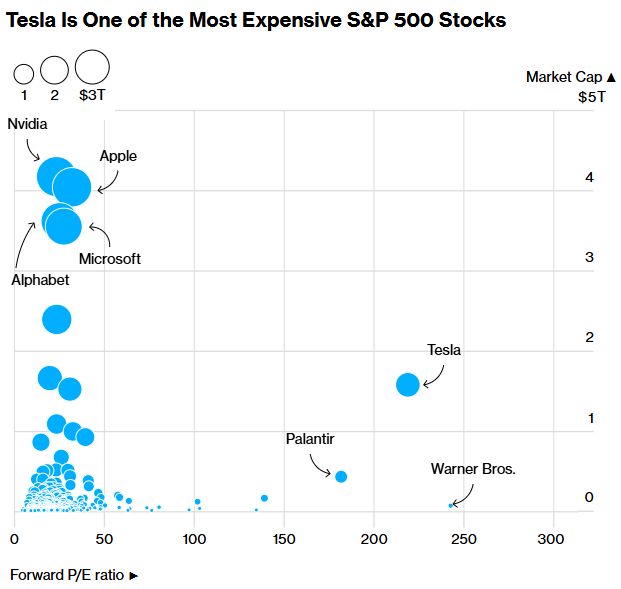
Core Viewpoint - Elon Musk is presenting a future vision involving autonomous vehicles, humanoid robot assistants, and life on Mars, with Tesla (TSLA.US) stock being the primary investment avenue for this vision [1] Group 1: Tesla Stock Performance - Tesla's stock reached a new high for the year, rising approximately 20% over the past four weeks and 111% since its low on April 8 due to tariff policy fears [1] - The current price-to-earnings (P/E) ratio for Tesla is 214, ranking second among S&P 500 constituents, significantly higher than Palantir Technologies' 178 [1] Group 2: Investor Sentiment and Valuation Concerns - Some investors express skepticism about Tesla's high valuation, citing poor fundamentals and declining sales and profits amid increased regulatory scrutiny [5][6] - Optimists believe Tesla has significant growth potential in autonomous driving and AI, projecting earnings growth of 30% to 35% over the next two to three years [6] Group 3: SpaceX IPO Impact - SpaceX is expected to go public next year with a valuation of $800 billion, potentially creating selling pressure on Tesla stock as some investors may shift their focus to SpaceX [4] - Conversely, the high-profile IPO of SpaceX could attract new investors to Tesla, as historical trends suggest that milestones achieved by Musk's companies often boost market sentiment for others [5] Group 4: Long-term Outlook - Despite short-term valuation concerns, many investors believe Tesla remains a worthwhile investment due to its potential in automation and robotics [7] - The long-term vision of Mars exploration and advancements in robot technology may take years to materialize, but the impact could be significant within three to five years [7]


马斯克,或成史上首位万亿美元富翁
财联社· 2025-12-14 01:26
Core Viewpoint - SpaceX is preparing for a potential IPO in 2026, aiming to raise significant funds if market conditions are favorable, although the timeline and valuation remain uncertain [1][2]. Group 1: IPO Preparation - SpaceX's CFO Brett Johnson confirmed to employees that the company is preparing for a potential IPO in 2026, with the goal of raising substantial capital [1]. - The internal stock price is currently set at $421 per share, indicating a valuation of approximately $800 billion, up from about $400 billion earlier this year [1][2]. Group 2: Fund Utilization - If the IPO proceeds, the funds will be used to increase the launch frequency of the Starship rocket, deploy AI data centers in space, and advance both crewed and uncrewed Mars missions [2]. Group 3: Company Background and Market Position - SpaceX is currently the busiest rocket launch company globally, frequently launching satellites with its Falcon 9 rocket and deploying over 9,000 Starlink satellites for high-speed internet services [2]. - The decision to consider going public has surprised some close to the company, as SpaceX has historically focused on achieving Elon Musk's vision of Mars colonization [2]. Group 4: Financial Performance and Future Valuation - Although SpaceX is private and does not disclose detailed financial data, Musk has indicated that the company's revenue for this year is expected to be around $15.5 billion, with positive free cash flow reported for several consecutive years [3]. - Investors are optimistic about the IPO news, believing it could provide funding for Musk's ambitious Mars plans and potentially elevate the company's valuation to over $1 trillion [3]. - Reports suggest that SpaceX aims for a mid to late 2024 IPO with a target valuation of approximately $1.5 trillion, comparable to Saudi Aramco's record valuation of about $1.7 trillion in 2019 [3].
马斯克“接管”NASA,聚焦“登陆火星”
Hua Er Jie Jian Wen· 2025-03-31 03:43
Core Insights - Elon Musk is attempting to reshape NASA into an agency that supports SpaceX's Mars mission by influencing its policies and resource allocation [1][2] - Concerns have been raised within NASA regarding Musk's influence, which may jeopardize existing projects and the agency's culture [3] Group 1: Musk's Influence on NASA - Musk has significant influence over NASA, having positioned himself as a senior advisor to the President, affecting budgets and personnel decisions across federal agencies [2] - He is pushing for his ally Jared Isaacman to become NASA's administrator and is working to prioritize Mars projects over existing NASA initiatives [1][2] - The White House plans to cut funding for the Artemis lunar program to allocate resources for Mars projects, indicating a shift in NASA's focus [1] Group 2: Conflicts with Existing Programs - The Artemis lunar program, which aims to return humans to the Moon and prepare for future Mars missions, is facing potential funding shortages and reassessment due to Musk's Mars ambitions [3] - Musk views the Artemis program as a distraction from his Mars plans, which creates a conflict with NASA's established strategy [2][3] Group 3: SpaceX's Position and Challenges - SpaceX is recognized as a leading aerospace company and a major contractor for NASA, with advantages in rocket development and cost reduction [4] - The company aims to establish a self-sustaining civilization on Mars, which is its long-term goal [4] - However, SpaceX faces significant challenges, particularly with the development and testing of its Starship vehicle, which has experienced multiple failures during testing [4][5]