
重返月球

Search documents
马斯克突然喊话“重返月球”!SpaceX要搞什么大事?
Xin Lang Cai Jing· 2026-02-09 11:06
Core Viewpoint - Elon Musk has shifted focus from Mars colonization to lunar exploration, stating that the Moon is the first step for humanity towards the stars, driven by time efficiency, policy pressures, and commercial viability [2][11]. Group 1: Reasons for the Shift - Time efficiency favors lunar missions, with a launch window every 10 days and a travel time of 3 days, compared to Mars which has a 26-month wait and a 6-month journey [2][11]. - Policy pressures from the U.S. government mandate a return of astronauts to the Moon by 2028, with SpaceX as a key contractor for NASA on a multi-billion dollar contract [2][11]. - The Moon presents quicker financial returns through NASA contracts and potential resource extraction, such as helium-3 for fusion energy, and opportunities for commercial ventures like hotels [2][11]. Group 2: SpaceX's Ambitious Plans - SpaceX plans to establish a "construction frenzy" on the Moon, utilizing AI satellites for environmental monitoring and building factories to 3D print materials from lunar regolith [3][12]. - The company aims to deploy 1 million satellites to create the first orbital data center, addressing AI computational needs on Earth, with a projected cost reduction for space computing to one-tenth of current Earth costs within four years [3][12]. - SpaceX's valuation has surged to $1.25 trillion, with an IPO planned for summer 2026, potentially raising over $30 billion, reflecting strong market interest in lunar initiatives [3][12]. Group 3: Challenges and Future Plans - Technical challenges include lunar dust damaging equipment, extreme temperatures during lunar nights, and high costs for transporting water from Earth [6][14]. - Ethical concerns arise regarding lunar resource extraction rights and the potential for conflict over these resources, alongside public skepticism about prioritizing commercial interests over scientific research [6][14]. - SpaceX plans to launch an unmanned lunar mission in March 2027 and establish the first lunar base by 2030, which could serve as a testing ground for technologies needed for future Mars colonization [6][14].


微信恢复千问、元宝红包口令复制;王慧文欲进军AI代理创业
2 1 Shi Ji Jing Ji Bao Dao· 2026-02-09 06:08
Group 1: Technology Industry Developments - Tencent's WeChat has allowed the copying of the red envelope codes for Alibaba's Qianwen app and Tencent's Yuanbao, after previously banning them [2] - OpenClaw has gained significant attention, with investor and entrepreneur Wang Huiwen inviting teams interested in this area to seek funding [3] - Alphabet's Gemini application has surpassed 750 million monthly active users, with a capital expenditure target for 2026 raised to $185 billion, focusing on AI data centers and infrastructure [4] Group 2: Corporate Announcements and Financials - Meitu announced a projected net profit growth of 60% to 66% for the fiscal year 2025 compared to 2024 [8] - ZhuiMi's CEO revealed that the total year-end bonus pool will reach approximately $1 billion, with the highest individual bonuses potentially reaching 20 months' salary [7] Group 3: Product Launches and Innovations - OpenAI's first hardware, named Dime, is expected to be released this year, focusing on a simpler AI audio headset rather than a complex device [9] - Qingtian Rental launched a 999 yuan experience plan for various robots, making advanced robotics accessible to consumers [10] Group 4: Space Exploration and Recruitment - Elon Musk emphasized the need for a large-scale return to the Moon, with SpaceX actively recruiting engineers for AI satellite and space data center development [5] - Musk also revealed that Apple had aggressively recruited Tesla engineers for its now-canceled electric vehicle project, with over 300 employees poached by 2019 [6]


早报 | 马斯克:是时候大规模重返月球了;王楚钦孙颖莎夺冠;外卖小哥打翻32杯奶茶愣住,古茗回应;1月乘用车新车平均降价3.7万元
虎嗅APP· 2026-02-09 00:14
Group 1 - Elon Musk stated that it is time for a large-scale return to the Moon, with SpaceX hiring engineers to develop AI satellites and space data centers [2] - NASA's new administrator announced plans for a lunar return during Trump's second term, including establishing a lunar base and exploring helium-3 mining [2] - Samsung Electronics will be the first to mass-produce HBM4, a new generation of high-bandwidth memory aimed at AI chips, starting in the third week of February [5][6] Group 2 - Netflix's proposed $82.7 billion acquisition of Warner Bros. Discovery is under investigation by the U.S. Department of Justice for potential anti-competitive behavior [7] - In January 2026, the average price drop for new passenger cars was 37,000 yuan, with a total decline of 14.9% in the market [9][10] - China's central bank increased its gold reserves for the 15th consecutive month, reaching 7,419 million ounces by the end of January 2026 [14] Group 3 - The first week of the Spring Festival travel period saw over 1.4 billion people traveling across regions, a 2% increase compared to the previous year [15] - Beijing will launch a new subsidy scheme for replacing old cars with new ones starting February 9, with subsidies up to 20,000 yuan [28] - Semiconductor manufacturer SMIC is set to announce its Q4 2025 earnings on February 9, which will be a key indicator for China's chip manufacturing progress [29]




最新!马斯克:是时候大规模重返月球了
Mei Ri Jing Ji Xin Wen· 2026-02-09 00:00
Group 1 - Elon Musk has indicated that it is time for a large-scale return to the Moon, with SpaceX reportedly hiring engineers in Austin and Seattle to develop AI satellites and space data centers [1] - NASA's new administrator, Jared Isaacman, announced plans for the U.S. to return to the Moon during Trump's second term, including establishing a space data center and infrastructure, and mining helium-3 on the Moon [4] - NASA is collaborating with SpaceX, Blue Origin, and Boeing on the Artemis launch missions [7] Group 2 - The White House issued a statement on December 18, 2025, where Trump signed an executive order outlining a vision for a "America First" space policy, aiming for a return to the Moon by 2028 and establishing initial facilities for a permanent lunar outpost by 2030 [8] - The executive order directs the upgrade of launch infrastructure and the development of commercial pathways to replace the International Space Station by 2030, stimulating private sector innovation and investment [8] - The order also instructs the President's science and technology advisor to coordinate national space policy and mandates federal agencies to simplify procurement processes and implement space safety strategies [8]
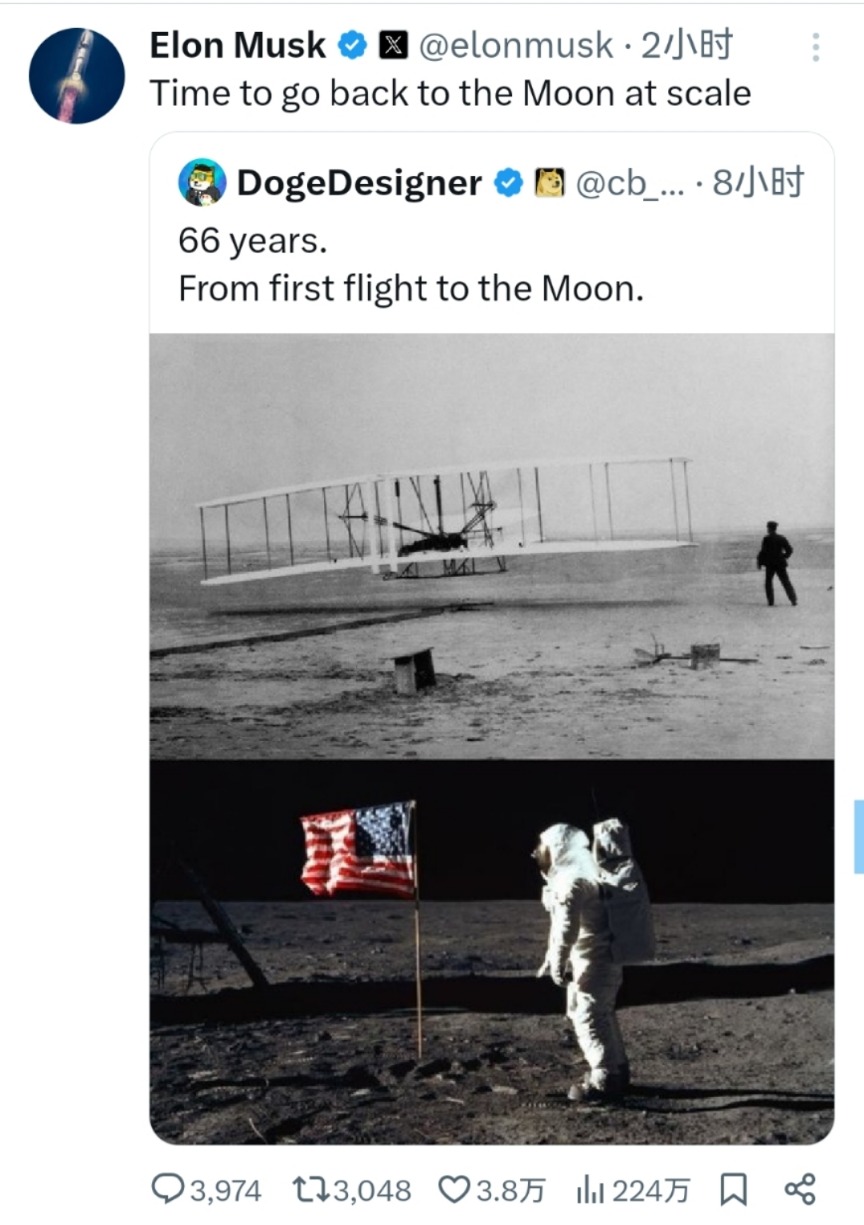
马斯克:是时候大规模重返月球了
财联社· 2026-02-08 10:55
Core Viewpoint - Elon Musk has indicated that it is time for a large-scale return to the Moon [1] Group 1 - SpaceX is reportedly hiring engineers in Austin and Seattle to develop artificial intelligence satellites and space data centers [2] - Musk confirmed the hiring news by retweeting and responding affirmatively [2]
24小时环球政经要闻全览 | 12月29日
Ge Long Hui· 2025-12-29 00:57
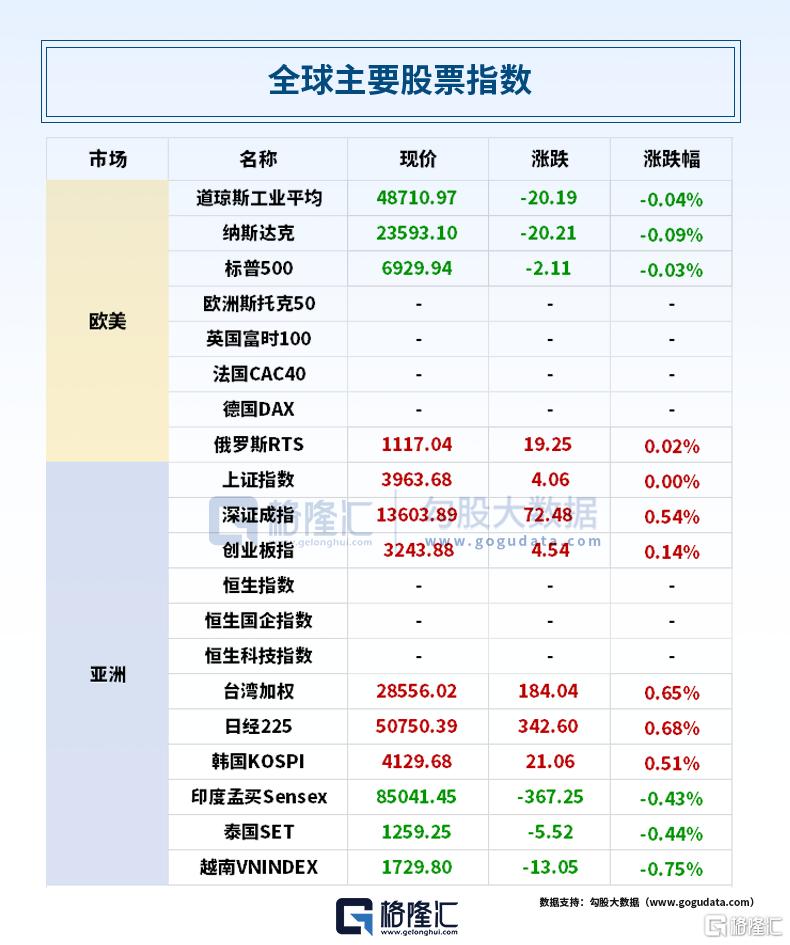
Market Overview - Major US indices showed slight declines, with the Dow Jones Industrial Average at 48,710.97, down 20.19 points or 0.04% [2] - The Nasdaq Composite decreased by 20.21 points, closing at 23,593.10, a drop of 0.09% [2] - The S&P 500 index fell by 2.11 points to 6,929.94, reflecting a decrease of 0.03% [2] - In Asia, the Taiwan Weighted Index rose by 184.04 points to 28,556.02, an increase of 0.65% [2] - The Nikkei 225 in Japan increased by 342.60 points, closing at 50,750.39, up 0.68% [2] - The KOSPI in South Korea rose by 21.06 points to 4,129.68, a gain of 0.51% [2] - The Indian Sensex fell by 367.25 points to 85,041.45, down 0.43% [2] - The Thai SET index decreased by 5.52 points to 1,259.25, down 0.44% [2] - The Vietnamese VNINDEX dropped by 13.05 points to 1,729.80, a decline of 0.75% [2] Geopolitical Developments - US President Trump and Ukrainian President Zelensky discussed a proposed peace plan for the Russia-Ukraine conflict, indicating both leaders' interest in reaching a peace agreement [3] - Trump emphasized the importance of ending the conflict, stating that a security agreement between the US and Ukraine will be established, which he described as "very strong" [3] Defense and Security - Ukraine conducted a drone attack on Moscow, temporarily disrupting air traffic and leading to the cancellation of hundreds of flights [4] - Russian authorities reported intercepting approximately 30 Ukrainian drones, with a total of 273 drones shot down within Russian territory [4] Space Exploration - NASA's new administrator announced plans for the US to return to the Moon during Trump's second term, including the establishment of a lunar base and exploration of helium-3 mining [5] - Collaborations with private companies like SpaceX and Boeing are ongoing for the Artemis missions [5] Corporate Developments - Tesla is actively recruiting hardware engineers for its Robotaxi project in Shanghai, indicating progress towards launching autonomous ride-hailing services in China [9] - TSMC reported no damage to its facilities following a 6.6 magnitude earthquake near Taiwan, ensuring stability in global chip supply [12] - Toyota is expected to exceed a production target of 10 million vehicles in 2026, driven by strong demand for hybrid vehicles in the US [13]
军工本周观点:商业航天X太空算力X重返月球:国防军工-20251222
Huafu Securities· 2025-12-22 05:36
Investment Rating - The report maintains a rating of "stronger than the market" for the defense and military industry [6]. Core Viewpoints - The report highlights the rapid advancement of the commercial aerospace sector, driven by recent developments such as Google's "Project Suncatcher" and the U.S. government's renewed focus on lunar exploration [35][36]. - The military aerospace index rose by 1.53% during the week of December 15-19, outperforming the Shanghai Composite Index, which fell by 0.28% [9][14]. - The report emphasizes the expected strong recovery in demand for the military industry by 2026, suggesting a favorable outlook for future funding and investment [38]. Summary by Sections Weekly Market Review - The military aerospace index increased by 1.53% from December 15 to 19, while the Shanghai Composite Index decreased by 0.28%, resulting in an excess return of 1.8 percentage points [9][14]. - Since 2025, the military aerospace index has risen by 22.95%, compared to a 16.09% increase in the Shanghai Composite Index, leading to a relative excess return of 6.85 percentage points [15]. - The aerospace and commercial aerospace sectors performed particularly well due to frequent launches, while the information technology sector showed relatively flat performance [19][20]. Key Industry and Company News - On December 17, Google announced "Project Suncatcher," which aims to create a solar-powered space data center using a cluster of 81 AI-equipped satellites [35]. - The U.S. Space Force awarded contracts worth $3.5 billion for the procurement of 72 missile warning and tracking satellites, marking the largest deal for low Earth orbit constellations to date [36]. - Domestic developments include multiple successful launches in China's commercial aerospace sector, with upcoming missions expected [36][39]. Funding and Valuation - The report notes a net outflow of passive funds from military ETFs, amounting to 3.865 billion yuan, while leveraged funds saw a significant increase in inflows [24][28]. - As of December 19, the military aerospace index had a TTM price-to-earnings ratio of 71.89, indicating a high valuation relative to historical levels, but with strong recovery expectations for 2026 [38][29]. - The report suggests that the military industry is poised for significant growth driven by multiple catalysts, including the upcoming 14th Five-Year Plan and the centenary of the military [38].
军工本周观点:商业航天 X 太空算力 X 重返月球-20251222
Huafu Securities· 2025-12-22 02:05
Investment Rating - The report maintains a rating of "stronger than the market" for the defense and military industry [6]. Core Insights - The report highlights the rapid advancement of the commercial aerospace sector, driven by recent developments in space exploration and technology, including Google's "Project Suncatcher" and SpaceX's plans for a lunar base [45][46]. - The report notes that the military industry index (801740) increased by 1.53% during the week of December 15-19, outperforming the Shanghai Composite Index, which decreased by 0.28%, indicating a relative excess return of 1.8 percentage points [10][19]. - The report emphasizes the expected strong recovery in demand for the military industry by 2026, suggesting a favorable outlook for continued investment in this sector [30][36]. Summary by Sections 1. Weekly Market Review - The military industry index rose by 1.53% from December 15-19, while the Shanghai Composite Index fell by 0.28%, ranking 11th among 31 sectors [19][20]. - The aerospace and commercial aerospace sectors performed particularly well due to frequent launches, while the information technology sector showed relatively flat performance [25][26]. 2. Key Developments in the Industry - The report discusses significant developments in the commercial aerospace sector, including multiple launches in China and the U.S. government's commitment to returning to the moon by 2028 [45][46]. - The U.S. Space Force awarded contracts worth $3.5 billion for missile warning and tracking satellites, marking the largest deal for low Earth orbit constellations to date [46]. 3. Stock Performance - The top-performing stocks during the week were primarily from the commercial aerospace sector, with notable gains from companies like Xicai Testing and Western Materials [27][28]. - Conversely, stocks that experienced declines were largely those that had previously seen significant increases, indicating a potential market correction [27]. 4. Funding and Valuation - The report notes a net outflow of passive funds from military ETFs, totaling 3.865 billion yuan, while leveraged funds showed a significant increase in net inflows [30][35]. - As of December 19, the military sector's price-to-earnings ratio (TTM) was 71.89, indicating a high valuation relative to historical levels, but still presenting a favorable investment opportunity given the expected recovery in demand [36][41].
马斯克“接管”NASA,聚焦“登陆火星”
Hua Er Jie Jian Wen· 2025-03-31 03:43
Core Insights - Elon Musk is attempting to reshape NASA into an agency that supports SpaceX's Mars mission by influencing its policies and resource allocation [1][2] - Concerns have been raised within NASA regarding Musk's influence, which may jeopardize existing projects and the agency's culture [3] Group 1: Musk's Influence on NASA - Musk has significant influence over NASA, having positioned himself as a senior advisor to the President, affecting budgets and personnel decisions across federal agencies [2] - He is pushing for his ally Jared Isaacman to become NASA's administrator and is working to prioritize Mars projects over existing NASA initiatives [1][2] - The White House plans to cut funding for the Artemis lunar program to allocate resources for Mars projects, indicating a shift in NASA's focus [1] Group 2: Conflicts with Existing Programs - The Artemis lunar program, which aims to return humans to the Moon and prepare for future Mars missions, is facing potential funding shortages and reassessment due to Musk's Mars ambitions [3] - Musk views the Artemis program as a distraction from his Mars plans, which creates a conflict with NASA's established strategy [2][3] Group 3: SpaceX's Position and Challenges - SpaceX is recognized as a leading aerospace company and a major contractor for NASA, with advantages in rocket development and cost reduction [4] - The company aims to establish a self-sustaining civilization on Mars, which is its long-term goal [4] - However, SpaceX faces significant challenges, particularly with the development and testing of its Starship vehicle, which has experienced multiple failures during testing [4][5]