白酒打假

Search documents
浙江绍兴茅台文化体验馆开业;西凤电商多维发力奋战营销高峰;钓鱼台发布打假声明
Sou Hu Cai Jing· 2025-12-08 18:20
Group 1 - The opening of the 73rd Moutai Cultural Experience Hall in Shaoxing, Zhejiang, marks a significant step in Moutai's strategy to transform from selling liquor to selling a lifestyle [1] - The experience hall aims to integrate Moutai's culture with the local heritage of Shaoxing, enhancing customer engagement and service transformation [1] Group 2 - Xifeng E-commerce is gearing up for the upcoming sales peak during the Double Twelve and New Year Festival, focusing on online and offline integrated marketing strategies [2] - The company is participating in innovative activities such as the Haikou Music Festival and live streaming events to attract younger consumers and boost sales [2] Group 3 - Diaoyutai has issued a statement regarding counterfeit products resembling its trademark, warning consumers to purchase from official channels to avoid infringement [3] Group 4 - Jinjiu responded to rumors about its product being a "miracle water" for menstrual pain, clarifying that it is a health wine with immune-regulating properties, not a medicine [4] Group 5 - The "Harmonious Gift" box, featuring a collaboration between French champagne brand and Kuaijishan, was included in the gift list for French President Macron's visit to China [5] Group 6 - The China Light Industry Federation conducted a research visit to the historic Li Du distillery, known as the "cradle of Chinese liquor," to explore its heritage [6] Group 7 - A destruction event in Yibin, Sichuan, resulted in the disposal of 17,600 bottles of counterfeit liquor, valued at over 20 million yuan, as part of a crackdown on fake products [7] Group 8 - Luzhou Laojiao launched its customized liquor product "Junhuai Tianxia" on the Yima delivery platform, priced at 129 yuan per box (500ml), emphasizing its rich flavor and quality [8]

知名酒企,出手“打假”!
证券时报· 2025-06-17 16:01
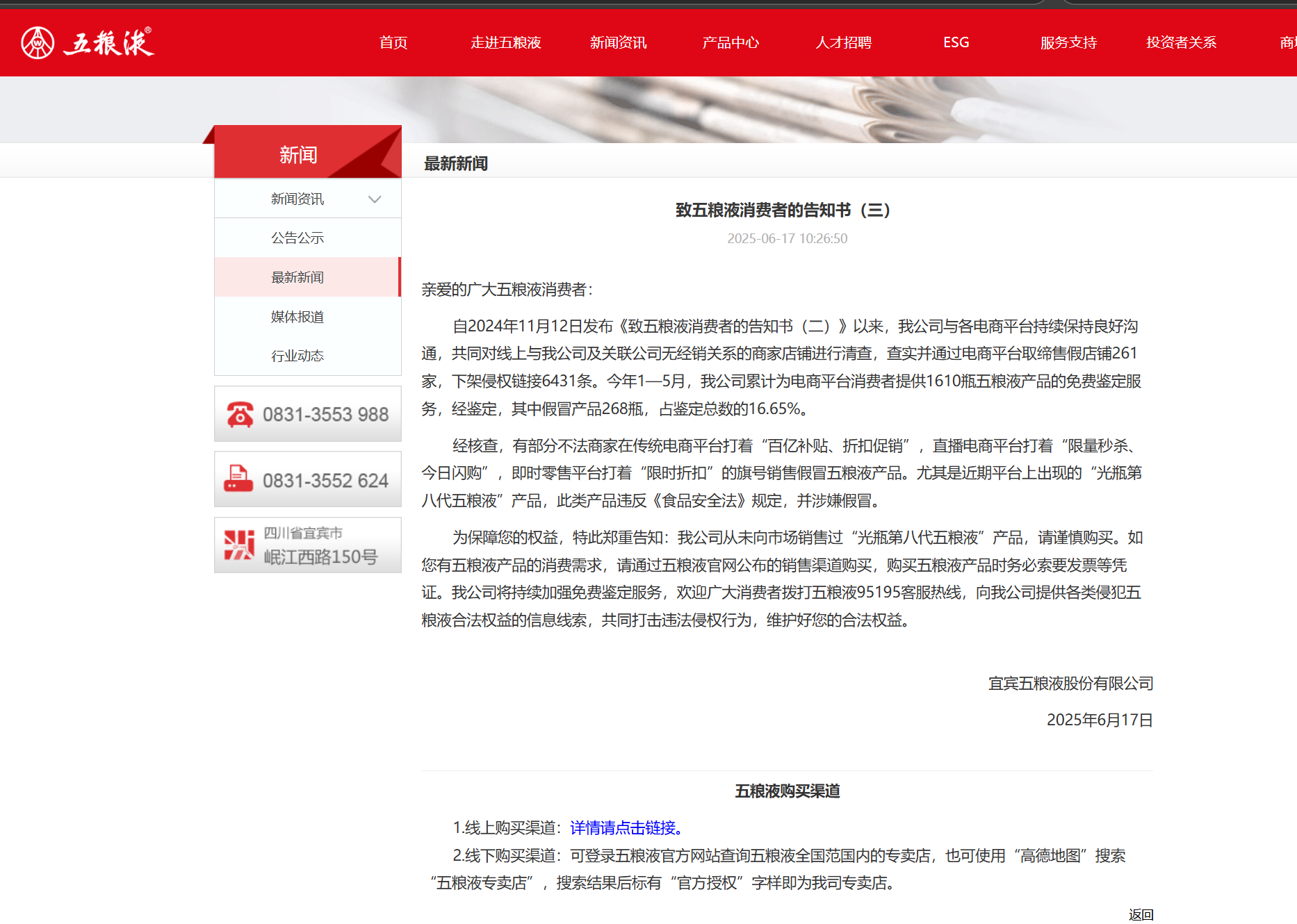
Core Viewpoint - The article highlights the ongoing issue of counterfeit liquor sales on e-commerce platforms, particularly focusing on the actions taken by the company Wuliangye to combat this problem and protect consumer rights [1][4]. Group 1: Company Actions Against Counterfeiting - Wuliangye provided free authentication services for 1,610 bottles of its products sold on e-commerce platforms from January to May this year, discovering 268 counterfeit bottles, which accounts for 16.65% of the total [2]. - The company has actively communicated with e-commerce platforms to identify and eliminate unauthorized sellers, resulting in the closure of 261 counterfeit shops and the removal of 6,431 infringing links [5]. - Wuliangye has warned consumers about the sale of a product called "Light Bottle Eighth Generation Wuliangye," which it has never sold, urging consumers to purchase through official channels and retain proof of purchase [6]. Group 2: Industry Context and Challenges - The white liquor industry is currently in a period of stock competition, with e-commerce platforms using low-price strategies that compromise product quality, negatively impacting consumer rights and the industry's reputation [8]. - National statistics indicate a decline in white liquor production, with a 7.8% year-on-year decrease in output from January to April 2025, and a significant drop of 13.8% in April alone [9]. - Since 2016, white liquor production has been on a downward trend, with production reaching a peak of 13.584 million kiloliters in 2016 and falling to 4.145 million kiloliters in 2024 [10]. Group 3: Market Outlook - The white liquor sector is currently undergoing an adjustment phase, influenced by policies and pricing pressures, leading to a pessimistic market sentiment [11]. - Analysts predict that the demand for white liquor will continue to stabilize, with varying performance in banquet demand and a focus on inventory management [12].



消费者注意!五粮液再发告知书:从未向市场销售过“光瓶第八代五粮液”产品
Mei Ri Jing Ji Xin Wen· 2025-06-17 10:13
Core Viewpoint - The liquor industry, particularly the white liquor sector, is currently undergoing a deep adjustment period, with a significant impact from counterfeit products affecting consumer trust and pricing structures [1][2]. Group 1: Counterfeit Products and Consumer Trust - In the first five months of this year, the company provided authentication services for 1,610 bottles of its products sold on e-commerce platforms, discovering a counterfeit rate of 16.65%, with 268 bottles identified as fake [2][4]. - The company has issued multiple notices since November of last year regarding online counterfeit issues, indicating ongoing communication with e-commerce platforms to address these concerns [4][8]. - The emergence of counterfeit products, particularly the "light bottle eighth generation Wuliangye," has raised alarms, as the company has never sold such a product in the market [1][8]. Group 2: Actions Taken Against Counterfeiting - The company has collaborated with e-commerce platforms to shut down 261 counterfeit shops and remove 6,431 infringing links from their sites [4]. - The company has provided updated links for legitimate online purchasing channels and encourages consumers to verify the authenticity of physical stores through its official website [4][8]. - The company emphasizes the importance of obtaining invoices and proof of purchase when buying its products to safeguard consumer rights [8].