白酒行业触底反弹

Search documents
茅台带动春节白酒价格触底止跌
Di Yi Cai Jing Zi Xun· 2026-02-24 05:17
Core Insights - The overall demand for the liquor market has declined compared to previous years, but the high-end liquor market prices have stabilized, driven by Moutai [2][5] - Many institutions are optimistic about a rebound in the liquor industry in the second half of 2026, despite current market caution from liquor merchants [2][5] Group 1: Market Trends - The 2026 Spring Festival liquor market is expected to be the "coldest" in history, with a psychological expectation of this among industry players [3] - There is a noticeable shift in consumption habits, with fewer people attending gatherings and a decrease in the number of tables at banquets [3] - Sales of liquor are reported to have declined by 10% to 20% across multiple provinces during the 2026 Spring Festival [3] Group 2: Price Stability - High-end liquor prices, particularly for Moutai, have stabilized, with the wholesale price of Moutai around 1700 yuan per bottle, up approximately 150 yuan from the end of 2025 [5] - Other premium brands like Wuliangye and Fenjiu have also shown price stability, indicating a potential recovery in consumer sentiment [5][6] Group 3: Market Dynamics - The market is experiencing a "two extremes hot, middle cold" situation, where products priced between 100-200 yuan and above 800 yuan are performing well, while mid-range products face pressure [6] - The core products of leading liquor companies are selling well, but the profit margins for these products are limited, indicating a complex market situation [6] - The stabilization of high-end liquor prices is seen as a signal of industry bottoming out, but further recovery depends on the restoration of business dining and overall economic support for high-end consumption [6]


茅台带动春节白酒价格触底止跌,券商看好今年反弹,酒商仍观望
Di Yi Cai Jing· 2026-02-24 04:28
Core Viewpoint - The white liquor market is experiencing a downturn in demand, particularly for the 2026 Spring Festival, but high-end liquor prices have stabilized, driven by Moutai's influence [1][6]. Market Overview - Despite concerns about the 2026 Spring Festival being the "coldest" for the white liquor market, several institutions are optimistic about a rebound in the second half of 2026 [1]. - The overall demand for white liquor has declined compared to previous years, with many retailers adopting a wait-and-see approach for the current market [1][7]. Consumer Behavior - Consumer habits have shifted towards more rational spending, with a decrease in the number of tables and guests at banquets, now typically not exceeding eight people [2]. - E-commerce has diverted some traditional offline demand, allowing consumers to purchase liquor quickly even during the Spring Festival [1]. Price Trends - High-end liquor prices, particularly for Moutai, have stabilized, with the wholesale price of Moutai remaining around 1,700 RMB per bottle, up approximately 150 RMB from the end of 2025 [6]. - Other premium brands like Wuliangye and Fenjiu have also shown price stabilization, indicating a potential recovery in the high-end market [6]. Market Dynamics - The market is characterized by a "two extremes hot, middle cold" situation, where products priced between 100-200 RMB and above 800 RMB are performing well, while mid-range products face pressure [7]. - The core products of leading liquor companies are selling well, but the profit margins for these products are limited, indicating a complex market situation [7]. Future Outlook - Analysts expect that the high-end liquor market's stabilization is a sign of industry recovery, although the market is still in a fragile state [7][8]. - The recovery of business banquets and the overall economic environment will be crucial for supporting high-end consumption in the future [8].
茅台定价改革的信号!高盛:白酒行业加速价格出清,下半年有望触底反弹
Hua Er Jie Jian Wen· 2026-01-15 10:24
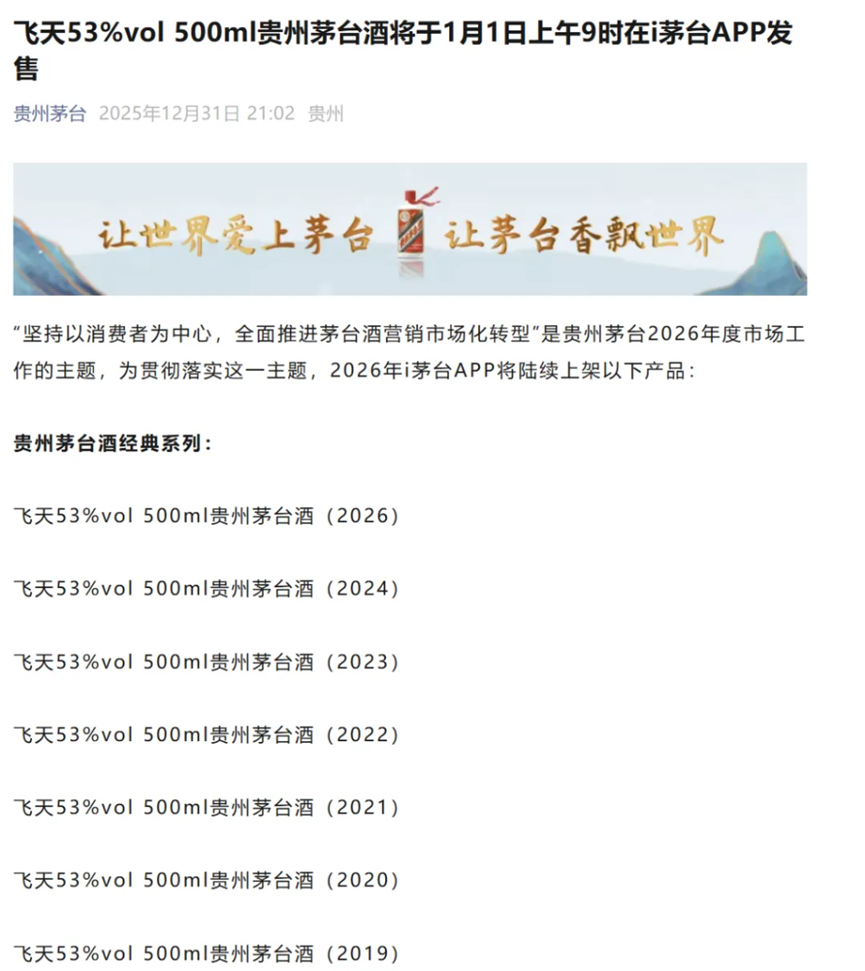
Core Viewpoint - Kweichow Moutai is accelerating its pricing, channel, and direct sales reforms, indicating a clearer market-oriented pricing system, which Goldman Sachs interprets as a signal that the liquor industry is bottoming out [1]. Group 1: Pricing and Sales Adjustments - On January 1, Kweichow Moutai announced adjustments to the suggested retail prices of key products in its non-standard Moutai series, aligning factory prices based on channel research [1]. - The iMoutai platform launched the Feitian Moutai series on January 1, with suggested retail prices set at 1499 RMB per bottle for various product sizes [1]. - Goldman Sachs estimates that iMoutai could contribute approximately 4.5 billion RMB in total sales within the first nine days of 2026, representing about 35% of iMoutai's revenue for the first nine months of 2025 [5]. Group 2: Wholesale Price Trends - Recent trends show a divergence in wholesale prices, with the wholesale price of Feitian Moutai decreasing by 40 RMB per bottle, while other products like Wuliangye and Guojiao 1573 remain stable [6]. - The wholesale prices for other Moutai products have varied, with some increasing while others, such as the boutique Moutai and Moutai 15 years, have seen price reductions [7][8]. Group 3: Market Demand and Recovery - High-end liquor retail demand remains weak year-on-year, with current terminal sales at 50%-70% of previous levels, indicating a need for time to recover [1][9]. - Goldman Sachs anticipates a potential bottoming opportunity for the liquor industry in the second half of 2026, driven by a recovery in high-end banquet and business demand from a low base in June 2025 [9]. - The pricing reforms by Moutai are expected to have a demonstration effect on the entire liquor industry, promoting normalization of channel pricing and profit levels, while also accelerating inventory reduction processes [9].
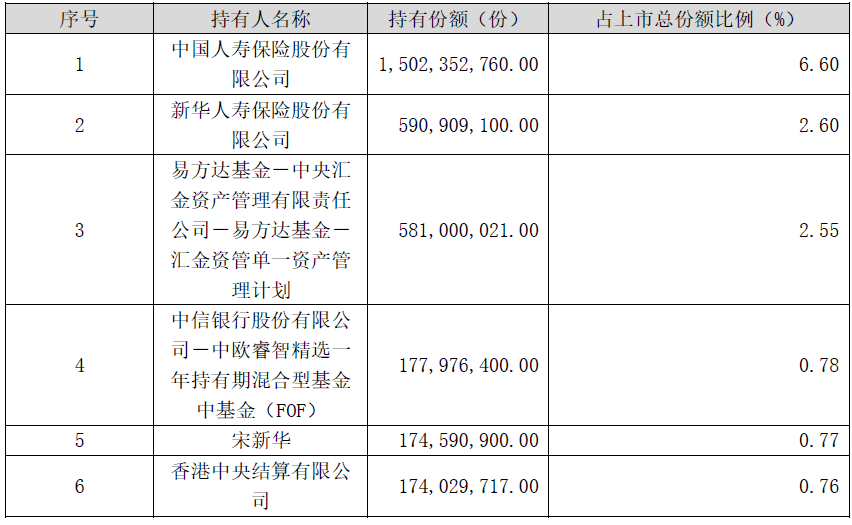
中央汇金新动向披露!加仓白酒ETF 机构关注白酒机会
Shang Hai Zheng Quan Bao· 2025-08-28 08:21
Core Viewpoint - Central Huijin has increased its holdings in various ETFs, particularly in the liquor and chemical sectors, demonstrating a strong commitment to stabilizing the market amid fluctuations in the second quarter of this year [1][2]. Group 1: Central Huijin's Investment Actions - In the first half of this year, Central Huijin significantly increased its investment in broad-based ETFs, purchasing approximately 150 billion yuan worth of ETFs, including four Hu-Shen 300 ETFs and the Huaxia Shanghai 50 ETF [1]. - Central Huijin's asset management plan has acquired 121 million shares of the Penghua Liquor ETF, bringing its total holdings to 581 million shares, making it the third-largest shareholder [2][3]. - The Penghua Liquor ETF saw a net subscription of 57.5 billion yuan this year, with a notable acceleration in the third quarter, where net subscriptions reached 45.47 billion yuan [9]. Group 2: Liquor Sector Insights - The liquor sector has experienced a significant valuation compression, attracting renewed investment interest after a period of decline [9]. - Institutional reports indicate that the liquor industry is at a bottoming phase, with expectations of a recovery as companies release their semi-annual reports, which may alleviate market concerns [12]. - The white liquor sector has seen a 72% decline in valuation since February 2021, with fund holdings in the sector dropping to levels not seen since 2017 [13]. Group 3: Market Dynamics and Future Outlook - The market is observing a gradual improvement in liquor sales, with expectations of a turning point as external positive factors increase [13]. - Central Huijin's strategy reflects a broader trend of institutional investors recognizing the long-term value in the liquor sector, particularly in leading companies with strong brand power and dividend yields [13].