
私募投资

Search documents
王一平、李骧、李春瑜等118位私募大佬旗下全部产品创历史新高!26位来自百亿私募!
私募排排网· 2026-03-11 03:39
Core Insights - The article highlights that 193 private fund managers achieved historical net value highs for all their products in February 2026, reflecting their strong investment research capabilities [2] - Among these, 118 fund managers had at least three products with nearly one year of performance data, with 81 of them focusing on stock strategies [2] Group 1: Fund Managers with Over 100 Billion Scale - 26 fund managers from private funds with over 100 billion scale achieved historical highs for all their products, with 21 of them focusing on stock strategies [3] - Notably, Wang Yiping from Evolutionary Asset Management had 16 products with nearly one year of performance data [6] Group 2: Fund Managers with 50-100 Billion Scale - 13 fund managers from private funds with 50-100 billion scale also achieved historical highs, with 8 focusing on stock strategies [9][10] - Han Guangbin from New Thinking Investment is highlighted as a notable fund manager in this category [14] Group 3: Fund Managers with 20-50 Billion Scale - 14 fund managers from private funds with 20-50 billion scale reached historical highs, with 10 focusing on stock strategies [15][16] Group 4: Fund Managers with 10-20 Billion Scale - 18 fund managers from private funds with 10-20 billion scale achieved historical highs, with 9 focusing on stock strategies [21] Group 5: Fund Managers with 5-10 Billion Scale - 14 fund managers from private funds with 5-10 billion scale reached historical highs, with 9 focusing on stock strategies [27] Group 6: Fund Managers with Below 5 Billion Scale - 33 fund managers from private funds with below 5 billion scale achieved historical highs, with 24 focusing on stock strategies [32][33]


超1700位私募女将大起底!6人坐拥头部“基金经理+实控人”双头衔
私募排排网· 2026-03-06 04:01
Core Viewpoint - The article highlights the rising influence of female professionals in China's private equity market, showcasing their unique resilience, insight, and strategic vision, which are reshaping investment logic and team dynamics in the industry [2]. Group 1: Female Professionals in Private Equity - As of February 2026, the number of female professionals in private equity has reached 1,787 [2]. - Among female professionals, there are 1,045 serving as fund managers, with 48 in leading private equity firms (those managing over 5 billion) [4]. - The majority of the 48 leading female fund managers are from firms managing between 5 billion and 10 billion, with 31 in the quasi-100 billion category and 17 in the 100 billion category [4]. Group 2: Notable Female Fund Managers - Six leading female fund managers also serve as controlling persons of their firms, including notable figures such as Li Bei and Gao Lei [4][9]. - Li Bei, a prominent figure, manages a macro strategy product that has achieved significant returns since its inception [9]. - He Rui Lin, another notable fund manager, has products with cumulative net values exceeding a certain threshold, showcasing strong performance [10]. Group 3: Female Controlling Persons - There are 241 female controlling persons in the private equity sector, with 33 managing firms of 1 billion or more, representing 13.69% of all female controlling persons [10]. - Among these, 19 are from firms managing between 1 billion and 2 billion, while only two are from firms managing over 100 billion [10]. Group 4: Educational Background - Among female professionals in private equity managing over 500 million, only 20 hold a doctoral degree, with 13 serving as fund managers [15]. - The distribution of female professionals with doctoral degrees is relatively balanced across firms managing between 1 billion and 5 billion, with only two in the 100 billion category [15]. Group 5: Experience in the Industry - There are 19 female professionals with over 30 years of experience in private equity, with 11 also serving as fund managers [18]. - Notable experienced professionals include Jiang Tong from Jinglin Asset Management, who has a strong background in global investment research [18][21].

深圳市名家汇科技股份有限公司关于公司全资子公司与专业投资机构共同投资的进展公告
Shang Hai Zheng Quan Bao· 2026-02-05 17:38
Investment Overview - Shenzhen Mingjiahui Technology Co., Ltd. approved a joint investment by its wholly-owned subsidiary, Liu'an Mingjiahui Optoelectronics Technology Co., Ltd., and professional investment institutions, contributing a total of 21.77 million yuan to Shenzhen Lihua Suanxin No. 2 Venture Capital Enterprise (Limited Partnership) [1] - Liu'an Mingjiahui plans to invest up to 15 million yuan, with a contribution ratio of 6.8902% [1] Investment Progress - As of February 4, 2026, the Shenzhen Lihua Suanxin No. 2 Venture Capital Enterprise has completed the private investment fund filing procedures and obtained the Private Investment Fund Filing Certificate [2] - The total actual contribution from partners to the fund has changed to 80 million yuan, with Liu'an Mingjiahui's final actual contribution being 12 million yuan, resulting in a contribution ratio of 15% [2]

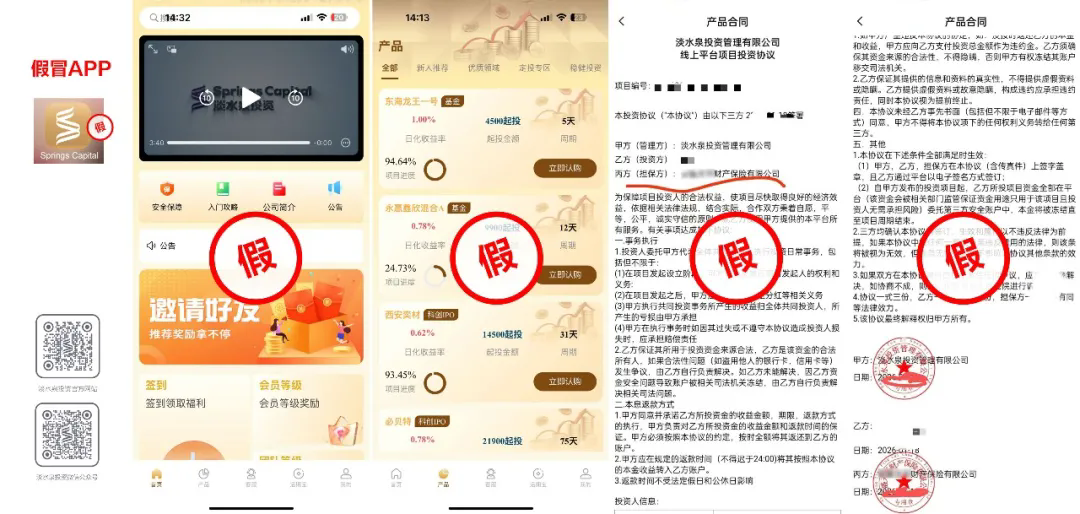
淡水泉投资:警惕不法分子冒用淡水泉名义进行荐股、集资等违法活动
Zhong Guo Jing Ji Wang· 2026-02-05 14:02
Group 1 - The core message of the news is that Freshwater Capital (Beijing) Investment Management Co., Ltd. warns investors about illegal activities conducted by fraudsters using its name for stock recommendations, illegal fundraising, and project investments [1][3] - Freshwater Capital emphasizes that it is a registered private securities investment fund manager and has never engaged in public securities investment or authorized any third party to conduct such activities on its behalf [3] - The company provides its official website and social media accounts, urging investors to verify the authenticity of any communications and to be cautious of non-compliant securities activities [3] Group 2 - Freshwater Capital strongly condemns the illegal actions of individuals impersonating the company and reserves the right to pursue legal action against them [3] - Investors are advised to remain vigilant and to protect their legal rights by reporting any suspected fraudulent activities to local law enforcement [4]
穆巴达拉资本扩展私募投资
Shang Wu Bu Wang Zhan· 2026-02-05 12:44
Group 1 - Mubadala Capital has established a joint investment fund, MCCF I, with a size of $554 million aimed at global institutional investors [1] - The fund will focus on sectors such as finance, healthcare, and software [1] - The objective of the fund is to enhance participation in the private equity market [1]
D1资本押注SpaceX 助推私募投资组合去年涨幅达39%
Xin Lang Cai Jing· 2026-01-09 19:55
Core Insights - D1 Capital Partners' private investment portfolio experienced a 39% increase last year, primarily driven by its investment in Elon Musk's SpaceX, which recently achieved a valuation of $800 billion [1][2] - The investment in SpaceX accounts for approximately 45% of the hedge fund's exposure to venture capital and private equity investments [2] - Excluding the SpaceX investment, D1 Capital's private investment portfolio would have only seen an increase of about 18% [3] Company Statements - D1 Capital's founder, Dan Sundheim, stated in a letter to investors that SpaceX's latest valuation reflects its "transformative developments" [3] - Sundheim expressed confidence that if SpaceX succeeds, it will become the largest engine driving value creation for D1 Capital [3]
深度访谈110位亿万富翁:他们如何做出投资决策
3 6 Ke· 2026-01-05 23:40
Core Insights - The report titled "Conversations with the World's Wealthiest Families" analyzes the lifestyles and thought processes of influential wealthy families, surveying 110 family heads with a combined net worth exceeding $500 billion [1] Investment Process and Decision-Making Mechanism - Many wealthy families are formalizing their investment processes, recognizing the need for structured decision-making akin to institutional investors. About one-third of respondents have introduced formal organizational structures to varying degrees [2] - A significant portion of families (25%) have established Chief Investment Officers (CIOs) and dedicated investment teams, with investment committees being common for providing advice and oversight [4] - Larger and more mature families often set measurable investment goals, extending governance to family boards and advisory committees [5] Investment Decision-Making Approaches - Investment decisions typically follow three main approaches: 1. Family core members lead the decision-making process, often consulting trusted family members and external advisors [7] 2. Decisions are made based on consensus or majority voting, with core family members retaining final approval [9] 3. Specific asset classes may be delegated to trusted family members or the family office for focused oversight [10] Family Investment Preferences - Diversification remains central to many families' investment portfolios, with a combination of public and private investments, focusing on listed stocks, private equity, real estate, fixed income, and cash [12] - Many families continue to invest actively in industries where they initially created wealth, often relying on external advisors when venturing outside their core expertise [14] - There is a notable trend of increasing allocations to private equity, with families treating themselves more like institutional investors, allowing for patient capital deployment [15][16] Due Diligence and Sourcing Transactions - Families recognize the importance of due diligence as a core capability for long-term success, often institutionalizing this process within their family offices [18] - Transaction opportunities are sourced from a wide range of channels, with personal networks being the most common source (78%), followed by banking partners (44%) [19][20]

私募认购ETF份额热情高涨 持有2025年上市ETF超33亿份
Zheng Quan Shi Bao Wang· 2026-01-05 03:57
Group 1 - In 2025, ETFs are highly favored by private equity institutions, with 171 private equity firms entering the top ten holders of 209 newly listed ETFs, collectively holding 3.341 billion shares [1] - Subjective private equity firms are the main contributors to ETF subscriptions, holding 1.257 billion shares, accounting for 37.62% of the total shares [1] - Quantitative private equity firms follow closely, holding 1.137 billion shares, which is 34.03% of the total shares [1] - Mixed private equity firms hold 0.947 billion shares, making up 28.34% of the total shares [1] Group 2 - Medium-sized private equity firms (10 billion to 50 billion) prefer to allocate to ETFs, holding 1.357 billion shares, which is 40.62% of the total shares [2] - Small-sized private equity firms (0 to 10 billion) hold 1.291 billion shares, accounting for 38.64% of the total shares [2] - Large-sized private equity firms (over 50 billion) also favor ETF investments, holding 0.693 billion shares, which is 20.74% of the total shares [2] - 106 newly listed ETFs are favored by private equity, with holdings of no less than 10 million shares, and 14 ETFs have holdings of no less than 50 million shares [2] Group 3 - Technology ETFs are particularly popular among private equity firms, with 68 ETFs containing "technology" or "innovation" in their names, collectively holding 1.136 billion shares, which is 34.00% of the total shares [3] - Among the 106 newly listed ETFs with holdings of no less than 10 million shares, 36 are technology-related, and 6 out of 14 ETFs with holdings of no less than 50 million shares are also technology-related [3] - The core driving force for private equity's active subscription to ETFs in 2025 is their comprehensive advantages, including high efficiency, low cost, and strong risk control [3] - The high liquidity of ETFs allows private equity to quickly execute portfolio adjustments, while low fees and diversified holdings reduce risks and research costs [3]
调研110位亿万富翁,发现他们七个习惯与十大爱好
虎嗅APP· 2026-01-03 09:39
Core Insights - The article discusses a report titled "Conversations with the World's Wealthiest Families," which analyzes the habits and mindsets of influential wealthy families, highlighting the importance of deliberate time management and reading as key to success [4][5]. Group 1: Key Habits of Wealthy Families - The report identifies seven key habits attributed to the success of the wealthiest families: reading, exercising, consistency, waking up early, task prioritization, goal setting, and deep thinking time [8]. - Reading, while not the primary leisure activity, is viewed as a strategic practice among wealthy families, ranking seventh among their interests [8][9]. Group 2: Popular Interests and Hobbies - The top ten interests or hobbies of wealthy families include outdoor activities, work, spending time with family and friends, tennis, winter sports, golf, reading, fitness, fishing, and cycling [9]. - Despite reading being a lower-ranked leisure activity, its strategic value is emphasized, especially as AI reshapes information consumption [9]. Group 3: Investment Trends - Private equity investment is gaining momentum, with family leaders increasingly becoming active participants rather than passive capital providers. In 2025, the allocation to private equity is expected to double compared to previous years [12]. - Approximately 70% of family leaders prefer to engage actively in governance and operational oversight, marking a shift towards a more hands-on investment approach [12]. Group 4: Rise of Specialized Assets - Specialized assets, such as sports clubs, are evolving from mere collectibles to serious investment opportunities, with 20% of family leaders currently holding stakes in sports clubs, up from 6% in 2022 [13]. - The valuation of sports clubs in the U.S. and Europe is around $400 billion, with significant growth in mergers and investments in the sports sector over the past five years [13]. Group 5: Resilience in Global Challenges - Political and geopolitical factors are seen as primary risks, with 56% of family leaders acknowledging geopolitical tensions as a significant concern [15]. - Wealthy families are adopting pragmatic approaches to navigate these challenges, focusing on risk diversification and strengthening their business capabilities [15]. Group 6: AI Integration - AI usage is prevalent among wealthy families, with nearly 80% using it in personal life and 69% in business contexts for research, planning, and strategy [16]. - Understanding AI is becoming essential for maintaining a competitive edge, as its integration into daily practices is seen as a necessity rather than an option [16]. Group 7: Evolution of Family Leadership - Many family leaders are focusing on building a sense of purpose and responsibility across generations, with over 70% establishing dedicated charitable resources [17]. - Education, healthcare, and community development remain the primary charitable focuses, reflecting a commitment to influence and leadership that transcends generations [17].

新华网:全资子公司1500万元参投基金完成备案登记
Xin Lang Cai Jing· 2025-11-27 10:41
Core Viewpoint - The company has invested 15 million yuan in a private equity fund, acquiring a 6.79% stake in a partnership with a total subscribed capital of 221 million yuan, indicating a strategic move to leverage professional resources for returns while maintaining its core business operations [1] Investment Details - The investment was made by the company's wholly-owned subsidiary in a partnership named Zhongbao Toxin Sichuang (Jiaxing) Equity Investment Partnership (Limited Partnership) [1] - The fund completed its private investment fund registration on November 26, following the signing of the agreement on November 20 [1] Financial Implications - The total amount invested by the company in private equity collaborations has reached 68.32 million yuan to date [1] - The investment is expected to generate returns through professional institutional resources, although it may be subject to various factors that could impact expected returns [1]
