粗钢平控政策

Search documents
南华期货2026钢材年度展望:供需再平衡,区间震荡起涟漪
Nan Hua Qi Huo· 2025-12-25 11:01
1. Report Industry Investment Rating No relevant information provided. 2. Core Viewpoints of the Report - In 2026, the steel market is expected to achieve a re - balance between supply and demand, with steel prices showing a range - bound pattern. The upper pressure mainly comes from the decline in steel consumption in real estate and infrastructure, the possible weakening of manufacturing demand growth, and tightened export controls. The lower support stems from anti - involution policy expectations, capacity regulation, the concentrated implementation of projects at the beginning of the 15th Five - Year Plan, consumption expansion policies, and overseas interest rate cuts. The price may first experience a bottom - grinding and pressure - bearing stage, and then the price center may rise if supply contraction continues and demand recovers [2]. - The reference operating ranges are: rebar (2900 - 3500) and hot - rolled coil (3000 - 3600) [2]. 3. Summary by Relevant Catalogs 3.1 2025 Steel Market Review - In the first half of 2025, steel prices rebounded briefly at the beginning and then declined slowly due to weak consumption demand. The cost - pricing logic dominated, and the continuous decline of coking coal prices dragged down steel prices. Frequent negative news about Sino - US tariff policies also deepened the market's expectation of weakening steel prices [3]. - In the third quarter, the "anti - involution" policy expectation and the notice of coal over - production review led to a rise in coking coal prices, driving up finished steel prices. However, after the Politburo meeting in August, the policy statement was adjusted, the policy premium was partially withdrawn, and the steel price oscillated downward [4]. - In the fourth quarter, the market trading logic was mainly macro - oriented. The improvement of Sino - US relations and the US interest rate cut cycle boosted market sentiment at first, but after the policy was implemented, the market sentiment declined rapidly. The loose supply of coking coal and the off - season of steel consumption also led to a continuous decline in steel prices [5]. 3.2 Core Concerns 3.2.1 Whether Negative Feedback Production Cuts Will Occur - The current profitability rate of steel enterprises is 35%, far higher than the 15% critical point for negative feedback. The cost reduction from coking coal has improved the profits of blast furnaces and electric furnaces. Therefore, the probability of widespread negative feedback in the industry in the short term is low [10]. - Considering capacity regulation policies and high inventory levels, the industry is expected to implement moderate production cuts to relieve inventory pressure and achieve a dynamic balance between production and profitability [10]. 3.2.2 Whether Export Controls Will Affect Steel Exports - Export controls will affect steel exports. The implementation of steel export license management in 2026 and the formal collection of EU CBAM carbon tariffs will lead to an expected 10% decline in steel exports. However, it will also guide steel enterprises to transform towards high - end products and optimize the export structure [12][13]. 3.2.3 Whether the Demand for Steel in the Manufacturing Industry Can Continue to Increase - The steel demand structure is clearly differentiated. The steel consumption in the manufacturing industry has become the core support for demand growth, effectively offsetting the decline in demand from real estate and infrastructure. Although the growth rate may slow down in 2026, the overall resilience can still be maintained due to consumption - boosting policies and structural growth in some fields [14]. 3.3 Valuation and Supply - Demand Outlook 3.3.1 Valuation - In terms of term structure, rebar and hot - rolled coil show a C - shaped structure. If this structure remains unchanged, steel prices may continue to be weak. In terms of basis, the valuation of steel is relatively neutral. The basis of rebar is more stable than that of hot - rolled coil [15]. - Steel profits mainly come from raw material price concessions. In 2026, with weak steel demand, the cost - pricing logic will prevail, and profits will depend on raw material price concessions [15]. 3.3.2 Supply - As of October 2025, China's cumulative crude steel production was 817 million tons, with a year - on - year decrease of 3.90%. The apparent contradiction between the increase in molten iron production and the decrease in crude steel production may be due to factors such as crude steel production control policies, the cost - effectiveness of molten iron, and the diversion of molten iron [18]. - In 2026, due to factors such as the decline in steel demand in real estate and infrastructure, the continuation of crude steel production control policies, and the implementation of export controls, crude steel production is expected to continue to decline by about 30 million tons, with an annual output of 931 million tons, a year - on - year decrease of about 3.1% [1][19]. 3.3.3 Demand - **Real Estate**: In 2025, the real estate market was in a downward adjustment, with new construction area, development funds, and investment all declining. The demand for steel in real estate was dragged down. In 2026, the decline in steel consumption in real estate is expected to slow down, with an estimated consumption of about 167 million tons, a year - on - year decrease of about 9.43% [31][32]. - **Infrastructure**: In 2025, infrastructure investment growth slowed down. Although the scale of special bonds remained high, the investment in traditional infrastructure decreased. In 2026, as the beginning of the 15th Five - Year Plan, major projects may be launched intensively. The scale of special bonds may increase, and infrastructure steel consumption is expected to increase by about 1% year - on - year [45][47]. - **Manufacturing**: In 2025, the steel consumption in the manufacturing industry became the core support for demand growth. In 2026, the demand growth rate in the manufacturing industry may slow down. The demand for steel in the automotive and home appliance sectors may decline, while the machinery and shipbuilding sectors are expected to have stable growth [55][58][59]. - **Export**: In 2025, steel exports increased significantly. However, in 2026, due to the implementation of export license management and the collection of EU carbon tariffs, steel exports are expected to decline by about 10% [62][63]. 3.3.4 Inventory - Rebar inventory was relatively low in 2025 due to weak demand in real estate and infrastructure and low - production strategies of steel mills. Hot - rolled coil had a fast de - stocking speed in the first half of the year but experienced super - seasonal inventory accumulation later. In the future, if the profit of steel mills recovers, the de - stocking speed may slow down [73].
薛鹤翔:供需双增叠加政策预期,盘面走势极强-焦煤期货
Sou Hu Cai Jing· 2025-09-17 07:01
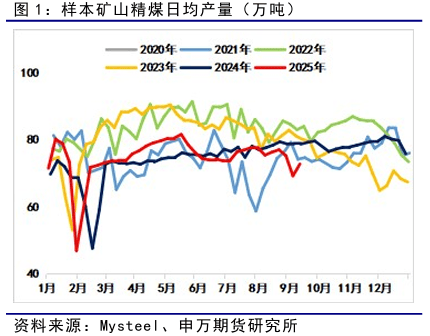
Group 1 - The main contracts for coking coal and coke showed weak performance, with coking coal closing at 1187.5 CNY/ton and coke at 1688.5 CNY/ton, both experiencing daily increases of over 4% [1] - Supply side indicators show a significant recovery in production, with premium coal and raw coal output at 728,400 tons and 1,856,200 tons respectively, both increasing week-on-week. The operating rate of coal mines rose by 6.93% to 82.71% [2] - Demand from steel mills has increased significantly, with average daily pig iron output rising by 117,100 tons to 2,405,500 tons, which is notably higher than the same period last year [2] Group 2 - Inventory levels for premium coal at sample mines decreased by 135,600 tons to 2,545,200 tons, marking two consecutive weeks of decline. Independent coking plants also saw a reduction in coking coal inventory and available days [2] - The profit margin for coking plants decreased to 35 CNY/ton, although it remains higher than the same period last year. The market fundamentals have improved with increased supply and demand, alongside a decrease in inventory [3] - Overall, the current supply of premium coal is lower than last year, while pig iron production is higher, supported by positive policy expectations. However, there are concerns regarding steel inventory and potential supply pressures from imports [5]