红利增强

Search documents
长期配置不猜市:为什么价值ETF能穿越牛熊稳赚收益?
Sou Hu Cai Jing· 2026-02-12 03:28
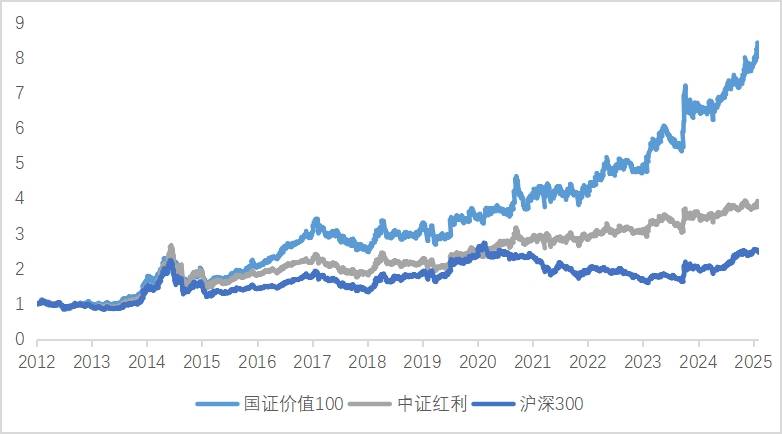
Core Viewpoint - The article emphasizes the importance of investing in resilient assets that can withstand market fluctuations, highlighting the value ETF E Fund (fund code: 159263) which tracks the Guozheng Value 100 Index, known for its solid fundamentals and ability to provide stable returns regardless of market conditions [1]. Performance Summary - Since 2013, the Guozheng Value 100 Index has achieved an annualized return of 18%, outperforming the Zhongzheng Dividend Index which returned 11.3% [2]. - The Guozheng Value 100 Index has demonstrated strong performance across various market conditions, with only one year (2015) in the past 13 years where it underperformed the Zhongzheng Dividend Index [2]. Historical Performance Data - The Guozheng Value 100 Index has shown resilience during bear markets, gaining 48.2% from 2021 to 2024 while the Zhongzheng Dividend Index only increased by 21.3% [3]. - In bullish markets from 2016 to 2018, the Guozheng Value 100 Index rose by 117.0%, outperforming the Zhongzheng Dividend Index by 57.7% [3]. Investment Strategy - The Guozheng Value 100 Index combines high dividend yield, strong free cash flow, and low valuation to select stocks, addressing the common issues of high dividend but low growth and volatility associated with pure free cash flow strategies [5]. - This dual approach provides investors with a "double insurance" by ensuring stable dividends during downturns and growth potential during upturns, making it suitable for long-term holding regardless of market conditions [7]. Historical Holding Performance - Historical data indicates that holding the Guozheng Value 100 Index for one year results in a profit in 84.8% of the periods, and 96.5% for two years, with an average one-year return of 20.8% [7].

市场震荡上行,大盘股占优,电子增强组合超额明显
Changjiang Securities· 2025-12-09 00:45
- The report highlights the performance of the A-share market, with the CSI A50 leading the gains and the ChiNext Index showing strong performance[1][6] - The Dividend Enhanced Portfolio outperformed the CSI Dividend Total Return Index, with the Central SOE High Dividend 30 Portfolio and the Balanced Dividend 50 Portfolio achieving weekly excess returns of approximately 0.41% and 0.75%, respectively[6][21] - The Electronic Enhanced Portfolio also outperformed the Electronic Total Return Index, with the Electronic Balanced Allocation Enhanced Portfolio and the Electronic Sector Preferred Enhanced Portfolio achieving weekly excess returns of approximately 1.78% and 1.53%, respectively[6][29]
市场反弹,双创和小微盘占优,红利增强组合超额显著
Changjiang Securities· 2025-11-30 23:30
Quantitative Models and Construction Methods Dividend Enhancement Portfolio - **Model Name**: Dividend Enhancement Portfolio - **Model Construction Idea**: The model focuses on selecting high-quality dividend stocks and constructing portfolios that outperform the benchmark dividend index by leveraging dividend quality and growth factors[7][15][21] - **Model Construction Process**: - The portfolio is constructed by selecting stocks with high dividend yields and strong dividend growth potential - The selection process incorporates a combination of fundamental analysis and quantitative screening to identify stocks with stable and growing dividends - The portfolio is rebalanced periodically to ensure alignment with the dividend quality and growth criteria[13][14][15] - **Model Evaluation**: The model demonstrates strong performance in capturing excess returns over the benchmark dividend index, particularly in volatile market conditions[7][15][21] Electronic Balanced Allocation Enhancement Portfolio - **Model Name**: Electronic Balanced Allocation Enhancement Portfolio - **Model Construction Idea**: This model aims to achieve excess returns by balancing exposure across various sub-sectors within the electronics industry, focusing on growth and stability[7][24][29] - **Model Construction Process**: - The portfolio is constructed by allocating weights to sub-sectors such as LED chips and semiconductor distribution, which exhibit strong growth potential - Quantitative screening is applied to identify leading companies within these sub-sectors - The portfolio is periodically rebalanced to maintain a balanced exposure across the electronics industry[13][14][24] - **Model Evaluation**: The model effectively captures excess returns and ranks in the top 15% of active technology-themed products in terms of weekly performance[7][24][29] --- Model Backtesting Results Dividend Enhancement Portfolio - **Weekly Excess Return**: Approximately 0.23% for the "Central SOE High Dividend 30 Portfolio" and 1.45% for the "Balanced Dividend 50 Portfolio"[7][15][21] - **Year-to-Date Excess Return**: The "Balanced Dividend 50 Portfolio" achieved an excess return of approximately 7.91% relative to the benchmark dividend index, ranking in the top 35% of all dividend-themed funds[21] Electronic Balanced Allocation Enhancement Portfolio - **Weekly Excess Return**: Approximately 0.89%, ranking in the top 15% of active technology-themed products[7][24][29]

震荡市不想躺平又怕回撤?博时资本红利增强策略&波动增利策略:一边收息一边薅波动
私募排排网· 2025-10-14 09:04
Core Viewpoint - In the current volatile capital market, asset management institutions must maintain stability and long-term growth, with Bosera Capital exemplifying this through its multi-asset strategy and over 2.24 trillion yuan in managed assets [2][3]. Group 1: Company Overview - Bosera Capital was established in February 2013 with a registered capital of 850 million yuan and is a subsidiary of Bosera Fund, which is primarily controlled by China Merchants Securities [8][6]. - The company has issued over 1,500 products and has a cumulative management scale exceeding 2.24 trillion yuan [2]. - Bosera Capital shares a risk control system with its parent company, ensuring comprehensive risk monitoring and compliance management [10]. Group 2: Investment Strategy - The investment strategy framework of Bosera Capital includes various strategies such as fixed income, fixed income plus, quantitative stock selection, quantitative derivatives, ETF rotation, volatility enhancement, and overseas thematic FOF strategies [3][12]. - The investment strategies are designed to complement those of the parent company, providing differentiated products [12]. Group 3: Volatility Enhancement Strategy - The volatility enhancement strategy aims to capture market fluctuations and enhance returns through non-linear grid trading and futures pricing [15]. - The flagship product, "Bosera Rongxiang Enhanced Income No. 1," is tailored for volatile markets and aims to achieve excess returns while controlling drawdowns [15]. - The strategy's returns are derived from four main sources: volatility profits, basis spread profits, index returns, and cash returns [16]. Group 4: Performance and Risk Management - Historical performance shows that the volatility enhancement strategy has achieved positive returns for nine consecutive years from 2016 to 2024, with annualized returns significantly outperforming the CSI 500 index during downturns [22][24]. - The strategy has demonstrated strong risk control, with maximum drawdowns significantly lower than the CSI 500 index during adverse market conditions [24]. Group 5: Dividend Enhancement Strategy - The fixed income plus quantitative dividend enhancement strategy focuses on high-dividend, low-volatility stocks while maintaining a significant allocation to bonds [34]. - The strategy benefits from favorable policies encouraging cash dividends and stock buybacks, enhancing the selection of potential investment targets [37]. - The strategy employs a rigorous selection process to ensure sustainable high dividends and robust company fundamentals [39][40]. Group 6: AI Integration - Bosera Capital aims to integrate AI technology into various aspects of its strategies, including factor development, return prediction, and model optimization [43]. - The use of AI is expected to enhance the efficiency of investment research and decision-making processes [43].