
存款非银化

Search documents
2026年初银行存贷形势更新与展望
KAIYUAN SECURITIES· 2026-01-26 10:30
Investment Rating - The industry investment rating is "Positive" (maintained) [1] Core Insights - The report indicates that banks are likely to continue the strategy of early loan disbursement for early returns in 2026, with Q1 new loans expected to account for 62%-65% of the annual total [3][15] - In January, new RMB loans are projected to be between 5.2-5.3 trillion yuan, showing a slight year-on-year increase, with potential acceleration in loan issuance towards the end of the month [4][37] - The overall loan volume for the year is expected to be around 15.5 trillion yuan, reflecting a year-on-year decrease, but with a stabilization in loan pricing [4][37] Summary by Sections Loans - The loan issuance rhythm for 2026 is anticipated to be front-loaded, although the pace in early January may be slower than expected due to various factors including lower discount rates and a cautious approach from banks [3][24] - The trend of front-loading loan issuance is expected to continue, with Q1 new loans projected to represent a significant portion of the annual total [15][17] Deposits - Large banks are expected to have a strong start in deposit growth, potentially exceeding expectations due to proactive marketing and better retention rates of maturing deposits [5][38] - The liquidity situation for large banks is relatively stable, with a high average daily lending balance of 4.5 trillion yuan in January 2026, indicating manageable funding pressures [38][40] - The competition for deposits among smaller banks is diminishing, as larger banks enhance their marketing efforts and pricing strategies [44][45] Investment Recommendations - The report suggests focusing on state-owned banks and wealth management-oriented joint-stock banks, as they are likely to benefit from the early loan and deposit growth dynamics [7]
11月金融数据点评:财政发力仍待观察,实体需求仍弱
Shenwan Hongyuan Securities· 2025-12-15 08:09
Core Insights - The report indicates that the financial stimulus remains to be observed, with weak real demand persisting in the economy [2] - In November 2025, new RMB loans amounted to 0.39 trillion yuan, down from 0.58 trillion yuan in November 2024, while new social financing reached 2.49 trillion yuan, up from 2.33 trillion yuan in the same period last year [3] - The year-on-year growth rate of social financing was 8.5%, unchanged from October 2025, and M2 growth was 8%, slightly up from 8.2% in October 2025 [3] Financial Data Analysis - The year-on-year growth rate of social financing remained stable, primarily supported by government and corporate bonds, while the credit demand from the real sector was a drag [3] - Government bonds continued to support the social financing growth in November, but the net financing scale of government bonds (1.27 trillion yuan) was lower than that of November 2024 (1.83 trillion yuan) due to high base effects [3] - In November, corporate long-term loans decreased by 40 billion yuan year-on-year, indicating weak investment confidence among enterprises, although short-term loans and bill financing increased by 110 billion yuan and 211.9 billion yuan respectively compared to the previous year [3] Household Sector Insights - The demand for medium and long-term loans from households significantly shrank in November, with a year-on-year decrease of 290 billion yuan, continuing the trend of deleveraging among households [3] - The improvement in housing demand remains to be observed, constrained by real estate inventory and price factors [3] - Short-term loans for households also saw a year-on-year decrease of 178.8 billion yuan, likely due to the high base effect from last year's "old-for-new" policy [3] Deposit Trends - In November, both household and corporate deposits decreased year-on-year, with new household and corporate deposits reaching 670 billion yuan and 645.3 billion yuan respectively, both showing a year-on-year decline [3] - The new non-bank deposit scale fell to 80 billion yuan, returning to seasonal lows, reflecting that the attractiveness of deposits has diminished due to low deposit rates [3] Monetary Supply Dynamics - The growth rates of M1 and M2 both showed marginal declines, with M1 growth dropping significantly by 1.3 percentage points to 4.9%, while M2 growth decreased slightly by 0.2 percentage points to 8.0% [3] - The widening gap between M1 and M2 indicates a shift in the monetary supply dynamics, with M1 growth declining more sharply due to high base effects from strong fiscal injections at the end of 2024 [3] Market Sentiment and Bond Market Outlook - The report suggests that the current economic environment is characterized by a transition between old and new growth drivers, with recent adjustments in the bond market primarily driven by institutional behavior [3] - Despite a balanced and loose monetary environment supported by the central bank, the bond market faces constraints such as a cautious market sentiment and limited attractiveness compared to equities [3] - The report concludes that while there may be opportunities for bond market positioning at high yield points, the overall attractiveness remains weak [3]
非银化增长,波动率加大
KAIYUAN SECURITIES· 2025-11-19 06:38
Investment Rating - Investment rating: Positive (maintained) [1] Core Views - The current credit growth continues to slow down, and social financing growth is also declining from high levels. Although policies are in place to support the market, their impact on demand recovery has not yet been reflected due to time lags. The retail risk for listed banks has increased but remains manageable, supported by substantial provisioning and stable dividend policies, which together form a "stable anchor" for the "dividend revaluation" logic of banks. The banks' advantages in capital markets, wealth management, and investment banking create a "growth sail" for differentiated valuations. Bank valuations are still at historically low levels, and medium to long-term funds have the potential for allocation, making increased allocation to the banking sector a favorable choice under the "high cut low" and balanced allocation strategy. It is recommended to invest in state-owned banks as they still offer good value compared to risk-free interest rates. Specific recommendations include CITIC Bank, benefiting from China Construction Bank, Agricultural Bank of China, China Merchants Bank, Jiangsu Bank, Chongqing Bank, Hangzhou Bank, and Chongqing Rural Commercial Bank [7]. Summary by Sections Deposit and Loan Growth - The deposit and loan growth rates for small and medium-sized banks continued to recover, with the national large banks' deposit-loan growth rate difference at -1.31% at the end of October, a decrease of 0.33 percentage points from the end of September. The four major banks' deposit-loan growth rate difference narrowed by 0.02 percentage points to -2.10%. Small and medium-sized banks recorded a deposit-loan growth rate difference of 3.74%, an increase of 0.08 percentage points [3][4]. Deposit Structure - In October, both large and small banks saw an acceleration in deposit growth, with large banks and small banks' deposit growth rates at 7.40% and 9.33%, respectively, increasing by 0.16 and 0.22 percentage points month-on-month. However, corporate deposits faced pressure, with both large and small banks experiencing negative growth in corporate deposits for the month. The increase in deposits was primarily driven by non-bank contributions, indicating a trend of "deposit migration" [4][5]. Credit Demand and Supply - The overall credit volume and structure remain poor, with small and medium-sized banks increasing lending. The total loans from deposit-taking financial institutions to residents and enterprises saw a year-on-year decrease. The credit growth is under pressure due to unfulfilled demand and other factors, including banks completing most of their annual credit targets in the first three quarters and a lack of actual credit demand conversion from policy measures [6]. Investment Recommendations - Given the current environment, increasing allocation to the banking sector is recommended as it presents a favorable opportunity for investors. The report emphasizes the potential of state-owned banks and suggests specific banks for investment based on their performance and market conditions [7].



如何理解“存款搬家”?存款非银化路径再明晰,理财“固收+”不只是做加法
Di Yi Cai Jing· 2025-11-17 10:39
Core Viewpoint - The article discusses the trend of "deposit migration" from traditional savings to investment products, particularly in the context of the growing popularity of "fixed income plus" (固收+) products in the financial market, driven by low interest rates and a favorable stock market environment [2][3][7]. Group 1: Deposit Migration Trends - In October, there was a significant decrease in both resident and corporate deposits, amounting to a reduction of 1.34 trillion yuan and 1.09 trillion yuan respectively, while non-bank deposits increased by 1.85 trillion yuan [1]. - The trend of deposit migration is attributed to the expansion of wealth management and asset management products, as well as the high trading activity in the stock market, which has attracted deposits to enter the market [3][4]. - The concept of "deposit migration" is debated, with some experts suggesting it is a reallocation of deposits among different entities rather than a net decrease in total deposits [3][4]. Group 2: Growth of "Fixed Income Plus" Products - "Fixed income plus" products have gained traction, with some achieving annualized returns of 5% to 7%, and the overall market for these products expected to grow by over 1.4 trillion yuan this year [2][7]. - The shift towards "fixed income plus" is seen as a response to the low interest rate environment, with the one-year fixed deposit rate dropping below 1% [7][8]. - The number of investors in wealth management products has significantly increased, with personal investors rising by 10.29 million in the first half of the year, reaching a total of 136 million [5]. Group 3: Strategic Focus on Equity Assets - Financial institutions are increasingly focusing on equity assets within their "fixed income plus" strategies, with a notable shift towards more flexible, equity-like investments [8][9]. - The growth of "fixed income plus" products is expected to continue, with projections indicating that the total scale could exceed 33.5 trillion yuan by 2025 [7]. - Companies are enhancing their product offerings by incorporating diverse strategies, such as multi-asset and quantitative approaches, to improve returns and manage risks [8][12]. Group 4: Balancing Risk and Return - The challenge for wealth management companies is to balance the pursuit of higher returns with the inherent risks associated with more volatile investments [10][11]. - Companies are advised to develop robust risk management frameworks and diversify their asset allocations to mitigate risks [11][12]. - There is a growing acceptance among institutional investors for "fixed income plus" products, indicating a shift in risk tolerance and investment preferences [12].
监管研究系列三:存款非银化对流动性风险指标的影响与测算
KAIYUAN SECURITIES· 2025-11-11 14:12
Investment Rating - The investment rating for the banking industry is "Positive" (maintained) [1] Core Insights - The report highlights the ongoing trend of deposit non-bankization, which is leading to a marginal decline in liquidity indicators for banks. This trend is particularly pronounced among large banks, with a notable increase in the proportion of non-bank deposits [12][16] - The liquidity coverage ratio (LCR) and net stable funding ratio (NSFR) are critical indicators for banks, and the report provides quantitative assessments of how deposit non-bankization impacts these metrics. The effects are manageable for major banks, with LCR expected to remain above 120% even under significant conversion scenarios [4][34] Summary by Sections 1. Deposit Non-Bankization and Liquidity Management - The process of deposit non-bankization is intensifying the demand for banks to manage liquidity indicators more stringently. Since May 2025, the growth rate of personal fixed deposits has been declining, with large banks showing a decrease in monthly increments compared to the same period in 2024 [12][16] - The report quantifies the impact of deposit non-bankization on LCR and NSFR for major banks, indicating that even with a 70% conversion of personal fixed deposits to non-bank deposits, the LCR for most large banks is expected to remain above 120% [4][34] 2. Liquidity Indicator Management - The management of LCR focuses on maintaining liquidity asset reserves, while NSFR management emphasizes improving the liability structure. Issuing long-term interbank certificates of deposit is highlighted as an effective method to optimize these liquidity indicators [5][22] - The report details how the conversion of personal fixed deposits to non-bank deposits affects various liquidity risk indicators, with specific calculations provided for LCR and NSFR under different conversion scenarios [18][23] 3. Investment Recommendations - The report suggests a tiered investment strategy: - Core holdings should focus on large state-owned banks, benefiting from institutions like Agricultural Bank of China and Industrial and Commercial Bank of China - Core allocations should include leading comprehensive banks such as China Merchants Bank and CITIC Bank - Flexible allocations can target regional banks like Jiangsu Bank and Chongqing Bank [6][19]


金融市场流动性与监管动态周报:融资交易活跃度改善,存款非银化趋势持续-20250916
CMS· 2025-09-16 12:01
Group 1 - The report indicates that the M1 growth rate continued to rebound in August, while the M2-M1 differential narrowed, reflecting the ongoing activation of time deposits [10][15][13] - Non-bank deposits increased year-on-year in August, with significant increases in non-bank financial institution deposits, while household and corporate deposits saw varying degrees of decline [13][15] - The trend of households and enterprises moving time deposits into investment and wealth management continues, driven by active trading in the equity market and improving profit effects [10][15] Group 2 - The report highlights that the financing balance increased, with net buying of financing reaching 636.7 billion yuan, indicating improved trading activity in the market [30][41] - The net outflow from ETFs was 44.5 billion yuan, while new equity public funds saw a decrease in issuance [30][41] - The report notes that the sectors of electric power equipment, non-bank financials, and non-ferrous metals received significant net inflows from various funds [51][52] Group 3 - The report mentions that the U.S. labor market continues to weaken, with August CPI aligning with market expectations, leading to increased expectations for interest rate cuts by the Federal Reserve [3] - The report states that the market sentiment improved, with a decrease in the VIX index and an increase in risk appetite in overseas markets [43][44] - The report indicates that the trading activity in various style indices and major industry turnover rates generally decreased [47]
浙商早知道-20250915
ZHESHANG SECURITIES· 2025-09-14 23:32
Group 1: Key Recommendations - The report highlights the potential of Zhongtian Rocket (003009) as a leading player in the small solid rocket industry, driven by increasing demand for rain enhancement and hail prevention rockets, supported by government policies and a growing domestic market [4] - Silver Dragon Co., Ltd. (603969) is recommended due to its increasing revenue from high value-added products, with a projected revenue growth of 21% CAGR from 2025 to 2027, indicating strong growth potential [6] Group 2: Financial Projections - For Zhongtian Rocket, the expected revenue for 2025-2027 is 1,033.08 million, 1,309.47 million, and 1,662.34 million CNY, with net profit projections of 75.54 million, 156.05 million, and 218.25 million CNY, reflecting significant growth rates [4] - Silver Dragon's projected revenue for the same period is 3.8 billion, 4.7 billion, and 5.6 billion CNY, with net profits expected to reach 370 million, 600 million, and 800 million CNY, indicating a robust growth trajectory [6] Group 3: Market Dynamics - The report notes that the demand for small unmanned precision weapons is increasing due to global instability, which is expected to drive the performance of Zhongtian Rocket [4] - Silver Dragon is positioned to benefit from the growing demand for pre-stressed materials, with a focus on expanding its international business, particularly in Russia [6] Group 4: Investment Strategy - The non-bank financial sector is highlighted as having underperformed, presenting a potential opportunity for investors to reposition their portfolios [7] - The strategy report suggests a rotation into three ETFs, emphasizing the importance of mid-cap indices and the ChiNext index, which are expected to outperform in the current market environment [8]


8月金融数据点评:存款非银化延续,贷款投放或“价在量先”
KAIYUAN SECURITIES· 2025-09-14 08:06
Investment Rating - The industry investment rating is "Overweight" (maintained) [1] Core Viewpoints - The report indicates that the financial management scale is expected to benefit, and there may be changes in investment fund preferences due to new regulations on fund sales [3] - The trend of deposit non-bankization continues, with loan issuance potentially prioritizing price over volume [4] - The report highlights a decrease in both corporate and personal loans in August, with a notable decline in short-term and medium-to-long-term loans [5][6] Summary by Sections Financial Data - In August, M1 and M2 year-on-year growth rates were 6.00% (up 0.4 percentage points month-on-month) and 8.80% (unchanged month-on-month), respectively [4] - The total social financing (社融) increased by 2.57 trillion yuan in August, a year-on-year decrease of 463 billion yuan, with a stock growth rate of 8.8% (down 0.2 percentage points month-on-month) [4] - The new RMB loans amounted to 590 billion yuan in August, a year-on-year decrease of 310 billion yuan [5] Loan Analysis - Corporate loans showed a decline, with medium-to-long-term loans decreasing by 20 billion yuan year-on-year, while short-term loans increased by 70 billion yuan, marking the first positive growth in five years for corporate short-term loans [6] - Residential loans also decreased, with medium-to-long-term loans adding only 20 billion yuan, a year-on-year decrease of 100 billion yuan [6] Investment Recommendations - The report anticipates a recovery in credit rhythm in September, with potential short-term loan growth for enterprises [7] - Recommended bank stocks include Agricultural Bank of China, China Merchants Bank, CITIC Bank, Industrial Bank, Beijing Bank, Jiangsu Bank, Hangzhou Bank, Chengdu Bank, and Chongqing Rural Commercial Bank [7]

【浙商宏观||李超】存款非银化“提速”,怎么看此后“搬家”?
Sou Hu Cai Jing· 2025-09-12 16:41
Core Viewpoint - The article discusses the acceleration of deposit migration from traditional banks to non-bank financial institutions, highlighting the impact of market conditions and policy measures on this trend [1][10]. Group 1: Deposit Migration - In August, non-bank deposits increased by 1.18 trillion yuan, a year-on-year increase of 550 billion yuan, while the M1-M2 spread narrowed to -2.8% from 3.2% in July, indicating a shift in deposit behavior [1][10]. - The prediction for excess household savings from 2020 to July 2025 has been revised down to 3.57 trillion yuan from a previous estimate of 4.25 trillion yuan, driven by declining deposit attractiveness and active capital market policies [1][10]. - The current stage of deposit migration is still in its early phase, with the potential for accelerated migration raising concerns about market overheating risks [1]. Group 2: Credit and Loan Data - In August, new RMB loans increased by 590 billion yuan, a year-on-year decrease of 310 billion yuan, with household loans showing a significant decline [2][3]. - Household loans in August totaled 303 billion yuan, down 1.6 billion yuan year-on-year, with both short-term and medium-to-long-term loans decreasing [2][3]. - Corporate loans increased by 590 billion yuan in August, but this was also a year-on-year decrease of 250 billion yuan, indicating a weak demand for loans amid economic uncertainties [3][4]. Group 3: Social Financing and Government Bonds - The social financing scale increased by 2.57 trillion yuan in August, a year-on-year decrease of 463 billion yuan, with the largest positive contribution coming from undiscounted bank acceptance bills [6][8]. - Government bonds increased by 1.37 trillion yuan in August, a year-on-year decrease of 251.9 billion yuan, indicating a slowdown in local government bond issuance [9]. - The overall financing environment is expected to face pressure in the fourth quarter if no new fiscal policies are implemented [9]. Group 4: Monetary Policy Outlook - The central bank emphasizes balancing financial stability with economic support, suggesting that a moderate easing of monetary policy is likely to continue [12]. - Expectations for a 50 basis point reserve requirement ratio cut and a 20 basis point interest rate cut by the end of the fourth quarter are noted, reflecting ongoing economic challenges [12].

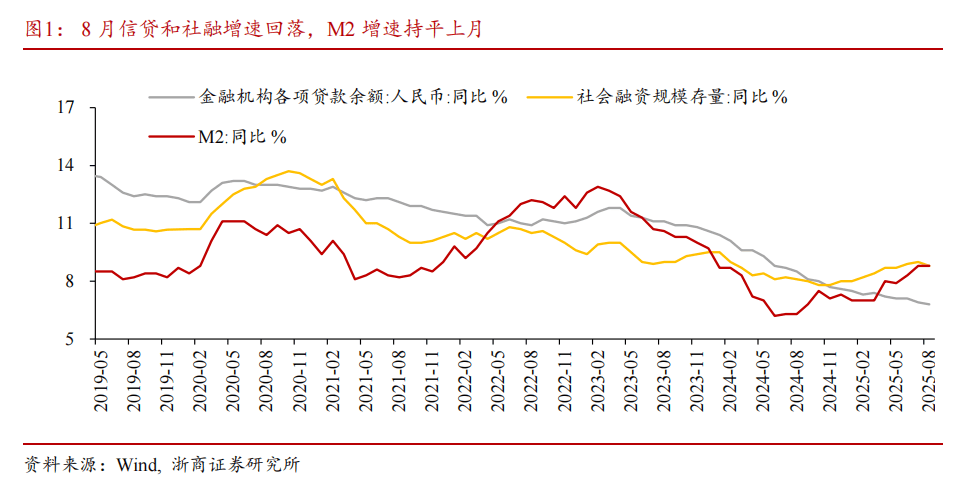
浙商证券浙商早知道-20250815
ZHESHANG SECURITIES· 2025-08-14 23:30
Market Overview - The Shanghai Composite Index fell by 0.5%, while the CSI 300 decreased by 0.1%. The STAR Market 50 rose by 0.7%, the CSI 1000 dropped by 1.2%, the ChiNext Index declined by 1.1%, and the Hang Seng Index decreased by 0.4% [3][4] - The best-performing sectors included non-bank financials (+0.6%), banks (-0.0%), food and beverage (-0.2%), home appliances (-0.3%), and real estate (-0.5%). The worst-performing sectors were comprehensive (-2.7%), defense and military (-2.2%), telecommunications (-2.1%), steel (-2.0%), and textiles and apparel (-1.7%) [3][4] - The total trading volume in the Shanghai and Shenzhen markets was 22,792 billion, with a net inflow of 1.03 billion Hong Kong dollars from southbound funds [3][4] Key Insights - The macroeconomic research indicates a rise in funds and a transition phase, highlighting government leverage and the non-bankization of deposits. The market anticipates a favorable financial data outlook [5] - The credit growth is gradually slowing, reflecting a structural transformation in the economy, leading to a shift in credit demand and a positive substitution for direct financing. Future evaluations of financial support should focus more on the effectiveness of interest rate reductions, indicating a new characteristic of "government increasing leverage, enterprises stabilizing leverage, and residents appropriately deleveraging" [5] - A forward-looking perspective suggests paying attention to new characteristics in financial data and the migration of residents' deposits [5]