美元估值

Search documents
非农“急刹车”后,华尔街再度集体“看空美元”
Hua Er Jie Jian Wen· 2025-08-05 11:10
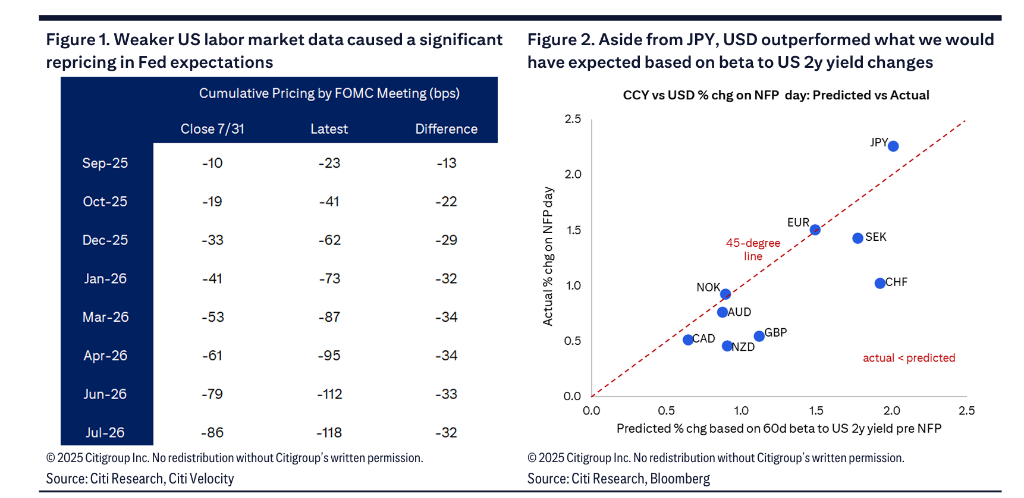
Core Viewpoint - The expectation of a Federal Reserve interest rate cut has increased significantly due to weak non-farm payroll data, yet the actual decline of the US dollar has been less than anticipated. Major Wall Street banks are collectively bearish on the dollar, citing overvaluation and weak fundamentals as key reasons [1][6]. Group 1: Market Analysis - Citigroup, Goldman Sachs, and Morgan Stanley have published reports indicating that the long-term logic for a declining dollar remains intact, with significant short-selling potential still available [1][6]. - Following the non-farm data release, the downward momentum of the dollar was restrained due to the pressure on risk currencies and specific weaknesses in certain currencies, preventing a full release of the dollar's decline [3][9]. - Despite the muted response of the dollar, Citigroup emphasizes that the logic for a dollar decline remains valid from a valuation perspective, with the euro currently undervalued and potential to overshoot to 1.20 against the dollar [7][9]. Group 2: Economic Indicators - Goldman Sachs notes that the dollar's actual trade-weighted exchange rate is still 15% above its long-term average, while the US current account deficit stands at 4% of GDP, both of which are unfavorable for the dollar [9]. - Morgan Stanley highlights domestic policy uncertainties, particularly following the resignation of Fed Governor Kugler, which adds downward pressure on the dollar [9]. Group 3: Short-term Catalysts - The dollar's next movements are expected to depend heavily on three potential catalysts: the nomination of a new Fed governor, changes in the leadership of the Bureau of Labor Statistics (BLS), and the upcoming CPI inflation report on August 12 [11][12]. - The nomination of Kugler's successor is seen as the most immediate catalyst, likely to be interpreted as dovish for the dollar if candidates like Walsh or Hassett are chosen [11]. - The leadership change at the BLS introduces uncertainty into upcoming employment data, which could lead to market speculation and positioning ahead of data releases [11].


关税会谈后,亚洲货币升值的逻辑变了?
Hua Er Jie Jian Wen· 2025-05-14 09:46
Group 1 - The core viewpoint of the article is that optimism in trade negotiations has alleviated downward pressure on the US dollar against Asian currencies, but Goldman Sachs believes the downward trend of the dollar against Asian currencies remains unchanged [1][2] - Goldman Sachs has raised its 2025 Q4 US GDP growth forecast from 0.5% to 1.0% and reduced the probability of a US recession from 45% to 35% due to better-than-expected trade negotiations [2] - The expectation for Federal Reserve rate cuts has been postponed, now anticipated in December 2025, March 2026, and June 2026, rather than previously expected in mid-2025 [2] Group 2 - Three core trends contributing to the ongoing downward pressure on the dollar are identified: 1. The dollar is still overvalued by approximately 17% according to Goldman Sachs' DEER valuation model [3] 2. Asian exporters are expected to continue converting dollars into local currencies, with foreign currency deposits in Taiwan, South Korea, Indonesia, Malaysia, Thailand, and the Philippines nearly doubling from $300 billion in 2015 to nearly $600 billion by February 2025 [4] 3. Asian currencies may have a stronger ability to resist depreciation during trade negotiations, as most Asian economies have trade surpluses with the US, which could lead to a strengthening of Asian currencies against the dollar if trade surpluses are reduced [5]
BBMarkets蓝莓市场:美元估值仍处高位 或将重演历史性贬值周期
Sou Hu Cai Jing· 2025-04-30 03:41
Group 1 - The core viewpoint indicates that the US dollar is experiencing a technical correction, with the current trade-weighted dollar index showing a 5% decline from its peak, yet still above long-term equilibrium levels by nearly two standard deviations, suggesting ongoing valuation correction pressure [1][3] - Historical patterns reveal that when the dollar's real effective exchange rate exceeds two standard deviations above the mean, it often leads to a deep adjustment cycle of 25%-30%, indicating significant devaluation pressures beyond conventional monetary policy [3] - The IMF forecasts that by 2025, the GDP growth rate differential between the US and the Eurozone will narrow to 0.8 percentage points, the smallest gap since 2019, reflecting a convergence of economic advantages [3] Group 2 - The political cycle and institutional risks are resonating, with the policy uncertainty index for the election year reaching 87.6, close to levels seen before Trump's first election in 2016, which undermines the credibility of the dollar as a global safe haven [3] - The diversification of global central bank foreign exchange reserves is accelerating, with the dollar's share dropping to 58.9%, the lowest in 28 years, indicating a fundamental challenge to the dollar's dominance in the global monetary system [3] - Technical analysis shows a typical topping pattern, with short-term resistance concentrated in the 99.40-99.45 range, and support levels identified at 98.95-99.00 and 98.70-98.75, suggesting potential trading strategies within these ranges [4]