
美元看跌

Search documents
Investors Turn Record Bearish On The Dollar – Is This The Final Flush?
Yahoo Finance· 2026-02-18 13:00
Group 1 - Global investors are currently more bearish on the U.S. dollar than at any point in the last 14 years, with USD positioning at its most underweight level since January 2012 [1] - The underweight positioning of the dollar has surpassed previous lows seen during the Trump tariff shock in April 2025, indicating a significant shift in investor sentiment [1] - Despite the nomination of a new Fed chief, concerns regarding Fed independence have decreased, yet this has not led to increased demand for the dollar or renewed optimism in U.S. assets [2] Group 2 - Expectations are growing that global reserve managers will continue to reduce their dollar allocations, with a minority anticipating an accelerated pace of diversification away from the dollar [3] - Recent comments from Atlanta Fed President Raphael Bostic suggest that confidence in the U.S. dollar is being questioned, which could lead to significant valuation impacts [3] - Nearly half of survey respondents view resilience in economic data, particularly strong job gains, as a potential catalyst for a dollar rebound [4][5]
下周美联储决议前瞻:“暂停”是确定,不确定的是“鹰派还是鸽派暂停”
Sou Hu Cai Jing· 2026-01-25 09:09
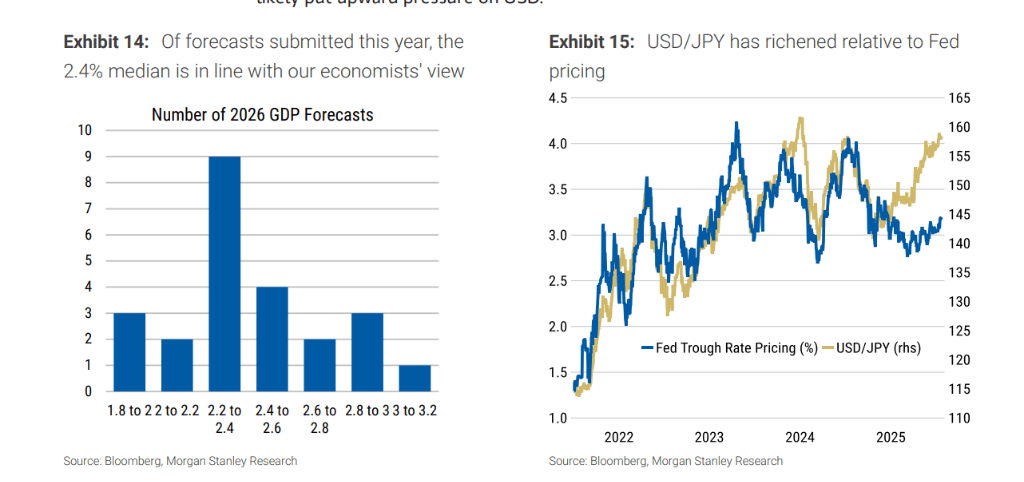
Group 1 - The core viewpoint is that Morgan Stanley anticipates the Federal Reserve will maintain interest rates during the upcoming January FOMC meeting, with a focus on the tone of the statement indicating a dovish pause to soothe the market [1][2] - The Federal Reserve is expected to keep the federal funds rate target range unchanged at 3.50%-3.75%, which is seen as a tactical adjustment rather than a return to a tightening cycle [1][2] - The key for investors lies in the forward guidance, with expectations that the Fed will retain language suggesting consideration for further adjustments, indicating a continued dovish stance [2][9] Group 2 - Jerome Powell is expected to justify the pause by referencing recent strong growth data, stable hiring, and a decrease in the unemployment rate to 4.375% [3] - Despite the Fed's pause on rate cuts, the short-term financing market remains loose, with repo rates normalizing below the interest on reserve balances (IORB), indicating an excess of cash in the system [4] - Morgan Stanley has revised its outlook on the foreign exchange market, now projecting a stronger U.S. economy with an upward adjustment of GDP growth to 2.4% for 2026, while delaying the anticipated rate cuts [5] Group 3 - In the mortgage-backed securities (MBS) sector, the announcement of a $200 billion purchase plan by government-sponsored enterprises (GSEs) has led to a significant narrowing of MBS spreads, prompting a neutral stance from Morgan Stanley [8] - The FOMC statement is expected to upgrade the assessment of economic growth from "moderate" to "robust" and remove references to increased risks in the labor market, reflecting a more positive outlook [9] - The Federal Reserve is projected to maintain a monthly purchase of $40 billion in Treasury bills to manage reserve levels, with expectations that the SOMA account will exceed $600 billion by the end of 2026 [9]

路博迈、安本集团等:加码新兴市场货币利差交易
Sou Hu Cai Jing· 2025-08-10 23:45
Core Viewpoint - Emerging market spread trading is experiencing a resurgence due to market expectations of a Federal Reserve rate cut next month, leading to a weaker dollar and increased interest in high-yield currencies [1] Group 1: Market Dynamics - Asset management firms such as Loomis Sayles and Aberdeen are increasing their positions in currencies from countries like Brazil, South Africa, and Egypt [1] - Earlier this year, these types of trades yielded double-digit returns, but the momentum slowed in July due to a rebound in the dollar [1] - Recent poor U.S. employment data has strengthened rate cut expectations, driving an increase in arbitrage trading [1] Group 2: Institutional Perspectives - Firms like DoubleLine and UBS have joined the bearish dollar camp, stating that "the bearish narrative on the dollar has returned" [1] - Loomis Sayles' co-head of emerging market debt, Urquieta, believes the likelihood of a significant dollar rebound is limited, citing overall global growth as stable [1] - Urquieta favors carry trades in South Africa, Turkey, and Brazil [1]
路博迈、安本等:加码新兴市场货币套利交易
Sou Hu Cai Jing· 2025-08-10 23:45
Core Viewpoint - The expectation of a Federal Reserve interest rate cut has increased, leading to a resurgence in carry trades among emerging market investors as the dollar weakens and interest in high-yield currencies rises [1] Group 1: Market Dynamics - The carry trade strategy is gaining traction among investors in emerging markets, with firms like Loomis Sayles and Aberdeen Group increasing their positions in currencies from Brazil, South Africa, and Egypt [1] - The softening of the dollar and reduced volatility have created a favorable environment for these trading strategies [1] Group 2: Performance and Expectations - Earlier this year, carry trades yielded double-digit returns, but these were paused in July due to a rebound in the dollar [1] - Recent poor U.S. employment data has heightened expectations that the Federal Reserve may need to cut rates next month to avoid a recession, reviving interest in carry trades [1] Group 3: Institutional Sentiment - Institutions like DoubleLine and UBS have recently joined the bearish sentiment on the dollar, indicating a renewed narrative of dollar weakness [1] - Loomis Sayles' co-head of emerging market debt, Urquieta, expressed limited potential for a significant rebound in the dollar, while noting that global growth remains relatively stable [1]
对关税裁决的外汇思考:为何美元在风险市场回调中仍应滞后?
2025-06-02 15:44
Summary of J.P. Morgan's FX Thoughts on Tariff Ruling Industry Overview - The document discusses the implications of a recent ruling by the US Court of International Trade regarding tariffs, particularly those related to China and Fentanyl, within the context of US trade policy and foreign exchange (FX) markets [1][2][3]. Key Points and Arguments 1. **Tariff Ruling Context**: The ruling that undoes certain tariffs is seen as a significant development in US trade policy, but it is not viewed as the end of the tariff saga. The court's decision is characterized as a "pothole" rather than a complete derailment of the US strategy [2][3]. 2. **Impact on the Dollar**: The initial reaction in macro markets included a stronger dollar, but this was followed by a retracement. The view is that the bearish case for the dollar remains intact despite the ruling, as the dollar is expected to lag behind the recovery in US markets [1][3]. 3. **Global Growth Outlook**: The removal of ultra-high tariffs is expected to positively impact not just the US but also global markets, particularly in China and broader Asia. This could lead to growth upgrades in these regions, which had previously been negatively impacted by high tariff rates [4][5]. 4. **US Terminal Rate and Dollar Dynamics**: If the current administration is constrained on tariffs, the gains from a higher US terminal rate would be modest. The focus may shift to term premium narratives, which could offset the usual positive correlation between a hawkish Fed and dollar strength [5][6]. 5. **Ongoing Trade Negotiations**: Despite the ruling, US trade negotiations with other countries are expected to continue. The administration has alternative policies to maintain tariffs as part of the agenda, which will motivate ongoing negotiations [6][7]. 6. **Long Position in Dollar**: The document notes that the world remains long on the dollar, and changing FX/equity correlations suggest an increase in FX hedges. This is particularly relevant for countries with large FX reserves, which may prefer to avoid weakening their currencies against the dollar [3][7]. 7. **Future Scenarios for the Dollar**: The dollar is anticipated to remain on a weakening path, although the intensity of this trend may vary. A significant change in this outlook would require a resurgence of US exceptionalism, characterized by strong US growth relative to disappointing growth in Europe and China [8][9]. Additional Important Content - **Tariff Specifics**: The ruling does not eliminate all tariffs, as Section 232 and Section 301 tariffs remain in place. An appeal against the ruling is expected, which could potentially reinstate broad-based tariffs under IEEPA [9][10]. - **Alternative Tariff Options**: The administration has other trade statutes available for imposing tariffs, which could be utilized if necessary [9][10]. This summary encapsulates the critical insights and implications of the recent tariff ruling as discussed in the J.P. Morgan report, highlighting the interconnectedness of US trade policy, global economic growth, and FX market dynamics.