
美国地产复苏

Search documents
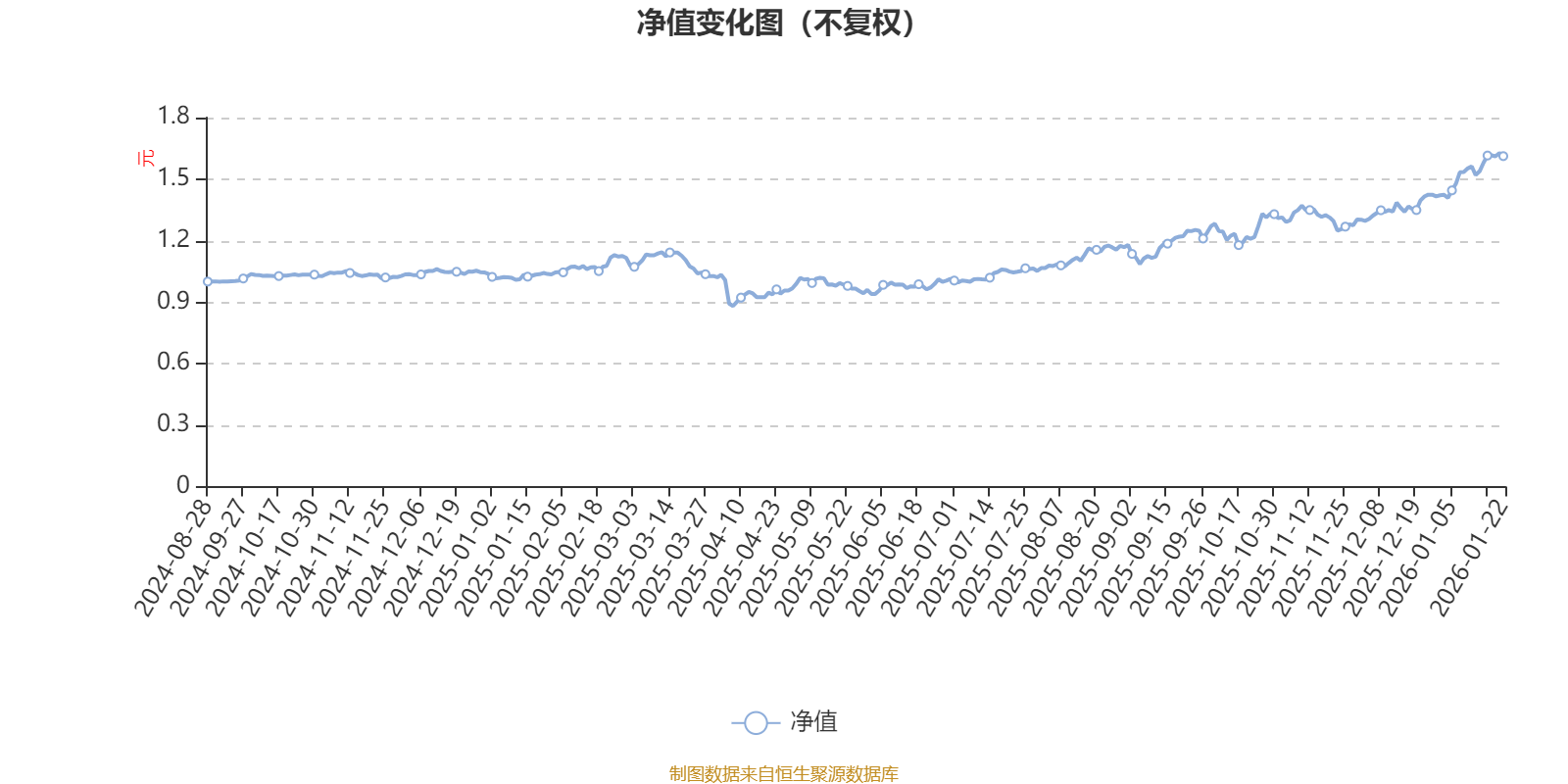
易方达产业机遇混合A:2025年第四季度利润412.61万元 净值增长率10.89%
Sou Hu Cai Jing· 2026-01-25 06:45
Core Insights - The AI Fund E Fund Industrial Opportunity Mixed A (021179) reported a profit of 4.1261 million yuan for Q4 2025, with a weighted average profit per fund share of 0.1396 yuan. The fund's net value growth rate for the reporting period was 10.89%, and the fund size reached 42.9818 million yuan by the end of Q4 2025 [2][15]. Fund Performance - As of January 22, the unit net value of the fund was 1.612 yuan. The fund manager, Yang Zongchang, oversees two funds that have both yielded positive returns over the past year. The highest growth rate among these funds was 70.29% for E Fund Supply Reform Mixed, while the lowest was 55.4% for E Fund Industrial Opportunity Mixed A [2][3]. Investment Strategy - In Q4, the fund continued to focus on technology innovation while adjusting its portfolio based on market changes since Q3. The overall allocation became more balanced, with significant reductions in holdings related to storage module companies and AI industry chain temperature control and power supply companies due to their substantial price increases and valuation improvements. The focus shifted towards semiconductor equipment and materials, particularly stocks affected by downstream storage customer expansions and areas with low domestic substitution penetration [3]. Sector Allocation - The fund increased its allocation to the coal industry and added positions in certain chemical stocks that had undergone sufficient adjustments and reasonable valuation recoveries. The automotive sector's allocation was maintained, and the fund continued to monitor opportunities arising from the recovery of the U.S. real estate market and overseas expansion [3]. Performance Metrics - As of January 22, the fund's net value growth rate over the past three months was 33.31%, ranking 13th out of 689 comparable funds. Over the past six months, the growth rate was 54.29%, ranking 53rd out of 689, and over the past year, it was 55.40%, ranking 145th out of 673 [3]. Risk and Return - Since inception, the fund's Sharpe ratio was 1.1162, indicating a favorable risk-adjusted return [8]. The maximum drawdown since inception was 22.95%, with the largest quarterly drawdown occurring in Q2 2025 at 14.72% [10]. Portfolio Composition - As of December 31, the fund's average stock position was 80.69%, compared to the industry average of 84.04%. The fund reached a peak stock position of 90.99% at the end of Q1 2025 and a low of 51.06% at the end of 2024 [13]. Top Holdings - By the end of Q4 2025, the fund's top ten holdings included Huayang Co., Changchuan Technology, Huafeng Technology, Zhongke Feicai, Juxing Technology, Weicai Technology, Geely Automobile, Jingyi Equipment, Shengong Co., and Jiaocheng Ultrasonic [18].

国泰海通:美国家具批发商被动去库 头部公司超额利润来自细分行业定位等
智通财经网· 2026-01-21 03:58
Group 1 - The core viewpoint is that U.S. furniture retailers are actively restocking, while wholesalers are entering a passive destocking cycle by September 2025. If the U.S. continues to lower interest rates, the real estate sector, which is highly correlated with interest rates, is expected to recover, leading to improved retail sales year-on-year and an increase in furniture import amounts, which will boost midstream manufacturing orders [1][3]. Group 2 - Retailers are in a destocking cycle from April 2025 to July 2025, with sales growth outpacing inventory growth. By August-September 2025, inventory growth is expected to exceed sales growth, indicating a shift to an active restocking cycle [1]. - Wholesalers are in a restocking cycle from October 2024 to August 2025, with inventory growth surpassing revenue growth. By September 2025, revenue growth is projected to exceed inventory growth, marking a transition to a passive destocking cycle [1]. Group 3 - The inventory-to-sales ratio for furniture brands is at historically low levels, aligning with the trend of retailers reducing inventory since May 2023. Meanwhile, the inventory levels of furniture and building material channel merchants are generally higher than those of brand merchants, consistent with wholesalers restocking more than they are destocking since September 2024 [2]. - Home Depot's inventory-to-sales ratio has returned to historical normal levels, with further restocking intentions being constrained by demand. In Q3 2025, inventory growth is expected to exceed revenue, indicating a restocking cycle [2]. Group 4 - The improvement in home demand is anticipated to be driven by the real estate sector, with retailers accelerating sales and initiating restocking. If interest rates continue to decline, the real estate market is likely to recover, leading to improved year-on-year retail sales and an increase in furniture imports, which will positively impact midstream manufacturing orders [3].


招商证券:美联储进入降息周期 把握工具行业投资机会
智通财经网· 2025-12-19 03:21
Core Viewpoint - The consumer goods export chain is expected to face multiple external disturbances in 2025, leading to structural differentiation in market conditions, with motorcycles and ATVs remaining strong while other segments see declining growth rates [1][2]. Group 1: 2025 Review - The consumer goods export chain encompasses a wide range of industries with varying growth drivers, resulting in a bottom-up driven market where individual stock logic is relatively independent, and sector effects are weak [2]. - In the first three quarters of 2025, revenue and net profit growth rates for export chain companies showed a declining trend, primarily due to tariff impacts and early inventory stocking by overseas clients [2]. - Despite the overall decline, certain segments like motorcycles and ATVs continue to outperform expectations, leading to sustained high growth in related companies' performance and stock prices [2]. Group 2: 2026 Outlook - The macroeconomic environment is expected to improve in 2026, with easing tariff issues and low freight costs, alongside the Federal Reserve initiating a new round of interest rate cuts, which will stimulate U.S. consumer and investment activities [3]. - The recovery of the U.S. real estate cycle is anticipated to benefit the tool industry, with continued attention recommended for the bathroom pump sector and domestic motorcycle exports [3]. Group 3: Tool Industry - Tool demand is directly correlated with the real estate industry's conditions, which are highly sensitive to mortgage rates currently suppressed by high rates, placing the real estate cycle at its lowest since 1999 [4]. - As the Federal Reserve's interest rate cuts take effect, mortgage rates are expected to decline, leading to a recovery in new and existing home sales, which will subsequently drive tool demand [4]. Group 4: Plastic Bathroom Pump Industry - The plastic bathroom pump sector, used in facilities like massage bathtubs and swimming pools, sees strong demand in Europe and North America [5]. - This sector is linked to new construction projects and also benefits from upgrades in existing facilities, with demand likely to increase following interest rate cuts [5]. Group 5: Motorcycle Industry - The global motorcycle market is vast and resilient, with 2023 sales reaching 54.6 million units, a year-on-year increase of 2.44%, and a market size of $139.6 billion, up 2.72% year-on-year [6]. - The competitive landscape features Japanese brands leading, Indian brands in the second tier, and Chinese brands breaking through, while European and American brands maintain a presence in high-end segments [6]. - Domestic brands are gradually moving away from reliance on low-end commuter models, shifting towards high-value segments like large displacement and electric motorcycles, aiming to increase market share in Europe and the U.S. [6]. - Key recommendations include companies like Juxing Technology (hand tools + power tools) and Quan Feng Holdings (power tools + garden tools), with additional attention suggested for Lingxiao Pump Industry, Chunfeng Power (small and mid-cap), Longxin General (automotive), and Taotao Industry (automotive & home appliances) [6].

