能源供应浪潮

Search documents
高盛力挺黄金为首选 央行购金或推金价破4900美元
Jin Tou Wang· 2025-12-29 03:21
Core Viewpoint - Goldman Sachs predicts that gold will be the best investment in commodities for the coming year, with a potential price breakthrough of $4,900 if private investors follow central banks in diversifying their portfolios [2] Group 1: Market Analysis - As of December 29, the latest spot price for London gold is $4,504.24 per ounce, down $28.25 from the previous trading day, marking a decline of 0.62%. The daily price range reached a high of $4,548.92 and a low of $4,471.99 [1] - The current technical indicators for London gold show a mixed market sentiment, with a strong mid-term trend but short-term volatility due to profit-taking and reduced market liquidity at year-end [4] Group 2: Price Forecast - Price predictions indicate a potential decline to $4,200 in Q1 2026, followed by a recovery above $4,400 in Q2, reaching a new high of $4,630 in Q3, and ending the year at $4,900 [3] Group 3: Support and Resistance Levels - Key support levels include the psychological barrier at $4,500, the range of $4,480-$4,485, and the critical zone of $4,450-$4,470, which is seen as a lifeline for bulls [5] - Resistance levels are identified at the $4,520-$4,530 range, the $4,550 mark, and the historical high zone of $4,580-$4,600, which presents significant psychological pressure [6] Group 4: Investment Trends - The report highlights two major trends: macro-level competition for geopolitical and technological dominance, and micro-level energy supply dynamics starting in 2025, which will drive investment decisions [2] - Central bank demand is crucial, with an average monthly gold purchase of 70 tons expected in 2026, significantly contributing to price increases [2]
高盛:2026年黄金将问鼎“大宗商品之首”,看涨至4900美元
Jin Shi Shu Ju· 2025-12-29 01:04
Core Viewpoint - Goldman Sachs believes that gold will be the best investment choice in the commodity sector for the coming year, with prices potentially exceeding $4,900 per ounce if private investors diversify their assets like central banks [1] Group 1: Commodity Market Outlook - The Bloomberg Commodity Index achieved a strong total return of 15% in 2025, driven by robust returns in industrial and precious metals, benefiting from anticipated Federal Reserve rate cuts [1] - Goldman Sachs' macroeconomic baseline forecast includes solid global GDP growth and a 50 basis point rate cut by the Federal Reserve in 2026, which is expected to support strong commodity returns [1] Group 2: Central Bank Demand for Gold - Central bank gold purchases are expected to remain strong in 2026, averaging 70 tons per month, contributing approximately 14 percentage points to the predicted price increase [2] - The freezing of Russian reserves in 2022 marked a significant turning point for emerging market reserve management regarding geopolitical risks [2] - Emerging market central banks' gold reserves are estimated to be relatively low compared to global peers, especially considering China's ambitions for renminbi internationalization [2] Group 3: Private Investor Trends - If the trend of diversification extends to private investors, there could be upward price risks for gold, as this has led to competition for bullion between investors and central banks [4] - Gold ETFs currently account for only 0.17% of U.S. private financial portfolios, down 6 basis points from their peak in 2012 [4] - An increase of 1 basis point in gold's share within U.S. financial portfolios, driven by investor purchases, could lead to a price increase of 1.4% [4] Group 4: Geopolitical and Supply Risks - Commodities provide insurance value in the current geopolitical environment, with gold being the most favored long position [7] - The geographic concentration of commodity supply, along with heightened geopolitical tensions and competition in trade and technology, increases the risk of supply disruptions [7] - Goldman Sachs anticipates that gold prices will dip to $4,200 per ounce in Q1 2026, then rebound to over $4,400 in Q2, reach around $4,630 in Q3, and potentially rise to $4,900 by the end of Q4 [7]

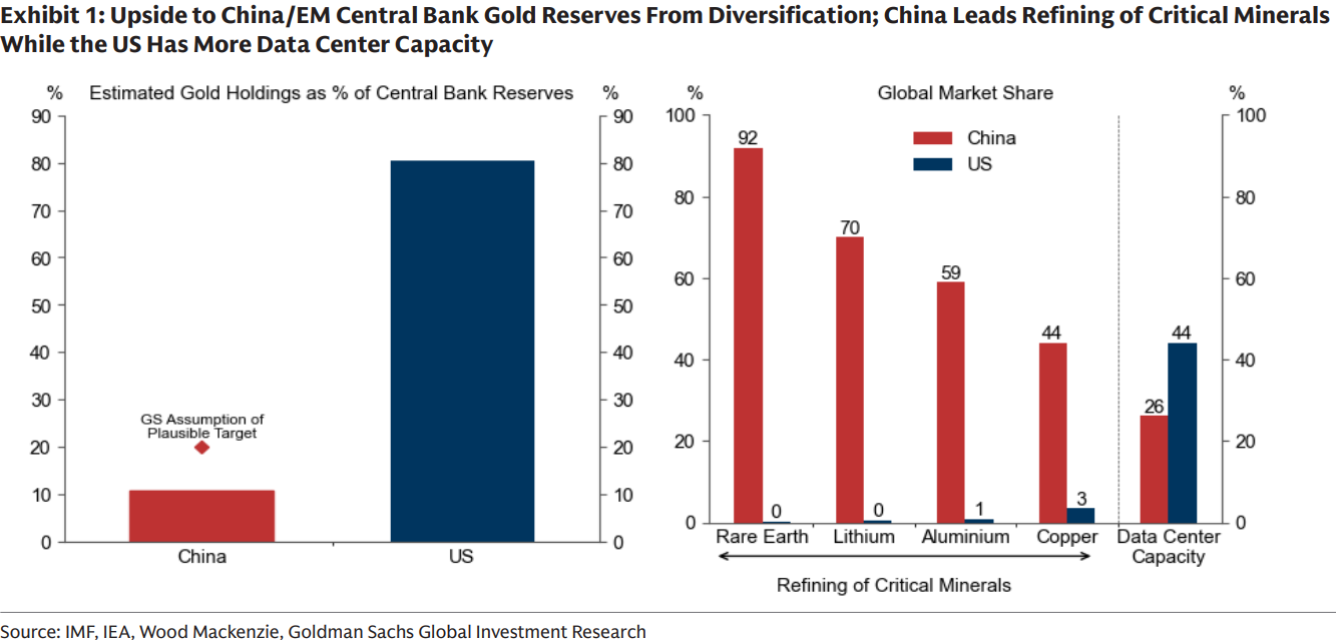
高盛2026大宗商品展望:黄金为王,看好铜胜过铝和锂,AI竞赛与能源浪潮主宰商品市场
对冲研投· 2025-12-26 10:32
Core Viewpoint - The commodity market in 2025 will experience a tug-of-war between the strong performance of precious metals and the lackluster performance of the energy market, creating significant structural opportunities for investors. This divergence will become more pronounced in 2026, driven by two major global structural changes: the US-China power competition over technological dominance and geopolitical influence, and contrasting supply waves in the energy market, particularly the short-lived oil supply surge and the long-lasting liquefied natural gas (LNG) expansion [1][2]. Group 1: Macro and Micro Trends - The overall commodity market performed strongly in 2025, with the Bloomberg Commodity Index (BCOM) returning 15%, largely due to the excellent performance of industrial metals, especially precious metals, which benefited from expectations of Federal Reserve rate cuts [2][3]. - The macro analysis framework identifies US-China geopolitical competition and AI rivalry as core pillars influencing the commodity market, while the micro analysis highlights two energy supply waves starting in 2025, with oil supply peaking in 2026 and LNG supply expanding significantly [3][4]. Group 2: Gold Demand and Price Projections - Central bank gold purchasing demand is expected to remain strong in 2026, averaging around 70 tons per month, which is over four times the long-term average of 17 tons before 2022. This demand is projected to support gold prices, potentially increasing them by approximately 14% by December 2026 [8][9]. - The model for "sticky belief buyers" (central banks and ETFs) indicates that their demand for gold is less volatile compared to opportunistic buyers, which could further stabilize gold prices [7][8]. Group 3: Copper and Industrial Metals Outlook - Despite recent price increases, copper is still viewed as a favored industrial metal due to its critical role in electrification, which drives nearly half of its demand. The forecast for copper prices in 2026 is an average of $11,400 per ton, with expectations of price stabilization and potential declines in the latter half of the year [27][29]. - The supply of copper is expected to face unique constraints, while strong demand from strategic sectors like AI and defense will provide a bottom support for prices [27][29]. Group 4: Energy Market Dynamics - The oil market is anticipated to experience a supply surplus in 2026, with Brent and WTI crude oil prices projected to average $56 and $52 per barrel, respectively. This surplus is attributed to a significant supply wave leading to an excess of 2 million barrels per day [40][43]. - In contrast, the LNG market is expected to see a rapid increase in supply, with global LNG exports projected to grow by over 50% from 2024 to 2030, driven by investments made during the previous energy crisis [49][50]. Group 5: Long-term Price Predictions - The forecast for gold prices suggests an increase to $4,900 by December 2026, while oil prices are expected to recover gradually by 2028, reaching around $80 per barrel as the market adjusts to long-term demand and supply dynamics [57][47]. - The divergence in performance among different commodities is expected to create significant relative value opportunities, with precious metals likely outperforming other sectors [56].