药品试验数据保护

Search documents
解读新药品管理法:持有人责任强化,市场独占期制度性落地
第一财经· 2026-01-30 11:33
Core Viewpoint - The newly revised "Regulations on the Implementation of the Drug Administration Law" will take effect on May 15, addressing the needs of the innovative drug industry in China, which has rapidly developed into the second-largest pharmaceutical market globally and is now in the second tier of global drug research and development. Group 1: Highlights of the New Regulations - Highlight 1: "Data Protection" Expanded to New Chemical Entities - The new regulations extend data protection to drugs containing new chemical entities, providing a protection period of up to 6 years for undisclosed trial data, encouraging drug innovation while balancing the relationship between innovative and generic drugs [5][4]. - Highlight 2: Institutionalization of the "Market Exclusivity" System - The new regulations establish a formal market exclusivity system for innovative drugs, granting up to 2 years of exclusivity for new pediatric drugs and up to 7 years for rare disease treatments, thus providing administrative protection for innovation [6][7]. - Highlight 3: Conditional Opening of Drug Contracted Segment Production - The regulations clarify conditions under which segmented production can be contracted, allowing for more flexibility in drug manufacturing while addressing potential risks associated with quality management and regulatory compliance [8][10]. - Highlight 4: Strengthening Oversight of Overseas New Drug Batch Approvals - The regulations enhance the management of commercial-scale batches of drugs approved overseas, allowing them to be sold in China after passing GMP compliance checks, thereby ensuring drug safety while meeting urgent clinical needs [11][10].


解读新药品管理法:持有人责任强化,市场独占期制度性落地
Di Yi Cai Jing· 2026-01-30 09:25
Core Viewpoint - The National Medical Products Administration (NMPA) is actively promoting the formulation of the "Implementation Measures for the Protection of Drug Trial Data," responding to the needs of the innovative drug industry and enhancing the regulatory framework to support drug development in China [1] Group 1: Drug Trial Data Protection - The revised "Regulations" expand the scope of drug trial data protection to include drugs with new chemical entities, providing a protection period of up to 6 years for undisclosed trial data [2] - The NMPA has previously solicited public opinions on the "Implementation Measures for the Protection of Drug Trial Data," indicating a move towards more concrete regulations [2] Group 2: Market Exclusivity Period - The new "Regulations" establish a market exclusivity period for innovative drugs, which had previously been discussed only in draft forms [3] - For new pediatric drugs and rare disease treatments, the exclusivity period can be up to 2 years and 7 years respectively, incentivizing the development of these critical medications [4] Group 3: Conditional Release of Drug Contracted Segment Production - The "Regulations" clarify conditions under which contracted segment production can be permitted, particularly for innovative drugs with special production requirements [6][7] - The segment production model has shown potential in reducing costs while maintaining efficacy, as evidenced by the successful registration of a rare disease treatment [6] Group 4: Strengthened Oversight of Imported Drug Batches - The "Regulations" enhance the oversight of commercial-scale batches of drugs approved for import before market approval, allowing for their sale under strict compliance with Good Manufacturing Practice (GMP) [8] - This approach aims to balance drug safety with the urgent clinical needs of patients, particularly for new drugs and treatments for rare diseases [8]
新版《药品管理法实施条例》发布 罕见病和儿童用药享市场独占期
Zhong Zheng Wang· 2026-01-28 08:44
Core Viewpoint - The newly revised "Regulations on the Implementation of the Drug Administration Law of the People's Republic of China" aims to promote drug innovation and clinical value-oriented drug development, effective from May 15, 2026 [1][2][4] Group 1: Drug Development and Innovation - The regulations support the development and innovation of drugs based on clinical value, encouraging the research and creation of new drugs [1][2] - It establishes a fast-track registration process for drug listings and clarifies the re-registration procedures [1][3] - The regulations provide market exclusivity for eligible pediatric and rare disease medications, aligning with international practices to ensure equitable access to health [2][3] Group 2: Drug Production and Management - The regulations emphasize strengthening drug production management and clarify the responsibilities of drug marketing authorization holders [1][3] - It specifies management requirements for traditional Chinese medicine products and outlines the conditions under which drug production can be entrusted [1][3] Group 3: Clinical Trial and Data Protection - The regulations introduce a modernized drug review and approval system focused on clinical value, facilitating faster market access for innovative drugs [3][4] - It includes provisions for data protection related to drug trials, balancing the interests of innovation and generic competition [3][4] - The data protection system is designed to enhance confidence in drug innovation while allowing for simplified applications for generics after the protection period [3] Group 4: Future Implications - The implementation of these regulations is expected to improve the quality and efficiency of drug review and approval processes, ultimately benefiting public health and advancing China from a major pharmaceutical country to a strong pharmaceutical nation [4]
新修订药品管理法实施条例公布 儿童药罕见病药迎创新激励
Bei Jing Shang Bao· 2026-01-27 17:00
Core Viewpoint - The newly revised "Regulations on the Implementation of the Drug Administration Law of the People's Republic of China" aims to enhance drug regulation and innovation, with a focus on pediatric and rare disease medications, and will take effect on May 15, 2026 [1] Group 1: Regulatory Changes - The revised regulations represent the first comprehensive update since 2002, reflecting significant changes in drug research, production, distribution, and usage over the past 23 years [1] - The regulations introduce a market exclusivity period for pediatric and rare disease medications, providing up to 7 years of exclusivity for qualifying drugs, contingent on the commitment to ensure supply [2][3] - The regulations establish a data protection system for trial data related to new chemical entities, preventing unauthorized commercial use of undisclosed data [2] Group 2: Support for Innovation - The regulations emphasize support for drug development and innovation driven by clinical value, encouraging the research and creation of new drugs [1] - A breakthrough therapy designation and expedited registration processes are introduced to accelerate the approval of innovative drugs [3] Group 3: Quality and Safety Management - Drug marketing authorization holders are required to establish comprehensive quality assurance and pharmacovigilance systems, ensuring ongoing evaluation of drug quality throughout its lifecycle [3] - The regulations clarify the responsibilities of online drug sales platforms, mandating them to implement strict oversight and management of drug transactions [3] Group 4: Traditional Chinese Medicine (TCM) and Institutional Management - The regulations promote quality management standards for TCM production, encouraging local governments to develop relevant plans [4] - The management of medical institution preparations is strengthened, allowing for the formulation of pediatric medications and detailing the approval and usage processes [4]
国家药监局:助力创新药“中国首发”
Xin Hua Wang· 2026-01-07 10:47
Core Insights - China is enhancing support for innovative drugs with new mechanisms and targets across the entire chain of communication, clinical trials, registration, and review processes to facilitate "China's first launch" of innovative drugs [1][2] - By 2025, there is an expectation for a significant increase in the market launch of urgently needed clinical products in the pharmaceutical and medical device sectors [1] Group 1: Pharmaceutical Sector - In 2022, the National Medical Products Administration (NMPA) approved a total of 4,087 drug registration applications, including 76 innovative drugs, marking a historical high [1] - The time gap for domestic and international drug listings has been reduced, with 59 foreign new drugs receiving temporary import approval [1] - A total of 138 children's drugs were approved, and 48 rare disease drugs were granted temporary import approval, addressing medication gaps for special populations [1] Group 2: Medical Device Sector - The NMPA approved 3,402 medical device products in 2022, including 76 innovative medical devices, achieving a new record [1] - The medical device innovation ecosystem is continuously improving, supporting industry upgrades [1][2] - In 2026, the NMPA plans to expedite the market launch of high-end medical devices and allocate more review resources to urgently needed innovative devices and those for rare disease prevention [2] Group 3: Future Initiatives - The NMPA will implement a drug trial data protection system and establish market exclusivity for children's and rare disease medications [2] - There will be a focus on optimizing the review and approval measures for cell and gene therapy drugs [2] - The establishment of a national standardized technical working group for intelligent frontier medical devices is planned to advance standard formulation in key areas such as brain-machine interfaces [2]
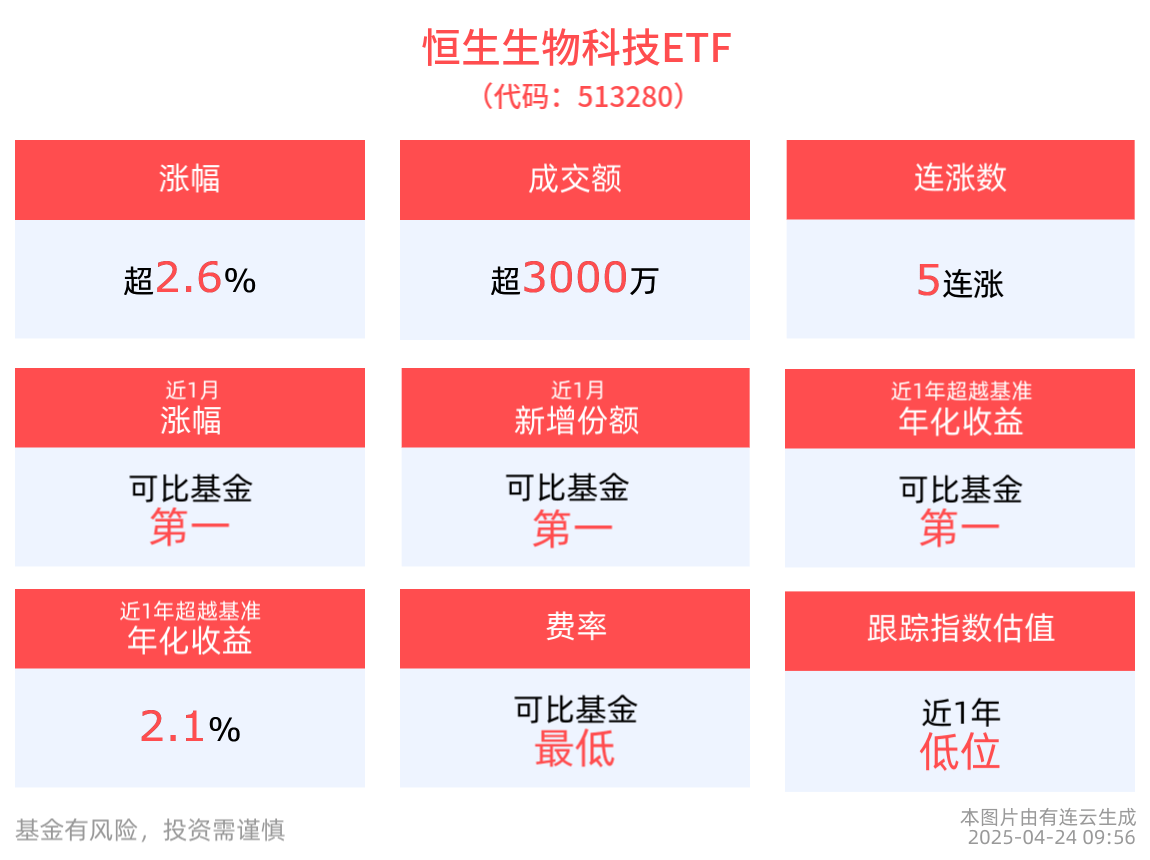
港药又冲高,康方生物涨超6%,再赢头对头临床研究!可T+0交易的恒生生物科技ETF(513280)涨超2%,冲击5连涨
Sou Hu Cai Jing· 2025-04-24 02:18
Group 1: Market Performance - The Hang Seng Biotechnology Index (HSHKBIO) rose by 2.65% as of April 24, 2025, with notable increases in constituent stocks such as Rongchang Biopharmaceutical (09995) up 11.47%, Ascentage Pharma-B (06855) up 8.46%, and Innovent Biologics (01801) up 7.68% [1] - The Hang Seng Biotechnology ETF (513280) also increased by 2.62%, marking its fifth consecutive rise, with the latest price at 0.9 HKD [1] - Over the past week, the Hang Seng Biotechnology ETF has accumulated an 8.79% increase, ranking in the top third among comparable funds [1] - The ETF's liquidity was strong, with a turnover rate of 13.76% and a trading volume of 36.43 million HKD, indicating active market participation [1] - In the past month, the ETF's average daily trading volume was 82.80 million HKD, and it saw a significant increase of 7 million shares in the last month, placing it in the top third of comparable funds [1] Group 2: Company Developments - On April 23, 2025, CanSino Biologics announced that its bispecific antibody drug, Ivorisumab, successfully outperformed PD-1 in a head-to-head trial against BeiGene's Tislelizumab for the first-line treatment of advanced squamous non-small cell lung cancer (sq-NSCLC) [4] - The trial results were described as having strong positive outcomes, with statistical significance and major clinical benefits, leading to a surge in CanSino's stock price, which rose over 10% to reach a historical high of 100 HKD per share [4] - The National Medical Products Administration (NMPA) has proposed a six-year data protection period for innovative drug trial data, which is seen as a significant encouragement for drug research and development [4] Group 3: Industry Insights - Guosen Securities highlighted the importance of focusing on innovative drugs that are accelerating their international presence and benefiting from policy support [5] - Since the beginning of 2025, domestic innovative drug companies have completed numerous outbound licensing transactions, indicating a growing global competitive edge in research and clinical data [5] - The upstream pharmaceutical research and development sector is viewed as a critical component of China's self-sufficient industrial chain, with opportunities for quality companies to accelerate growth amid tariff impacts from the U.S. [5] Group 4: ETF Characteristics - The Hang Seng Biotechnology ETF (513280) is noted for having the lowest fees in the market for Hong Kong innovative drug products, with a management fee of only 0.15% per year and a custody fee of 0.05% per year, significantly lower than similar products [6] - As of December 2024, the ETF's index composition includes 66.4% innovative drugs, 15.4% CXO, and over 9% in pharmaceutical distribution and medical devices, indicating a balanced exposure across sectors [6]