
融资缺口

Search documents
美国2026赤字率或逼近6.2%,近五年融资缺口将达5.5万亿美元,中短期债发行洪峰将至?
Hua Er Jie Jian Wen· 2025-11-19 08:33
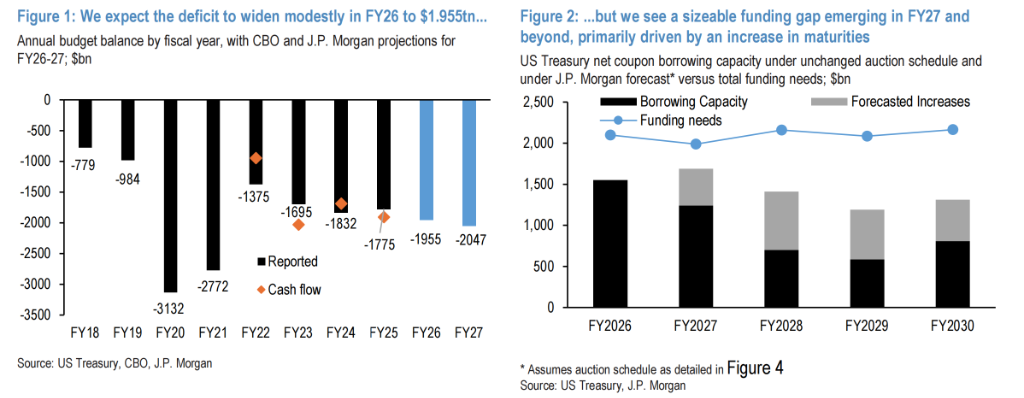
Core Insights - The U.S. federal budget deficit is projected to worsen to $1.955 trillion in FY2026, approximately 6.2% of GDP, with a total financing gap of $5.5 trillion expected from FY2026 to FY2030 due to a surge in debt maturities [1][9]. Group 1: Budget Deficit and Financing Gap - The budget deficit for FY2025 is expected to narrow slightly to $1.775 trillion, largely due to accounting adjustments related to student loans, masking the actual deterioration in financing needs [9]. - The anticipated financing gap of $5.5 trillion is primarily driven by significant debt maturities, indicating a critical need for revised debt management strategies [1][9]. Group 2: Debt Management Strategy Adjustments - Morgan Stanley predicts that the current Treasury issuance strategy will be unsustainable, necessitating a shift in debt management practices starting from November 2026 [5][10]. - The focus of new issuances will be on the front to mid-end of the yield curve, while the auction sizes for 20-year and 30-year bonds are expected to remain unchanged due to structural weakness in long-term demand [5][10]. Group 3: Role of the Federal Reserve - The Federal Reserve is expected to play a crucial role in the secondary market, with plans to purchase approximately $282 billion in Treasury securities, which will help alleviate private sector absorption pressures in the short term [11][12]. - The Fed's quantitative tightening is projected to end on December 1, 2025, which is four months earlier than previously anticipated [11]. Group 4: Inflation-Protected Securities and Repo Operations - The issuance of Treasury Inflation-Protected Securities (TIPS) has not increased, with the new issuance of 10-year TIPS in January remaining at $21 billion, breaking a two-year trend of steady increases [13]. - The Treasury's repurchase plan is expected to maintain its current scale, with quarterly liquidity support purchases up to $38 billion and annual cash management repos of up to $150 billion, potentially increasing financing needs by approximately $240 billion next year [13][15].


乌克兰总统泽连斯基:乌克兰每年需要额外250亿美元用于无人机生产。国防团队正在就价值高达300亿美元的无人机交易与美国进行磋商。乌克兰明年需要填补400亿美元的融资缺口。
news flash· 2025-07-25 07:03
Core Insights - Ukraine's President Zelensky stated that the country requires an additional $25 billion annually for drone production [1] - The defense team is negotiating a drone deal with the United States worth up to $30 billion [1] - Ukraine needs to fill a financing gap of $40 billion for the upcoming year [1]
摩洛哥2024年经济增长3.8%
Shang Wu Bu Wang Zhan· 2025-06-10 14:53
Economic Growth - Morocco's economy is projected to grow by 3.8% in 2024, slightly higher than the 3.7% growth in 2023, driven mainly by domestic demand while facing inflation and increased financing needs [1] - The GDP growth at current prices is expected to be 7.9% in 2024, down from 11% in 2023, indicating a reduction in inflationary pressures [1] Sector Performance - The primary sector is underperforming, with an overall value added decline of 4.5%, agricultural output shrinking by 4.8%, and fisheries growth slowing from 6.9% in 2023 to 2.6% in 2024 [1] - The secondary sector shows strong growth, with value added increasing by 4.2% in 2024 compared to only 0.8% in 2023, driven by mining (+13%), construction (+5%), manufacturing (+3.3%), and utilities (+2.6%) [1] - The tertiary sector remains active but experiences a slight slowdown, with growth rates decreasing from 5% in 2023 to 4.6% in 2024, although sectors like transportation and storage (+7.4%) and financial services (+7.3%) are accelerating [1] Income and Savings - National disposable income is expected to grow by 7.7% in 2024, down from 10.2% in 2023, while the national savings rate rises to 28.9% of GDP, compared to 28% in 2023 [2] - The investment rate is projected to be 30.1% of GDP in 2024, up from 29% in 2023, leading to an increase in the financing gap from 1% of GDP to 1.2% [2]