附息国债

Search documents
美联储购债规模超预期,华尔街集体修正2026年预测!
Jin Shi Shu Ju· 2025-12-12 03:49
Core Viewpoint - The Federal Reserve plans to purchase $40 billion of short-term U.S. Treasury securities monthly, exceeding market expectations, which has led to revisions in debt issuance forecasts for 2026 and a decrease in borrowing costs [1][2]. Group 1: Federal Reserve Actions - The Federal Reserve will begin purchasing short-term U.S. Treasuries this Friday to alleviate short-term interest rate pressures by rebuilding reserves in the financial system [2]. - Barclays estimates that the Fed's total purchases of short-term Treasuries could reach $525 billion by 2026, significantly higher than the previous forecast of $345 billion [2]. - The net issuance of short-term Treasuries for private investors is expected to drop from $400 billion to $220 billion due to the Fed's actions [2][5]. Group 2: Market Reactions - Major banks, including JPMorgan and Bank of America, anticipate that the Fed will absorb a larger amount of debt, with Bank of America suggesting that the Fed may need to maintain this accelerated purchasing pace for a longer duration [2][3]. - Strategists believe that these measures will help alleviate market pressures accumulated from the Fed's previous balance sheet reductions, benefiting swap spreads and the SOFR-federal funds rate basis trades [2][7]. Group 3: Strategic Insights - Analysts from various banks, including CIBC and Deutsche Bank, note that while the Fed's aggressive purchasing indicates a low tolerance for financing pressures, it may not completely eliminate market volatility [3][6]. - The Fed's actions are seen as a proactive measure to manage the transition to an "ample" reserve level, indicating a more cautious approach compared to 2019 [6]. - The anticipated monthly purchase of $40 billion is viewed as a high-end estimate, with adjustments likely based on the Fed's liability needs [15].
美国2026赤字率或逼近6.2%,近五年融资缺口将达5.5万亿美元,中短期债发行洪峰将至?
Hua Er Jie Jian Wen· 2025-11-19 08:33
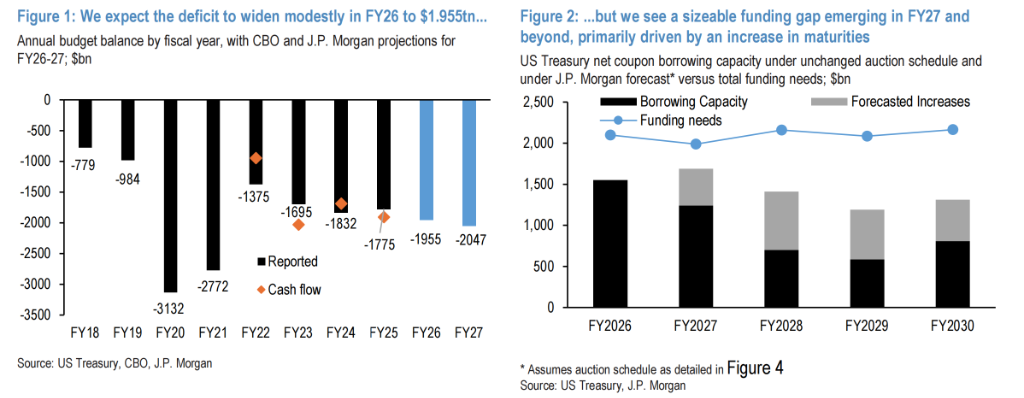
Core Insights - The U.S. federal budget deficit is projected to worsen to $1.955 trillion in FY2026, approximately 6.2% of GDP, with a total financing gap of $5.5 trillion expected from FY2026 to FY2030 due to a surge in debt maturities [1][9]. Group 1: Budget Deficit and Financing Gap - The budget deficit for FY2025 is expected to narrow slightly to $1.775 trillion, largely due to accounting adjustments related to student loans, masking the actual deterioration in financing needs [9]. - The anticipated financing gap of $5.5 trillion is primarily driven by significant debt maturities, indicating a critical need for revised debt management strategies [1][9]. Group 2: Debt Management Strategy Adjustments - Morgan Stanley predicts that the current Treasury issuance strategy will be unsustainable, necessitating a shift in debt management practices starting from November 2026 [5][10]. - The focus of new issuances will be on the front to mid-end of the yield curve, while the auction sizes for 20-year and 30-year bonds are expected to remain unchanged due to structural weakness in long-term demand [5][10]. Group 3: Role of the Federal Reserve - The Federal Reserve is expected to play a crucial role in the secondary market, with plans to purchase approximately $282 billion in Treasury securities, which will help alleviate private sector absorption pressures in the short term [11][12]. - The Fed's quantitative tightening is projected to end on December 1, 2025, which is four months earlier than previously anticipated [11]. Group 4: Inflation-Protected Securities and Repo Operations - The issuance of Treasury Inflation-Protected Securities (TIPS) has not increased, with the new issuance of 10-year TIPS in January remaining at $21 billion, breaking a two-year trend of steady increases [13]. - The Treasury's repurchase plan is expected to maintain its current scale, with quarterly liquidity support purchases up to $38 billion and annual cash management repos of up to $150 billion, potentially increasing financing needs by approximately $240 billion next year [13][15].