
行业生态重塑

Search documents
公募业绩基准新规落地,薪酬与基准达标挂钩,设置一年过渡期
Feng Huang Wang· 2026-01-23 12:19
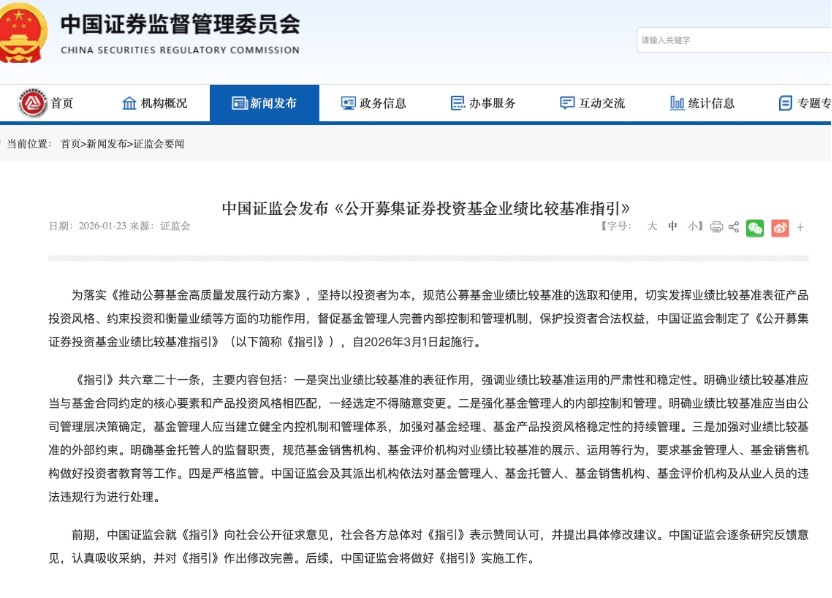
Core Viewpoint - The new regulations for the public fund industry, effective from March 1, 2026, aim to address issues such as unclear benchmarks, style drift, and misleading fund presentations, marking a significant step towards enhancing the quality and transparency of fund performance evaluation [1][2][3]. Group 1: Regulatory Framework - The new regulations include guidelines for performance benchmarks that clarify product positioning, investment strategies, and performance measurement, filling a regulatory gap in the public fund sector [2][4]. - A one-year transition period is established for existing products to comply with the new benchmark requirements, ensuring a smooth implementation [2][5]. - The regulations emphasize the importance of a well-defined benchmark as a "anchor" and "ruler" for fund performance, aiming to restore the functionality of benchmarks in the industry [5][10]. Group 2: Industry Challenges Addressed - The regulations target four main issues: inaccurate benchmark settings, non-standard usage, lax management, and declining investor satisfaction [4][5]. - Many funds have previously used broad indices as benchmarks without aligning them with actual investment strategies, leading to a disconnect between benchmarks and fund performance [4][5]. - The focus on short-term performance has led to excessive trading and volatility in fund returns, with managers often chasing market trends rather than adhering to established strategies [5][10]. Group 3: Implementation Details - The regulations require fund managers to establish comprehensive management mechanisms for benchmark selection, monitoring, and accountability, enhancing internal controls [7][8]. - Fund performance evaluations will now be linked to manager compensation, ensuring that underperformance relative to benchmarks results in reduced pay for fund managers [8][9]. - External oversight will be strengthened, with custodians responsible for verifying compliance with benchmark requirements and ensuring accurate information disclosure [9][10]. Group 4: Industry Impact and Future Outlook - The new regulations are expected to shift the industry focus from "scale competition" to "ability competition," fostering a more differentiated competitive landscape [10][11]. - Clear performance benchmarks will serve as a tool for investors to assess fund strategies and risk-return profiles, helping them make informed investment decisions [11]. - The regulatory body plans to guide the industry in optimizing existing product benchmarks during the transition period, ensuring alignment with fund contracts and actual investment styles [11].

富国基金:以投资者为本 共筑高质量发展新生态
Jin Rong Jie· 2026-01-02 02:33
Core Viewpoint - The release of the "Regulations on the Management of Sales Expenses for Publicly Raised Securities Investment Funds" marks a significant milestone in the public fund industry, aimed at promoting high-quality development and benefiting investors through reduced fees and improved service structures [1][4]. Summary by Sections Sales Fee Rate Reform - The overall reduction in sales fees across the industry is 34%, expected to save investors approximately 30 billion yuan annually [2]. - Specific fee reductions include a decrease in the sales service fee for money market funds to 0.25% per year, and a reduction in subscription fees for actively managed equity funds from 1.5% to a maximum of 0.8% [2]. Mechanism Optimization - The reform aims to shift the focus from short-term trading to long-term investment by decoupling sales agency income from short-term redemption behaviors [3]. - Non-money market funds will have a one-year holding period to waive sales service fees, encouraging long-term investment [3]. Development Orientation - The regulations encourage a focus on individual investors by limiting the client maintenance fee for personal investors to no more than 50% of management fees, enhancing service experiences [3]. - A new direct sales service platform (FISP) is established to improve efficiency and risk control for fund managers [3]. Key Transformations - The reform emphasizes a shift from a "scale" to a "return" orientation, reducing "traffic fees" and promoting a long-term, healthy investment model [4]. - It encourages a long-term investment philosophy through measures like redeeming fees being allocated to fund assets and waiving sales service fees for long-term holders [4]. - The regulations clarify various previously ambiguous areas, aiming to create a fairer and more transparent industry ecosystem [4]. Reform History - Since the initiation of the fee rate reform in July 2023, significant progress has been made, with cumulative annual savings for investors exceeding 50 billion yuan [5]. - The reform is viewed as not just a fee reduction but also a mechanism optimization and ecosystem restructuring effort [5]. Future Outlook - The industry aims to enhance research capabilities and service systems in line with the new regulations, striving to build a trustworthy investment institution that prioritizes investor satisfaction [6].
刘冰:借公募费改回归初心本源,构建财富管理价值共同体
Zhong Guo Ji Jin Bao· 2025-09-21 06:53
Core Viewpoint - The speech emphasizes the need for the wealth management industry to return to its foundational principles and focus on creating a value-driven ecosystem, particularly in light of recent public fund fee reforms [2][4]. Industry Transformation - The recent public fund fee reform is seen as a significant opportunity for the industry to reshape its ecosystem rather than merely reducing fees [2]. - Financial institutions are encouraged to shift their focus from product sales to enhancing service quality and building long-term relationships with individual clients [2][3]. - The competition in the industry is expected to evolve from price competition to value competition, necessitating a focus on internal capabilities and ecosystem development [2][3]. Client Service and Experience - There is a consensus in the industry regarding the need to transition from traditional brokerage services to comprehensive wealth management [3]. - Many wealth management institutions have struggled with patience in client service, leading to poor investment experiences and low client retention [3]. - The industry is called to cultivate a "patient service" approach, fostering deeper trust and engagement with clients [3][4]. Strategic Initiatives of the Company - The company has become a benchmark in the industry for its transition from brokerage to wealth management, supported by a comprehensive restructuring of its strategy, business, talent, and mechanisms [5][6]. - The company reported a wealth management business revenue of 10.496 billion yuan, accounting for 29.59% of total revenue, with a year-on-year growth of 15.73%, significantly outpacing overall company growth [5]. - The company has implemented a "Four Major Projects and Four Plans" strategy to enhance its financial service capabilities and brand influence [5]. Service System Development - The company has developed a service system that integrates online and offline resources, focusing on personalized service tailored to individual client needs [6]. - A tiered advisory service model has been established, leveraging technology and research to provide differentiated services to various client segments [6][7]. - The company emphasizes a comprehensive support system for clients, including extensive training for advisors and a focus on building trust through consistent engagement [7][8]. Talent Development - The company prioritizes the establishment of a robust talent development system, recognizing the importance of trust between employees and clients in wealth management [7]. - A structured training program has been implemented to enhance employee capabilities, ensuring alignment with client needs and fostering a culture of patience and service excellence [7][8].
