规模报酬递增

Search documents
倪鹏飞:城市群主导时代,长江中游如何破局崛起?
Xin Lang Cai Jing· 2025-12-29 12:01
Core Viewpoint - China's urbanization is undergoing a profound spatial restructuring, with urban agglomerations becoming the main form of urban development, leading the national spatial economic pattern into a new phase [2] Group 1: Urban Agglomeration Development - Urban agglomerations are now the dominant form of urbanization in China, with 19 planned urban agglomerations housing 70% of the population and contributing 80% of GDP [2] - The evolution of urban agglomerations in China reflects a shift from "dispersed concentration" to "concentrated concentration," and now to "concentration with dispersion" [3] - Urban agglomerations play a crucial role in promoting common prosperity by enabling resource flow and sharing between central cities and surrounding areas, thus reducing regional disparities [3] Group 2: Challenges and Strategies - The development of urban agglomerations faces unique challenges due to the strong government-led initiatives and unclear local interest distribution mechanisms, which can create administrative barriers [4] - To address these challenges, it is essential to establish a collaborative development system that clearly defines the responsibilities and rights of urban governments and creates incentive mechanisms for all parties involved [4] Group 3: Future Predictions and Strategic Proposals - In the next 15 years, China is expected to form an organic network consisting of 17 to 20 urban agglomerations, 100 urban circles, over 1,000 cities, and 10,000 to 20,000 towns [5] - The Yangtze River Economic Belt is highlighted as a key area for addressing regional economic disparities, serving as a vibrant corridor supported by urban agglomerations [5][6] - The development of "giant urbanized areas" in mature regions like the Yangtze River Delta and the Greater Bay Area will blur urban-rural boundaries and provide integrated solutions for urban challenges [6] Group 4: Specific Strategies for Wuhan and the Yangtze River Middle Reigon - Wuhan, part of the Yangtze River middle urban agglomeration, is still in the cultivation stage and requires strategies such as integrating into the Yangtze River basin's overall strategy and strengthening its urban circle [7] - Emphasis is placed on green development and sustainable practices to achieve long-term growth while addressing urbanization challenges [7] - The strategic path outlined by the research emphasizes the role of urban agglomerations in driving high-quality development and achieving common prosperity in China [7]


如何看待高成长与经典价值?柏基“传奇基金经理”2019年深度撰文 | 思考汇
高毅资产管理· 2025-12-12 07:03
Core Viewpoint - The article discusses the evolving landscape of investment strategies, particularly the tension between growth and value investing, emphasizing the need for a nuanced understanding of these concepts in the context of modern economic changes [6][8][9]. Group 1: Growth vs. Value Investing - James Anderson acknowledges a widening divide between growth and value investing, suggesting that traditional value metrics may not suffice in a changing economic landscape dominated by tech giants like Microsoft and Google [8]. - The article highlights that while growth and value investing appear divergent, they share fundamental principles, such as the importance of honest long-term cash flow estimation and risk awareness [9]. - Anderson emphasizes the need for a longer time perspective and serious company research, valuing patience and governance sensitivity inherent in value investing [9][10]. Group 2: Historical Context and Literature - The article notes a lack of literature supporting growth investing compared to the extensive documentation of value investing, which has a rich tradition and numerous classic texts [11][13]. - It references Benjamin Graham's views on growth stocks, indicating that while he recognized their potential, he also warned of their speculative nature and preferred investing in larger, less popular companies [13][14]. - The article argues that the realities of the past decade have diverged from Graham's observations, with growth stocks outperforming traditional value stocks [15]. Group 3: Future Investment Landscape - The article posits that future returns are highly uncertain, urging a reevaluation of investment beliefs and strategies in light of complex market dynamics [18][30]. - It suggests that understanding structural changes in the global economy is crucial for predicting long-term investment outcomes, rather than focusing solely on short-term financial metrics [33][34]. - The piece warns against relying on historical volatility to forecast future performance, advocating for a mindset open to exploring various possibilities [38][39]. Group 4: Case Studies - The article compares Coca-Cola and Facebook, illustrating how traditional value metrics may misrepresent the potential of high-growth companies [64][69]. - It highlights that Coca-Cola's growth has stagnated, while Facebook has shown significant growth potential, challenging the notion of which company represents true value [66][70]. - The automotive industry is used as a case study, showcasing how different companies within the sector exhibit varying growth and value characteristics, with General Motors and Ferrari serving as contrasting examples [82][88].




如何看待高成长与经典价值?柏基“传奇基金经理”詹姆斯·安德森2019年深度撰文︱重阳荐文
重阳投资· 2025-12-08 07:33
Core Viewpoint - The article discusses the evolving perspectives on growth and value investing, highlighting the need to reassess traditional investment principles in light of modern economic realities and the success of high-growth companies [5][6][7]. Group 1: Growth vs. Value - There is an acknowledged and widening divergence between growth and value investing, with traditional value principles struggling to account for the sustained high growth of companies like Microsoft, Google, and Amazon [7][8]. - The underlying economic structure has shifted, suggesting that reliance on historical value metrics may no longer be sufficient for investment success [7][8]. - Despite the differences, there are fundamental commonalities between growth and value investing, particularly in the importance of honest long-term cash flow estimation and risk management [8][9]. Group 2: Historical Context and Evolution - Historically, there has been a lack of literature supporting growth investing compared to the extensive documentation of value investing, which has created a bias in the investment community [13][14]. - The belief that "value will ultimately prevail" remains entrenched, despite evidence that growth strategies have outperformed passive indices over the long term [14][15]. - The past decade has seen a significant deviation from Graham's observations, with high-growth stocks yielding substantial returns, contrary to his predictions [18][19]. Group 3: Case Studies - Microsoft serves as a prime example of a company that has achieved remarkable long-term growth, with revenue increasing from $60 billion in 2008 to $110 billion in 2018, showcasing a compound annual growth rate of 24% [20]. - Google also exemplifies this trend, with its revenue growing from $21.8 billion in 2008 to $136.8 billion in 2018, reflecting the potential of high-growth companies to deliver exceptional returns [21]. - The article contrasts Coca-Cola's stagnation in stock value over the past 20 years with Facebook's growth trajectory, suggesting that the latter may align more closely with modern investment principles [70][75]. Group 4: Future Investment Landscape - The future of investing will likely be shaped by structural changes in the global economy, necessitating a shift in focus from short-term financial metrics to long-term transformative trends [40][41]. - The concept of "creative destruction" is becoming increasingly relevant, indicating that traditional investment strategies may need to adapt to a rapidly changing economic environment [41][42]. - Companies that can leverage network effects and platform positions may exhibit "super-linear growth," challenging traditional value investment assumptions [61][62].




如何看待高成长与经典价值?柏基“传奇基金经理”詹姆斯·安德森2019年深度撰文
聪明投资者· 2025-12-02 07:04
Core Viewpoint - The article discusses the evolving perspectives on growth and value investing, highlighting the need to reassess traditional investment principles in light of modern economic realities and the success of high-growth companies [5][6][25]. Group 1: Growth vs. Value Investing - James Anderson acknowledges a widening divide between growth and value investing, suggesting that traditional value metrics may not suffice in a changing economic landscape dominated by tech giants like Microsoft, Google, and Amazon [7][20]. - Despite the differences, Anderson emphasizes that both growth and value investing share common principles, such as the importance of honest long-term cash flow estimation and risk management [8][25]. - The article references the historical context of growth investing, noting a lack of comprehensive literature supporting long-term growth strategies compared to the extensive documentation of value investing [12][14]. Group 2: Case Studies of Companies - Microsoft serves as a prime example of a company that has achieved significant long-term growth, with revenue increasing from $60 billion in 2008 to $110 billion in 2018, showcasing a compound annual growth rate of 24% [22]. - Google, now Alphabet, also illustrates the potential for sustained growth, with revenue rising from $21.8 billion in 2008 to $136.8 billion in 2018 [23]. - The article contrasts Coca-Cola's stagnation in stock value over the past 20 years with Facebook's growth trajectory, suggesting that Facebook may align more closely with value investing principles despite its high valuation metrics [82][88]. Group 3: Economic Structural Changes - The article posits that the current economic environment is undergoing profound changes, necessitating a reevaluation of investment strategies that account for systemic transformations rather than relying solely on historical performance [44][46]. - It highlights the shift from asset-heavy to knowledge-based economies, where companies like Facebook and Google thrive due to network effects and scale advantages [71][73]. - The discussion includes the implications of these changes for future investment returns, suggesting that traditional metrics may not adequately capture the potential of companies operating in rapidly evolving sectors [41][60]. Group 4: Industry Examples - The automotive industry is examined, with General Motors and BMW representing traditional value stocks facing challenges, while Ferrari exemplifies a company achieving high margins and cash flow despite low sales volume [100][104][107]. - The article notes that the automotive sector is experiencing significant disruption, particularly with the rise of electric vehicles and changing consumer preferences, which complicates traditional valuation methods [96][98]. - The contrasting performance of companies within the automotive sector illustrates the broader theme of how different business models and market positions can lead to varying investment outcomes [100][106].

短视频流量经济学:内容与旅游经济的转化密码
Xin Jing Bao· 2025-04-23 02:34
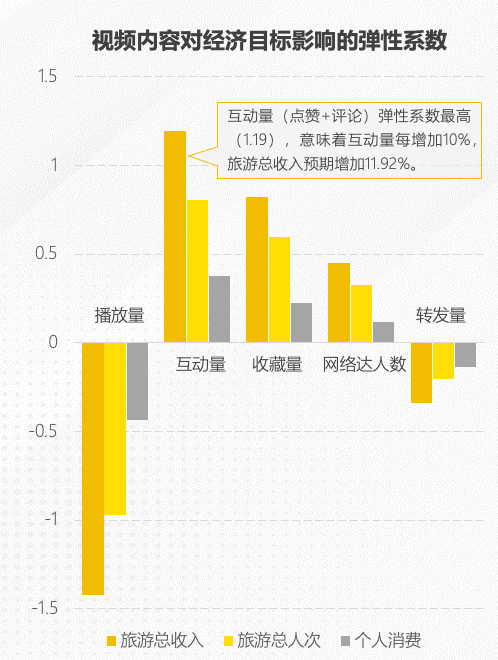
Core Insights - The article discusses the challenge of converting video content into tourism revenue in the era of short videos and influencer cities, questioning the correlation between viral videos and GDP growth [1] - The "New Beijing News Influencer City Potential Report (2025)" analyzes the impact of food and tourism-related video content on tourism economic goals, revealing the transformation mechanism between video content and tourism economy [1][2] Economic Model Analysis - A logarithmic elasticity model was constructed to analyze the impact of various video content indicators and influencers on tourism economy, indicating that interaction and collection metrics are the main positive factors, while views and shares have a negative impact [2][3] - The elasticity coefficient for total tourism revenue is 4.22, indicating significant increasing returns to scale from influencer economy, with interaction metrics showing a high elasticity of 1.19 [3][5] Differentiated Impact on Economic Indicators - The study identifies three significant characteristics in the impact of short video content on different tourism economic indicators, highlighting that while total tourism revenue shows increasing returns to scale, personal consumption is less influenced by video content [5][6] - Interaction quality plays a crucial role, with deep engagement (likes and comments) positively affecting economic conversion, while simple sharing may lead to negative outcomes [5][6] City Classification and Strategy - Cities were categorized based on GDP, revealing that influencer metrics have varying impacts across different city types, with high GDP cities benefiting more from food videos compared to lower GDP cities [7][9] - Economic development cities require a focus on tourism videos and local characteristics to enhance engagement, as reliance solely on food videos may not yield effective conversion [9][12] Recommendations for Marketing Strategies - Different city types should adopt tailored video marketing strategies: high GDP cities should leverage food content, economic large cities should balance various content types, and developing cities should focus on tourism videos [12][13] - The report emphasizes the need for cities to shift from quantity to quality in video content, focusing on user engagement and emotional resonance to convert viewers into tourists [14] Future Trends - The article predicts three major trends in the transformation of video content into tourism economy: a shift from quantity to quality, a move towards personalized marketing strategies, and a focus on value creation rather than mere traffic [14]