
财政余粮

Search documents
东吴证券:2026年财政可能有两个超预期
Sou Hu Cai Jing· 2026-01-05 04:11
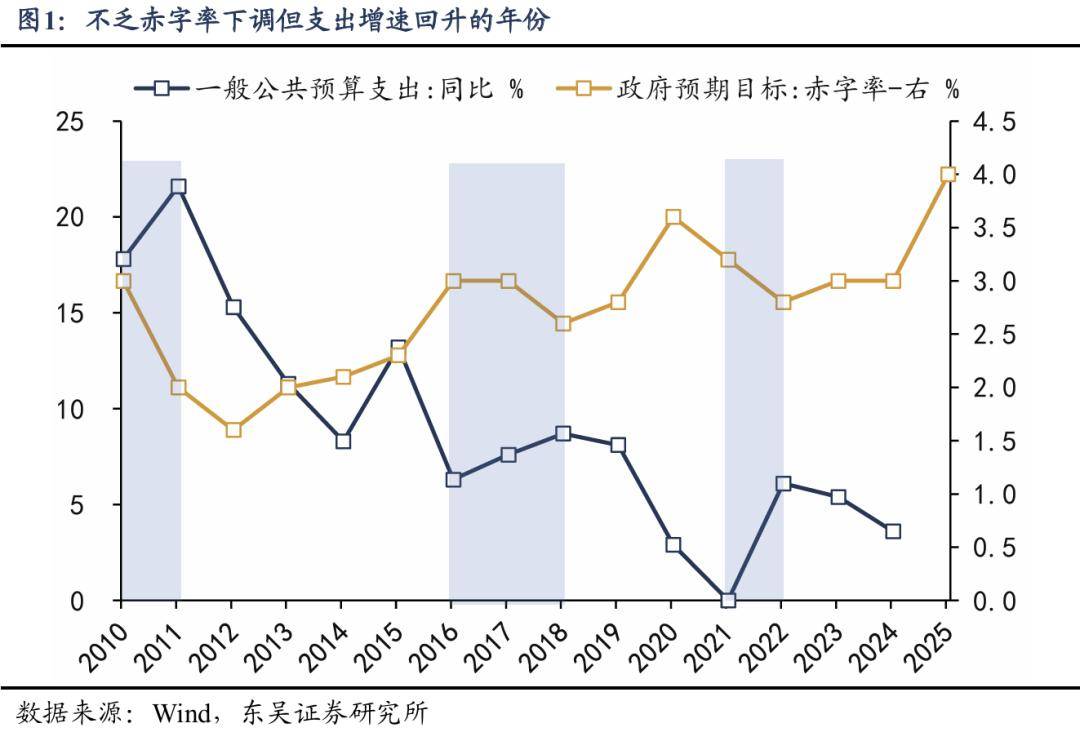
Core Viewpoint - Despite the market's general expectation that the marginal increase in fiscal funds may slow down in 2026, fiscal spending could still exceed expectations due to two main factors: a rebound in prices leading to increased fiscal revenue and a significant amount of unspent fiscal funds from 2025 that can be carried over to the next year [1][2][3] Group 1: Fiscal Spending Dynamics - The fiscal deficit rate may not increase, yet the growth rate of fiscal spending can still rise. Historical data shows instances where the deficit rate did not increase, but spending growth rebounded significantly [1][5][6] - The potential for "no increase in deficit and accelerated spending" may arise from two unexpected sources: a rebound in price growth leading to increased fiscal revenue and unspent funds from 2025 forming a substantial carryover [2][11] Group 2: Revenue from Price Rebound - A rebound in price growth could lead to an increase in tax revenue by approximately 260 billion yuan. The indirect tax system in China is highly sensitive to price fluctuations, with major tax channels such as VAT, additional taxes, corporate income tax, and resource tax accounting for nearly 67% of total tax revenue [2][23] - Historical experience indicates that a 1 percentage point increase in PPI typically results in a 0.5-0.8 percentage point increase in tax revenue growth, suggesting that a projected 1.8 percentage point rebound in PPI could yield around 260 billion yuan in additional tax revenue [2][23] Group 3: Fiscal Surplus from Unspent Funds - The fiscal surplus for 2025 is expected to exceed 500 billion yuan, with a cumulative increase in fiscal deposits reaching 2.04 trillion yuan in the first eleven months, marking a historical high [3][25][27] - The slow progress of fiscal spending in 2025, particularly in infrastructure-related areas, has contributed to this surplus. The focus on debt replacement and settling government debts has limited direct investment in traditional infrastructure projects [3][27]


2026年财政可能有两个超预期
Soochow Securities· 2025-12-30 12:57
Group 1: Fiscal Outlook for 2026 - Despite expectations of a slowdown in marginal fiscal funding for 2026, fiscal spending may exceed expectations due to rising prices and unspent fiscal resources from 2025[3] - A 1.8 percentage point increase in PPI could generate approximately 260 billion CNY in additional tax revenue, equivalent to a 0.2 percentage point increase in the deficit ratio[3] - Unspent fiscal resources from 2025 are expected to exceed 500 billion CNY, contributing to a potential increase in public budget spending growth by about 2.6 percentage points[3] Group 2: Historical Context and Mechanisms - Historical data shows instances where the deficit ratio decreased while spending growth increased, notably in 2021-2022 and 2016-2018[8] - The increase in fiscal spending can be attributed to revenue growth, deficit increases, and the utilization of unspent funds from previous years[11] - In 2025, fiscal deposits increased by 2.04 trillion CNY, the highest level for the same period historically, indicating a significant fiscal surplus[33] Group 3: Risks and Considerations - Changes in the real estate and land markets could significantly impact fiscal revenues and expenditures[38] - The estimated impact of rising prices on fiscal revenue is based on certain assumptions, which carry inherent risks[38] - Unexpected spending in December could reduce the anticipated fiscal surplus, affecting the overall fiscal outlook[38]
——11月财政数据点评:年末财政有多少余粮?
Changjiang Securities· 2025-12-19 04:41
Revenue and Expenditure Trends - From January to November 2025, general public budget revenue reached 20.1 trillion yuan, a year-on-year increase of 0.8%[6] - General public budget expenditure for the same period was 24.9 trillion yuan, with a year-on-year growth of 1.4%[6] - Cumulative general fiscal revenue and expenditure for the first eleven months fell to -0.2% and 4.5%, respectively[3] Tax and Non-Tax Revenue - Tax revenue in November showed a year-on-year increase of 3.2%, marking the eighth consecutive month of positive growth, while non-tax revenue dropped significantly by 10.8% due to a high base effect[3][10] - Major tax categories such as VAT and personal income tax increased by 3.3% and 11.4%, respectively, contributing positively to overall tax revenue[3] Expenditure Analysis - November's fiscal expenditure saw a reduced year-on-year decline of 2.0%, with significant increases in technology and health spending, which grew by 20-30%[3][10] - Infrastructure-related expenditures continued to decline, with specific categories like urban community and agricultural water management showing decreases of 16.6% and 28.0%, respectively[3][10] Land Sales and Fund Expenditure - Revenue from land sales in November fell sharply by 26.5%, continuing a negative trend for four consecutive months[3][10] - Fund expenditure in November turned positive with a growth of 2.8%, attributed to accelerated fiscal spending towards year-end[3] Fiscal Surplus and Future Outlook - The year-end fiscal situation may leave a surplus, potentially supporting growth in the first half of 2026[3][10] - Cumulative new fiscal deposits reached approximately 2 trillion yuan, the highest since 2013, indicating a strong fiscal position[3][10]