财政整顿计划

Search documents
印度经济将面临显著短期风险
Jing Ji Ri Bao· 2025-12-15 08:42
Core Viewpoint - The International Monetary Fund (IMF) report indicates that the Indian economy is performing well, supported by improving domestic conditions, with a projected growth rate of 6.5% for FY2024-2025 and 7.8% year-on-year GDP growth for Q1 FY2025-2026, despite facing significant short-term risks [1][2]. Economic Growth Projections - For FY2025-2026, India's actual GDP is expected to grow by 6.6%, with inflation projected to decrease to 2.8% [2] - By FY2026-2027, GDP growth is anticipated to slow to 6.2%, with inflation rebounding to 4% [2] Trade and External Debt - Commodity trade exports are projected to reach $416.3 billion, a year-on-year decline of 5.8%, while imports are expected to rise to $746.6 billion, a growth of 2.4% [2] - External debt is forecasted to increase to $791 billion, accounting for 19.2% of GDP [2] Structural Reforms - The implementation of the Goods and Services Tax (GST) on September 22, 2025, is expected to simplify the tax structure, stimulate domestic consumption, and mitigate the adverse effects of high tariffs [2][3] - Continuous structural reforms and fiscal consolidation are deemed crucial for achieving fiscal deficit targets and enhancing economic resilience [3] Risks and Challenges - The report highlights significant short-term risks, including potential tightening of financial conditions due to geopolitical fragmentation and unpredictable climate change impacts on agriculture, which could elevate inflation pressures [3] - The need for ongoing financial structural reforms and careful monitoring of non-bank financial institutions is emphasized to mitigate associated risks [3] Recommendations for Sustainable Growth - The Indian government is advised to enhance human capital accumulation, increase female labor participation, and optimize the business environment to attract foreign direct investment [4] - There is a call for increased R&D investment and innovation to support green economic transformation and ensure sustainable growth [4]
一波三折!高市早苗接近成为“日本第一位女首相”,但“早苗交易”前途未卜
Hua Er Jie Jian Wen· 2025-10-19 03:13
Core Points - Japan is on the verge of a historic moment with the formation of a coalition government between the Liberal Democratic Party (LDP) and the Japan Innovation Party, paving the way for the country's first female Prime Minister, Sanae Takaichi [1] - The coalition agreement is expected to be signed soon, with Takaichi likely to receive support from the Innovation Party in the upcoming parliamentary vote, although the party will not send ministers to her cabinet [1][2] - The economic policy outlook for the new government is uncertain, as the coalition may face challenges in passing legislation due to a fragmented political landscape [2][3] Economic Policy Challenges - The weakening of political consensus and the LDP's minority government status may hinder legislative efforts to address Japan's long-standing labor shortages, rapid aging population, and severe supply constraints [2] - Economic strategies that are expansionary in nature may have a higher chance of gaining support from opposition parties, but measures to address supply constraints may struggle to progress under the current political situation [3] Political Stability and Economic Recovery - Political instability increases uncertainty for businesses regarding the impact of U.S. tariffs, potentially hampering Japan's already fragile economic recovery [4] - Takaichi's weak position within the party and the influence of senior lawmakers advocating for conservative policies may limit her ability to implement aggressive economic measures [5] Debt Market Pressures - The bond market may become a significant constraint on large-scale spending, as rising government bond yields reflect market expectations for increased bond issuance to fund spending plans [7] - The International Monetary Fund (IMF) has advised Japan to avoid cutting consumption tax rates or implementing broad subsidy measures, suggesting that any support should be targeted and temporary [8]
【财经分析】法国失守“AA”评级 国债“安全资产”光环褪色
Xin Hua Cai Jing· 2025-09-15 06:29
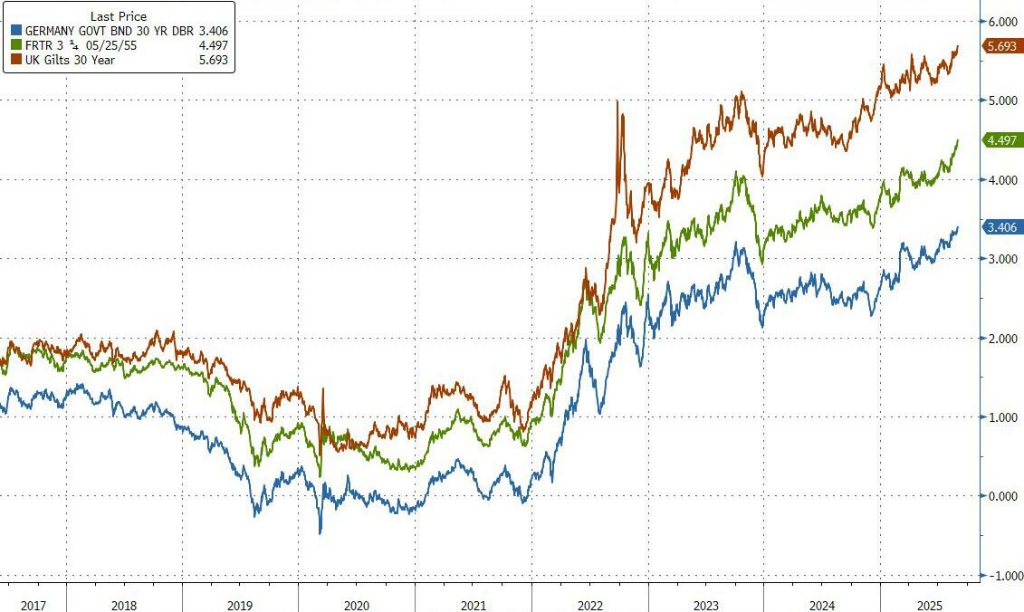
Group 1 - The French government led by Prime Minister Borne fell due to failure to pass a confidence vote, highlighting increasing political division in the country [1][2] - Fitch Ratings downgraded France's long-term foreign currency issuer default rating from "AA-" to "A+", indicating deteriorating debt repayment prospects [2][3] - The political instability in France is seen as weakening the government's ability to implement significant fiscal reforms, with the debt-to-GDP ratio expected to rise from 113.2% in 2024 to 121% by 2027 [3][4] Group 2 - The demand for French sovereign bonds may weaken further as the downgrade typically raises risk premiums, although some analysts believe the market has already priced in this impact [5][6] - The yield on 10-year French bonds has increased from 2.85% to 3.5% over the past year, reflecting investor awareness of France's fiscal challenges [6][7] - A rare inversion has occurred where yields on corporate bonds from major French companies are lower than those of sovereign bonds, indicating a shift in investor perception of risk [8]
贝鲁政府“岌岌可危”,谁能收拾法国债务的烂摊子?
Hua Er Jie Jian Wen· 2025-09-05 08:02
Core Viewpoint - France is facing a political crisis with Prime Minister Borne's government on the brink of collapse, which may lead to a larger economic or debt crisis if a strong fiscal consolidation plan is not implemented [1][6] Political Situation - A confidence vote in parliament is scheduled for September 8, with Borne's government likely to lose due to unpopular austerity measures [1] - Major political parties in France have vowed to overthrow the government unless unexpected abstentions occur [1] - President Macron aims to avoid early elections by seeking a consensus among parties to appoint a new Prime Minister [1] Debt Concerns - Analysts warn that without a robust fiscal plan, France's public debt-to-GDP ratio could rise by 10 percentage points to 125% by 2030 [4] - The current political deadlock is pushing the economy towards a dangerous edge, with market concerns already evident as long-term government bonds face selling pressure [2][5] Economic Outlook - The French economy is described as lacking growth momentum, with domestic demand suppressed by high political uncertainty [5] - Any tightening of financing conditions could jeopardize the anticipated economic recovery expected in 2026 [5] - The immediate economic consequences are currently manageable, but long-term investor concerns about France's fiscal situation are growing [6]