财政紧缩计划

Search documents
IMF预测:英国通胀年底将回落至2% 薪资增长放缓成关键因素
Zhi Tong Cai Jing· 2026-01-19 11:33
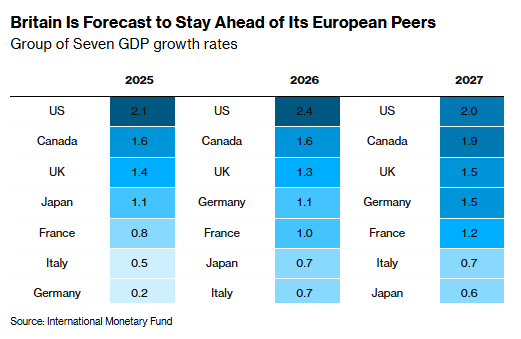
Group 1 - The IMF predicts that the UK's inflation rate will fall to the 2% target level by the end of this year, influenced by a weak labor market leading to slower wage growth [1][2] - The UK's economic growth rate has surpassed that of France, Germany, and Italy last year, and it is expected to remain the fastest-growing economy among G7 countries in the next two years, although the gap with the US and Canada will continue to widen [1] - The IMF has raised the UK's economic growth forecast for 2025 from 1.3% to 1.4%, while maintaining the 2026 growth forecast [1] Group 2 - The IMF expects the Bank of England to lower the benchmark interest rate from the current 3.75%, while urging a cautious stance until inflation stabilizes at the target level [2] - The UK Chancellor, Rachel Reeves, stated that the IMF's forecast indicates a turning point for the UK economy this year, highlighting that this is the third upward revision of the UK's growth forecast by the IMF in less than a year [2] - Reeves mentioned that measures taken to stabilize the economy and stimulate investment are helping to alleviate household cost pressures [2] Group 3 - The IMF has issued a warning to high-debt countries, including the UK, to enhance public financial management to avoid the risk of "long-term interest rate pressure," which could increase borrowing costs for households and governments [3] - The IMF emphasizes the importance of rebuilding fiscal buffers and maintaining public debt sustainability, especially in the context of high rigid expenditure demands [4] - Concerns have been raised regarding the fiscal rules implemented by Reeves, which are considered among the most lenient in UK history, potentially prolonging the time needed to restore fiscal balance after economic shocks [4]

法国再度发生多行业罢工 抗议政府财政紧缩计划
Zhong Guo Xin Wen Wang· 2025-10-03 00:54
Group 1 - The core viewpoint of the articles highlights the ongoing nationwide strikes in France, protesting against government austerity measures and demanding higher taxes on the wealthy [1][2] - The scale of the strikes has decreased compared to the previous month, with tens of thousands participating in demonstrations across the country [1] - Key sectors affected by the strikes include transportation, education, and healthcare, with notable closures such as the Eiffel Tower and some schools [1] Group 2 - The French Ministry of the Interior reported that nearly 200,000 people participated in the demonstrations nationwide, including 24,000 in Paris, while the French General Confederation of Labor claimed 600,000 participants [1] - The government has deployed 76,000 police and gendarmes to maintain order during the protests [1] - Prime Minister Le Cornu has expressed willingness to continue dialogue with union organizations regarding social welfare issues and is expected to finalize the new cabinet by the weekend [2]
法国发生多行业罢工 旨在反对政府财政紧缩计划
Zhong Guo Xin Wen Wang· 2025-09-19 01:47
Core Points - A nationwide strike occurred in France on September 18, with tens of thousands participating to protest against the government's austerity measures [1] - The strike significantly impacted various sectors, including transportation, education, healthcare, and energy, leading to service disruptions in Paris and other regions [1] - The French government reported approximately 500,000 participants in the protests, while unions claimed the number was around 1 million [1] - The main demands of the unions include the withdrawal of the 2026 budget plan proposed by the Borne government, increased public service spending, and higher taxes on the wealthy [1] - Recent polls indicate that over half of the French population supports the strike and related protests, with only 25% opposing them [1] - French Prime Minister Élisabeth Borne responded to the protests, emphasizing ongoing dialogue with social groups and condemning violence against police [1] Industry Impact - The strike led to significant disruptions in public transportation services, including metro, suburban trains, and buses, as well as the closure of tourist attractions like the Eiffel Tower [1] - The energy sector also experienced a decrease in electricity generation due to the strike [1] - The upcoming meeting of union representatives on September 19 may determine future actions, including the possibility of additional strikes, indicating ongoing labor unrest [2]
80万人上街 法国举行全国性罢工
Bei Jing Shang Bao· 2025-09-18 16:34
Group 1 - The core issue driving the protests is public dissatisfaction with the French government's proposed budget cuts aimed at reducing fiscal spending, which has led to widespread strikes and demonstrations across the country [1][3][4] - Major unions in France are organizing a nationwide strike on the 18th, expecting around 800,000 participants and over 250 gatherings, significantly impacting sectors such as transportation, education, and healthcare [1][2] - The protests are a response to a controversial budget proposal introduced by former Prime Minister Borne, which includes measures like reducing public holidays and freezing pension increases, reflecting the strain on France's public finances due to declining productivity and an aging population [3][4] Group 2 - The French police are preparing for the protests by deploying approximately 80,000 officers and military personnel, with additional resources like armored vehicles and drones on standby, indicating a high level of security not seen since the "Yellow Vest" movement [2] - The education sector is notably affected, with about one-third of primary school teachers and a significant number of high schools expected to participate in the strike, alongside a near-total shutdown of pharmacies [2][3] - The protests are seen as a reflection of broader political challenges in France and Europe, with the recent political turmoil following the failed confidence vote against the government highlighting the fragility of public support for fiscal austerity measures [4]
海外高频 | 特朗普解雇理事库克,金银价格共振大涨(申万宏观·赵伟团队)
申万宏源宏观· 2025-08-31 16:05
Group 1 - The article discusses the rapid appreciation of the Renminbi and the simultaneous surge in gold and silver prices, with COMEX gold rising by 3.0% to $3475.5 per ounce and COMEX silver increasing by 6.7% to $40.3 per ounce [2][39]. - The S&P 500 index fell by 0.1%, while the French CAC40 dropped by 3.3%, indicating a bearish trend in developed markets [2][3]. - Emerging market indices showed mixed results, with Brazil's IBOVESPA rising by 2.5% and India's SENSEX30 declining by 1.8% [3][11]. Group 2 - The article highlights the impact of political events in France, where a proposed €440 billion austerity plan led to a significant drop in the CAC 40 index and a spike in government bond yields, raising concerns about the stability of the French government [47]. - The U.S. Treasury auction results showed strong demand for short-term and floating rate bonds, with the 6-month bond receiving a bid-to-cover ratio of 3.36, indicating robust investor interest [51][52]. Group 3 - The article notes that the U.S. fiscal deficit for the year 2025 has reached $1.14 trillion, with total expenditures of $5.31 trillion and tax revenues of $3.29 trillion, reflecting a significant increase in government spending compared to the previous year [54][56]. - The article mentions that the Federal Reserve is facing pressure to lower interest rates, with expectations of a 25 basis point cut in September and further reductions in the following months [77][81]. Group 4 - The article reports that the U.S. PCE price index for July matched market expectations at 2.6%, while the core PCE index was at 2.9%, indicating stable inflationary pressures [81]. - Initial jobless claims in the U.S. were reported at 229,000, lower than the market expectation of 230,000, suggesting a resilient labor market [84].