
资本市场结构优化

Search documents
A股长期援军来了!险资入市再松绑,监管引导资金流向三类资产
Hua Xia Shi Bao· 2025-12-08 08:16
Core Viewpoint - The recent adjustment of risk factors for insurance companies by the Financial Regulatory Bureau aims to encourage long-term investment and stabilize the capital market structure, particularly benefiting the A-share market and promoting value investment [2][3]. Group 1: Policy Adjustments - The new notification introduces a differentiated reduction in risk factors for insurance companies holding specific stocks long-term, with a focus on encouraging stable investment behaviors [3]. - The risk factor for stocks held over three years in the CSI 300 index is reduced from 0.3 to 0.27, while for stocks held over two years in the STAR Market, it is reduced from 0.4 to 0.36 [3][4]. - This adjustment reflects a shift in regulatory philosophy from "scale-oriented" to "behavior-oriented," aiming to cultivate institutional investors that are committed to the capital market and the growth of quality enterprises [5]. Group 2: Market Impact - The estimated release of minimum capital due to the new policy could be around 326 billion yuan, with potential market inflow of approximately 1,086 billion yuan if all funds are allocated to the CSI 300 stocks [5]. - The policy is expected to guide funds towards three asset categories: large-cap blue chips in the CSI 300, high-dividend low-volatility stocks in the CSI 100, and innovative growth stocks in the STAR Market [5][6]. - Following the announcement, insurance indices saw significant increases, with leading companies like China Pacific Insurance and Ping An Insurance rising over 5% in a single day, indicating positive investor sentiment towards the policy [6]. Group 3: Long-term Investment Strategy - The new regulations provide insurance companies with more flexibility to adjust their asset structures, particularly in a low-interest-rate environment where fixed-income returns are under pressure [7]. - Experts emphasize that insurance companies should focus on strategic asset allocation based on liability duration and cash flow characteristics, prioritizing investments in companies with stable dividends and strong governance [7]. - Different-sized insurance companies may adopt varied strategies, with larger firms likely to optimize their long-term asset portfolios more effectively than smaller firms, which may rely on indirect investments through funds or ETFs [8]. Group 4: Broader Regulatory Context - The adjustments to risk factors for equity investments are part of a broader regulatory strategy that also includes lowering risk factors for export credit insurance, reflecting a comprehensive approach to support both the capital market and the real economy [8][9]. - The series of policy adjustments since 2023, including previous reductions in risk factors for the CSI 300 and STAR Market stocks, indicate a sustained effort to encourage insurance capital to enter the market [9]. - The role of insurance capital as a long-term funding source is expected to become increasingly prominent, contributing to the development of direct financing and enhancing the interaction between finance and the real economy [9].


金融行业周报(2025、10、12):分红型重疾险有望回归,建议提前布局优质银行标的-20251012
Western Securities· 2025-10-12 12:04
Investment Rating - The report suggests a positive outlook for the insurance sector, indicating it as a growth area within the financial industry, particularly with the anticipated return of dividend-type critical illness insurance [2][21]. Core Insights - The non-bank financial index increased by 0.50%, outperforming the CSI 300 index by 1.01 percentage points, with the insurance sector showing a notable increase of 0.73% [1][11]. - The report highlights the reintroduction of dividend-type long-term health insurance, which is expected to stimulate growth in the insurance sector [16][21]. - The brokerage sector is experiencing a positive trend, with a significant increase in new A-share accounts, suggesting a growing market and potential for brokerage firms [3][22]. - The banking sector is advised for long-term investment, with a focus on high-growth banks with stable performance and low non-performing loans [3][25]. Summary by Sections Insurance Sector - The insurance sector's index rose by 0.73%, outperforming the CSI 300 index by 1.25 percentage points, indicating strong performance [15][21]. - The introduction of policies supporting dividend-type health insurance is expected to revitalize the market, with over 40% of new life insurance products being dividend-based [17][21]. - Insurance companies are streamlining operations, with a significant number of branch closures, reflecting a shift towards digital transformation and cost efficiency [19][21]. Brokerage Sector - The brokerage index increased by 0.49%, outperforming the CSI 300 index by 1 percentage point, indicating a positive market sentiment [3][22]. - New A-share accounts reached 2.9372 million in September 2025, a 60.73% year-on-year increase, suggesting a robust influx of retail investors [3][22]. - The report anticipates a net profit of 67.2 billion yuan for the brokerage sector in Q3 2025, representing an 87% year-on-year increase [23][22]. Banking Sector - The banking index rose by 0.28%, outperforming the CSI 300 index by 0.80 percentage points, indicating a stable performance [3][25]. - The report emphasizes a long-term bullish outlook for banks, suggesting that quality banks with diversified operations and stable earnings should be prioritized for investment [3][28]. - Specific banks recommended for investment include Hangzhou Bank and several others with strong fundamentals and growth potential [4][28].
游戏板块ETF领涨;国内ETF规模达5.24万亿丨ETF晚报
2 1 Shi Ji Jing Ji Bao Dao· 2025-09-15 10:24
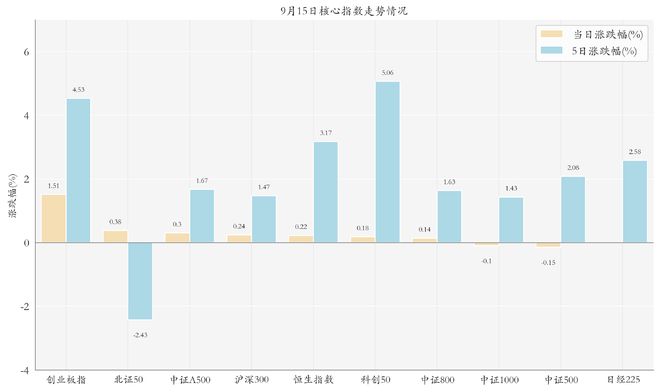
Group 1: ETF Market Overview - The total scale of ETFs in China has reached 5.24 trillion yuan, setting a new historical record, with a total of 1,293 funds and 2.76 trillion shares as of September 14, 2025 [2] - The growth in ETF numbers over the past year is 29.69%, with total shares increasing by 23.77% and total net asset value rising by 49.71% compared to September 2024 [2] - The increase in ETF scale is attributed to multiple factors including policy support, improved market sentiment, product innovation, and rising investment demand, reflecting an upgrade in the market's demand for asset allocation tools [2] Group 2: Daily Market Performance - On September 15, 2025, the three major indices showed mixed results, with the Shanghai Composite Index down by 0.26%, the Shenzhen Component Index up by 0.63%, and the ChiNext Index up by 1.51% [3] - The ChiNext Index, Northbound 50, and CSI A500 ranked highest in daily performance, with daily increases of 1.51%, 0.38%, and 0.3% respectively [3] - Over the past five trading days, the Sci-Tech 50, ChiNext Index, and Hang Seng Index have shown strong performance, with increases of 5.06%, 4.53%, and 3.17% respectively [3] Group 3: Sector Performance - In today's sector performance, the top-performing sectors included power equipment, media, and agriculture, with daily increases of 2.22%, 1.94%, and 1.79% respectively [6] - Conversely, the sectors of comprehensive, communication, and defense industry showed weaker performance, with daily declines of -1.8%, -1.52%, and -1.05% respectively [6] - Over the past five trading days, the electronics, real estate, and communication sectors performed well, with increases of 6.11%, 5.53%, and 5.08% respectively [6] Group 4: ETF Performance - The gaming sector ETFs led the market today, with notable increases in the gaming ETF (159869.SZ) by 4.38%, gaming ETF Huatai-PB (516770.SH) by 4.02%, and gaming ETF (516010.SH) by 3.88% [10] - The average performance of stock-themed index ETFs was the best among various categories, with an average increase of 0.28%, while stock strategy index ETFs had the worst performance with an average decline of -0.28% [8] - The top three ETFs by trading volume today were Sci-Tech 50 ETF (588000.SH) with 5.258 billion yuan, ChiNext ETF (159915.SZ) with 5.228 billion yuan, and A500 ETF (512050.SH) with 4.881 billion yuan [12]
【环球财经】巴西ETF市场回暖 固定收益产品成主要推动力
Xin Hua Cai Jing· 2025-09-07 02:09
Core Insights - The Brazilian ETF market has shown significant recovery since 2025, with a projected net inflow of approximately 6.25 billion reais in 2023, reversing two years of consecutive outflows [1] - Fixed income ETFs have been the main driver of this recovery, contributing about 71% of the net inflow, with notable funds like LFTB11 and LLFT11 attracting nearly 700 million reais each [1] - The total number of local fixed income ETF holders increased by 31% in the first half of the year, reaching 61,000, indicating a growing interest despite representing less than 10% of the overall ETF investor base [1] Market Dynamics - The global interest rate environment stabilizing and Brazilian bond yields being favored by investors are key factors in the growing popularity of ETFs in Brazil [2] - The advantages of ETFs, such as risk diversification, low costs, strong liquidity, high transparency, and exemption from financial transaction tax (IOF), are increasingly recognized [2] - The transition of investment advisory services from commission-based to fee-based models is expected to enhance the role of ETFs in wealth management, making them a significant option for both institutional and individual investors [2] Future Outlook - The rapid expansion of fixed income ETFs reflects investors' demand for hedging against macroeconomic uncertainties and indicates a trend towards optimizing capital market structures [2] - With expectations of declining interest rates and ongoing regulatory improvements, the Brazilian ETF market is anticipated to experience new growth opportunities through diversification [2]