超长期低息金融购车方案

Search documents
鸿蒙智行、小米登顶,零跑失榜一,2026新能源开局“冷热交织”
Feng Huang Wang· 2026-02-02 04:25
Core Insights - The new energy vehicle market in China is experiencing a mixed performance, with some companies showing year-on-year growth while facing month-on-month declines [1][2][3] - The sales data for January indicates a challenging start to the year, influenced by structural adjustments and consumer sentiment [2][4] Group 1: Sales Performance - BYD reported January sales of 210,051 units, a year-on-year decline of 30.11% [1] - Hongmeng Zhixing achieved 57,915 deliveries in January, marking a year-on-year increase of 65.6% and becoming the only new force to exceed 50,000 monthly sales [1] - NIO delivered 27,182 vehicles in January, a significant year-on-year increase of 96.1% [1] - Li Auto faced substantial pressure with declines in both year-on-year and month-on-month sales [1][3] - Xiaomi's performance was notable, with a strong delivery figure in January, and plans for new models launching in April [1][2] Group 2: Market Trends - The overall retail volume of passenger vehicles in China from January 1-18 saw a year-on-year decline of 28% and a month-on-month drop of 37% [2] - The new energy vehicle market also faced challenges, with a year-on-year decline of 16% and a month-on-month drop of 52% [2] - The end of the vehicle purchase tax exemption policy by the end of 2025 and the impact of year-end promotions have led to a demand recovery phase in early 2026 [2] Group 3: Strategic Adjustments - Companies are shifting from price wars to innovative financing solutions, with Tesla leading the way by introducing long-term low-interest financing options [7] - Xiaomi, Li Auto, and NIO have followed suit with similar financing plans, aiming to attract consumers without direct price cuts [7] - Li Auto is also exploring deeper strategic adjustments, including potential entry into the AI and humanoid robot sectors [7] Group 4: Future Outlook - The overall sales targets for major automakers in 2026 are ambitious, with a combined target of at least 24.55 million units, representing 71.37% of last year's total sales [6] - Analysts predict a growth rate of around 10% for new energy vehicle retail volumes in 2026, despite current market challenges [6][8] - The competition among automakers is expected to shift towards new model launches and enhancing user experience in the second quarter of 2026 [8]

“新王”诞生!比亚迪,大跌!雷军,大动作
Zhong Guo Ji Jin Bao· 2026-02-01 13:57
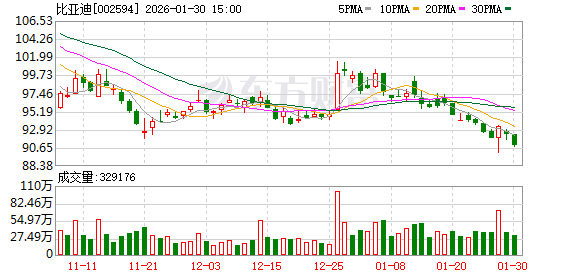
Core Viewpoint - The competition landscape in the Chinese automotive market has shifted in January, with Xiaomi emerging as the new leader among new energy vehicle manufacturers, while BYD faces significant declines in domestic sales [2][4]. Group 1: BYD's Performance - BYD reported a total sales volume of 210,051 units in January, marking a year-on-year decline of 30.11% and a month-on-month decline of 50.04% [2][5]. - The domestic sales of BYD reached 109,600 units in January, down 53.22% year-on-year and down 61.85% month-on-month [6]. - The decline in BYD's domestic sales is attributed to the reduction in the new energy vehicle purchase tax, which has impacted sales strategies [7]. Group 2: Competitors' Performance - Xiaomi's vehicle deliveries exceeded 39,000 units in January, surpassing Leap Motor for the first time and becoming the monthly sales champion among new energy vehicle manufacturers [4][12]. - Other competitors like Seres, NIO, and Lantu reported significant year-on-year growth in January, with increases of 104.85%, 96.08%, and 31.29% respectively [4]. - Geely's new energy and fuel vehicle sales both saw growth in January, with 124,252 units and 145,900 units sold respectively, showcasing a dual strategy that BYD lacks [8]. Group 3: Financial Strategies - Several automotive companies, including Xiaomi, have introduced long-term low-interest financing options to stimulate sales amid declining subsidies [16][17]. - The introduction of these financing plans is seen as a strategic response to counteract the effects of subsidy reductions and to alleviate consumer purchasing pressure [18].

“新王”诞生!比亚迪 大跌!雷军 大动作
Zhong Guo Ji Jin Bao· 2026-02-01 13:52
Core Viewpoint - The competition landscape in the automotive industry has shifted in January, with Xiaomi emerging as a new leader, while BYD faces significant domestic sales challenges [2][5]. Group 1: BYD's Performance - BYD reported a total sales volume of 210,051 units in January, representing a year-on-year decline of 30.11% and a month-on-month decline of 50.04% [4][7]. - The domestic sales of BYD reached 109,600 units in January, down 53.22% year-on-year and 61.85% month-on-month, indicating a continuous downward trend since October 2025 [7]. - The reduction in the new energy vehicle purchase tax from full exemption to 5% may have significantly impacted BYD's January sales [4][5]. Group 2: Competitors' Performance - Xiaomi's vehicle deliveries exceeded 39,000 units in January, surpassing Leap Motor for the first time, marking it as the monthly sales champion among new car manufacturers [5][11]. - Other companies like Seres, NIO, and Lantu reported significant year-on-year growth in January, with increases of 104.85%, 96.08%, and 31.29% respectively [5]. - Geely's new energy and fuel vehicle sales both grew in January, with 124,252 and 145,900 units sold respectively, showcasing a dual strategy that BYD lacks [7][10]. Group 3: Financial Strategies - Several automakers, including NIO and Xiaomi, have introduced long-term low-interest financing options to stimulate sales amid declining subsidies [17]. - Xiaomi's financing plan offers a starting down payment of 99,900 yuan and monthly payments as low as 1,931 yuan, aiming to attract more customers [17]. - The recent policy changes extending the personal consumption loan subsidy until the end of 2026 may further influence the competitive landscape by easing consumer purchasing pressure [17].