
车桩协同

Search documents
挚达科技股价下跌3.62%,受市场情绪与技术回调影响
Jing Ji Guan Cha Wang· 2026-02-13 11:31
Group 1 - The stock of Zhida Technology (02650.HK) experienced a decline of 3.62% on February 13, 2026, closing at HKD 277.00, while the Hang Seng Index fell by 1.72% [1] - The decline was attributed to weak overall market sentiment, technical corrections after significant prior gains, and a divergence in capital flows, with retail investors showing net inflows while institutional investors remained cautious [1][2] - The stock's recent performance showed a significant volatility with a trading range of 7.65%, hitting a low of HKD 268.00, and a trading volume of HKD 10.33 million, indicating a low turnover rate of 0.06% [1] Group 2 - The overall market sentiment was weak, with the Hang Seng Index under pressure and technology stocks experiencing a general pullback, leading to a net outflow of HKD 7.512 billion from the new energy vehicle sector in A-shares [2] - Zhida Technology's stock had risen over 80% since the second half of 2025, with a year-to-date increase of 37.13%, leading to increased profit-taking pressure [2] - The company established a joint venture with Chery Green Energy on January 29, 2026, focusing on automatic charging robots and AI charging systems, which is seen as a long-term positive for securing orders and promoting Chinese charging standards [3] Group 3 - For the first three quarters of 2025, Zhida Technology reported a revenue growth of 28.5%, capturing approximately 9% of the global home charging station market [3] - Institutions expect revenue in 2026 to be supported by orders from the joint venture, despite the current negative price-to-earnings ratio due to initial high investments [3] - Future developments will depend on the liquidity of the Hong Kong stock market, changes in new energy policies, and the progress of the joint venture [3]
挚达科技(02650)与奇瑞的“联姻”:一场出海与智能化的革命
智通财经网· 2026-01-30 03:18
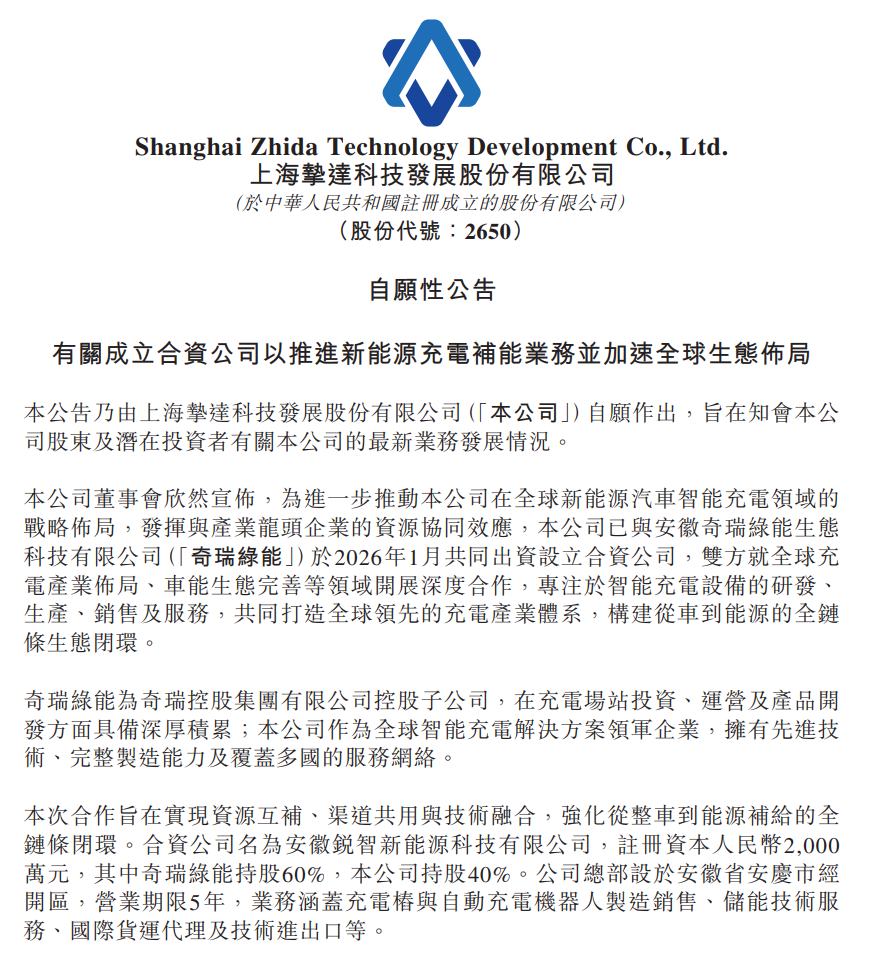
Core Viewpoint - The partnership between Zhida Technology and Chery Green Energy aims to establish a joint venture focused on the development, production, and global service of smart charging equipment, marking a strategic move in the electric vehicle infrastructure landscape [1][4]. Group 1: Joint Venture Details - Zhida Technology will hold a 40% stake in the joint venture, while Chery Green Energy will contribute 12 million yuan for a 60% stake, emphasizing a collaborative approach to risk and profit sharing [4]. - The joint venture will focus on creating a comprehensive ecosystem for smart charging technology, including automatic charging robots and AI applications [4][5]. Group 2: Strategic Implications - The collaboration is seen as a strategic gamble to secure a stable future in the competitive landscape of new energy charging solutions, leveraging technology for market access [4][9]. - The partnership combines Zhida's technological expertise with Chery's extensive global sales network, particularly in key regions like the Middle East and Southeast Asia [5][7]. Group 3: Market Position and Growth - Zhida Technology has established significant barriers in core technologies such as automatic charging robots and high-power DC fast charging systems, enhancing operational efficiency [5][12]. - The company has seen a market capitalization of 18.67 billion HKD and a revenue growth of 28.5% year-on-year for the first three months of 2025, indicating strong market performance [12][13]. Group 4: Future Outlook - The joint venture aims to integrate charging infrastructure into the vehicle export process, enhancing user experience and creating a competitive edge in emerging markets [10][11]. - The collaboration is expected to accelerate the commercialization of charging solutions in the Middle East, with a focus on establishing global standards for new energy charging solutions [11][14].

全球1550万个充电桩缺口待补!中国企业双路径“出海”
Mei Ri Jing Ji Xin Wen· 2025-12-29 06:47
Core Insights - The article discusses the growing presence of Chinese electric vehicle (EV) charging stations in international markets, particularly in Europe and Southeast Asia, highlighting the need for flexible strategies based on local conditions [1][4][9] Group 1: Market Demand and Growth - By the end of November this year, China exported 2.315 million electric vehicles, marking a year-on-year increase of approximately 100%, with a projected total exceeding 2.5 million for the year [1] - The International Energy Agency (IEA) estimates that by 2030, there will be a need for 5.5 million public fast charging stations and 10 million public slow charging stations globally, creating a market opportunity of 15.5 million units [3] - The global charging station market is expected to grow from $5.71 billion in 2024 to $14.96 billion by 2032, with a compound annual growth rate of 12.57% [5] Group 2: Regional Market Characteristics - Europe and Southeast Asia are identified as key markets for Chinese charging station companies, with Europe offering strong policy support and high payment capacity, while Southeast Asia shows rapid demand growth and significant potential [4][9] - The European market currently has over 1 million charging guns, while emerging markets like Brazil, Indonesia, Thailand, and Vietnam collectively have over 24,000, indicating a rapid development phase [5] Group 3: Challenges and Strategies - The article notes that the global charging infrastructure landscape is complex, with varying demands for charging types, technical standards, and operational models across different regions [3][11] - Chinese companies are adopting two main strategies for international expansion: following Chinese automakers abroad and leveraging local partnerships or dealer networks [9][10] - The need for local certification and compliance with different standards poses significant challenges for Chinese charging station manufacturers, as they must navigate various international regulations [10][11] Group 4: Competitive Advantages - Chinese charging stations are noted for their high cost-performance ratio, which provides a competitive edge in international markets [10] - The article emphasizes the importance of "localization of certification" to overcome challenges related to compliance and market entry in different countries [11] Group 5: Future Outlook - The charging station industry is expected to continue thriving, with projections indicating that the overseas market for EV charging equipment could reach 75.9 billion yuan by 2027, with the U.S. and European markets expected to account for 28.4 billion yuan and 33.5 billion yuan, respectively [14]

理想(LI.US/2015.HK)Q2:连续11个季度盈利,高研发投入夯实核心竞争力
Ge Long Hui· 2025-08-29 02:47
Core Viewpoint - The article highlights the significant growth potential in the electric vehicle (EV) market, with a forecast of 15.73 million units sold by 2025, representing a 29% year-on-year increase. However, the industry faces challenges due to intense price competition and profitability pressures among leading companies. In this context, Li Auto has demonstrated a unique performance, being the only new force in the industry to achieve profitability for 11 consecutive quarters [1][2]. Group 1: Li Auto's Financial Performance - In Q2 2025, Li Auto reported revenue of 30.2 billion RMB and an operating profit of 827 million RMB, marking a year-on-year increase of 76.7% and a quarter-on-quarter increase of 204.4% [1]. - Li Auto's sustained profitability amidst industry challenges showcases its effective business strategy and operational efficiency [1][6]. Group 2: R&D Investment and Technological Advancements - Li Auto's R&D investment reached 2.8 billion RMB in Q2 2025, with an expected total of over 12 billion RMB for the year, including over 6 billion RMB specifically for AI [2][3]. - The company is set to launch the world's first VLA driver model, which utilizes reinforcement learning and enhances user experience through advanced features [3]. - Li Auto's self-developed silicon carbide (SiC) chips and electric drive systems are now in mass production, improving efficiency and performance [4]. Group 3: Market Position and Sales Performance - As of July 2025, Li Auto led the market for SUVs priced above 200,000 RMB, with sales of 229,943 units and a market share of 12.31%, surpassing competitors like Tesla and AITO [6]. - The launch of the Li MEGA Home has positioned the company as a leader in the high-end MPV segment, achieving the highest sales in both the 500,000 RMB and pure electric categories [6]. Group 4: Financial Stability and Future Outlook - As of June 30, 2025, Li Auto's cash reserves stood at 106.9 billion RMB, providing a strong financial cushion for ongoing R&D and operational activities [7]. - The company is well-prepared for the anticipated competitive landscape in the automotive industry from 2025 to 2027, focusing on building technological barriers and enhancing brand competitiveness [8].
